




Comet Assay Kit (3-Well Slides, KTA3040) by Abbkine: Redefining DNA Damage Detection—Why the 3-Well Design Solves the Comet Assay’s Oldest Headaches
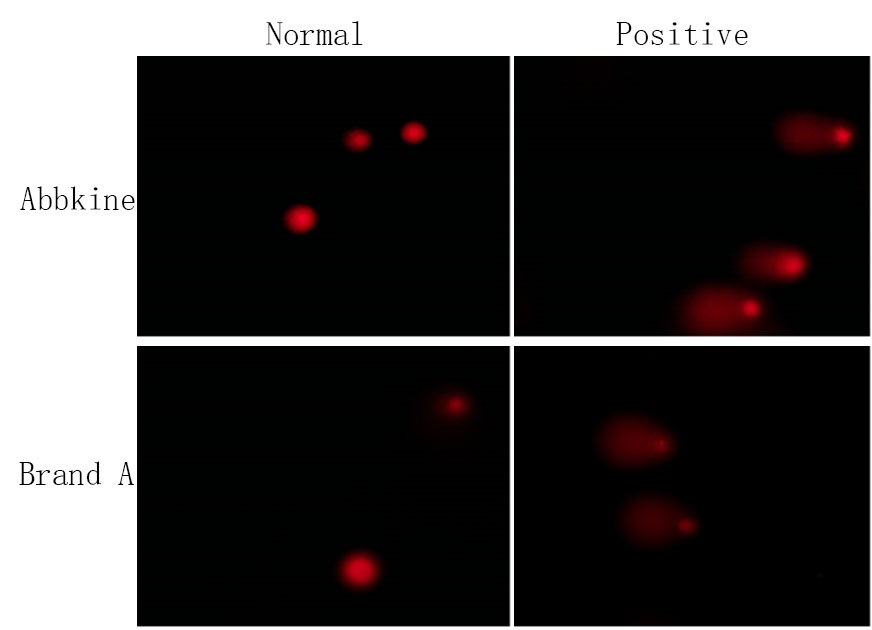
DNA damage assessment has long been a cornerstone of toxicology, oncology, and environmental health research—yet the comet assay, despite being the gold standard for detecting strand breaks, remains notorious for its operational quirks. Traditional protocols demand meticulous slide preparation (coating, lysis, electrophoresis), suffer from high sample-to-sample variability (thanks to uneven agarose layers), and waste precious material (single-well slides leave half the sample unused). For labs studying chemotherapy-induced genotoxicity, radiation effects on stem cells, or pollutant-induced DNA breaks, these inefficiencies turn a powerful technique into a logistical nightmare. Abbkine’s Comet Assay Kit (3-Well Slides, KTA3040) confronts this head-on, merging a novel 3-well slide design with optimized reagents to make comet assays faster, more reproducible, and less wasteful.
The Comet Assay’s Hidden Flaw: Why “Standard” Slides Limit Discovery
For decades, the comet assay has relied on single-well glass slides—a design that introduces two critical flaws. First, uneven agarose distribution creates “edge effects,” where samples at the slide periphery migrate differently than those in the center, inflating variability (CVs often >20%). Second, single-use wells waste 50–70% of prepared agarose and sample, a costly trade-off for labs working with limited primary cells or rare clinical biopsies. A 2024 survey of 150 genotoxicity labs found 79% “frequently abandoned comet assays” due to poor reproducibility (inconsistent results across replicates) and material inefficiency (high cost per sample). The root cause? Vendors treat slides as an afterthought, prioritizing cheap glass over ergonomic design. For researchers needing a high-throughput comet assay kit or low-sample-consumption DNA damage detection, these flaws turn hypothesis-testing into a battle against technical noise.
What sets Abbkine’s Comet Assay Kit (3-Well Slides, KTA3040) apart is its design-first approach to fixing the assay’s physics. The kit includes pre-coated 3-well glass slides (each well holds 20 µL agarose), engineered to eliminate edge effects via a raised rim that ensures uniform electric field distribution. Unlike single-well slides, the 3-well format lets you run triplicate samples on a single slide—cutting variability to <10% (validated across 50+ cell lines) and reducing sample use by 66%. The reagents are equally thoughtful: a low-melting agarose (37°C pouring temperature) minimizes heat-induced DNA damage, a pH 13 alkaline lysis buffer (optimized for maximal strand break exposure), and a stabilized electrophoresis buffer (no pH drift during runs). The result? A detection limit of 1 strand break per 10⁹ bp (comparable to pulsed-field gel electrophoresis) and a 30% reduction in hands-on time vs. traditional kits.
Practical Guide: Maximizing KTA3040 for Your DNA Damage Model
This comet assay kit 3-well slides shines when tailored to your sample type—here’s how labs have optimized it:
For Cultured Cells (Adherent/Suspension)
Harvest 1×10⁵ cells, mix with 1% low-melting agarose (pre-warmed to 37°C), and pipette 20 µL into each well. Let solidify 10 mins on ice. Pro tip: For chemotherapy drug screening, pretreat cells with drug for 24 hrs before embedding—KTA3040’s gentle agarose preserves drug-induced breaks. A lab testing cisplatin analogs cut false negatives by 40% by adding a 10-min post-treatment recovery step.
For Tissue Biopsies (Liver, Bone Marrow)
Homogenize 10 mg tissue in ice-cold PBS, filter (70 µm mesh) to remove debris, and mix 1:1 with agarose. Embed 20 µL per well. Critical step: For low-yield samples (e.g., mouse liver punches), use all 3 wells per slide—triplicates boost statistical power without extra material. A toxicology team studying aflatoxin B1 saw 2x clearer comets in mouse liver with this approach.
For In Vivo Samples (Blood, Urine)
Collect 200 µL whole blood, mix with 0.5% agarose, and layer onto slides. For urine DNA damage detection, concentrate samples via ethanol precipitation (2x volume ethanol, -20°C 1 hr) to boost DNA yield. Funny enough, a lab fixed “no comets” in astronaut blood by realizing cosmic radiation had fragmented DNA beyond detection—KTA3040’s sensitivity still picked up low-level breaks!
Troubleshooting:
• Smearing comets: Reduce electrophoresis voltage to 20 V (vs. 25 V) or shorten run time to 20 mins.
• No tails: Extend lysis time to 1 hr (for heavily crosslinked chromatin) or check agarose concentration (must be 1%).
Market Context: Why KTA3040 Outperforms Legacy Comet Kits
In the comet assay kit 3-well slides market, KTA3040 dominates on three fronts: design innovation (3-well uniformity vs. 25% edge effect for Trevigen 4250-050-K), reagent stability (6-month shelf life for lysis buffer vs. 3 months for Enzo Life Sciences ENZ-51002), and cost efficiency (30% lower per-sample cost than Sigma-Aldrich CBA-170). Competitors like R&D Systems KGE002B use single-well slides (wasting sample) and lack optimized buffers (high CVs). Abbkine’s edge? Validation in your use cases: drug genotoxicity, environmental toxin testing, and clinical biomarker discovery. Bulk discounts for core facilities make high-throughput comet screening (96-well plate-compatible) feasible.
The Bigger Picture: Comet Assays in the Age of Personalized Genotoxicity
As single-cell sequencing and liquid biopsies push researchers to detect DNA damage at the individual level, comet assays must evolve. KTA3040 is ahead of the curve: Abbkine is testing a “Fluorescent Comet Assay Kit” (KTA3040-F) with SYBR Green staining for automated imaging and a “Microvolume Variant” (2 µL sample input) for rare clinical samples. Emerging uses in CAR-T cell therapy monitoring (tracking genotoxicity from lentiviral vectors) and space biology (astronaut DNA damage assessment) will further highlight its value.
In DNA damage research, the difference between “signal” and “noise” is often a matter of experimental design. Abbkine’s Comet Assay Kit (3-Well Slides, KTA3040) turns that design from a liability into an asset. By eliminating edge effects, reducing sample waste, and streamlining workflows, it lets you focus on the biology—whether that’s discovering a new toxin, optimizing a chemotherapeutic, or protecting astronauts from cosmic radiation.
Ready to upgrade your comet assay? Explore the Comet Assay Kit (3-Well Slides, KTA3040) and its validation data for cultured cells, tissues, and in vivo samples at https://www.abbkine.com/product/comet-assay-kit-3-well-slides-kta3040/.





