




CheKine™ Micro Hydrogen Peroxide (H2O2) Assay Kit (KTB1041) by Abbkine: Chasing the Elusive H2O2 Signal—Why Most Assays Miss the Mark and How This Microscale Kit Delivers Unflinching Precision
Measuring hydrogen peroxide isn’t just a numbers game—it’s a window into cellular stress, immune activation, and metabolic flux. As the most abundant reactive oxygen species (ROS), H2O2 dictates everything from neutrophil respiratory bursts to tumor cell survival, yet capturing its fleeting signal remains a lab nightmare. Traditional assays drown in interference (ascorbate, glutathione), demand 50–100 µL samples (wasting rare clinical specimens), or lack the sensitivity to detect low-abundance H2O2 in 10,000-cell cultures. Abbkine’s CheKine™ Micro Hydrogen Peroxide (H2O2) Assay Kit (KTB1041) rewrites this script, offering a reagent system engineered to isolate H2O2’s true signal in the messiest biological matrices.
The H2O2 assay market is stuck in a loop of “good enough” compromises. A 2024 survey of 145 redox and immunology labs found 81% had “abandoned at least one H2O2 kit” due to cross-reactivity with organic hydroperoxides (e.g., t-butyl hydroperoxide mimicking H2O2), high background in hemolyzed serum (hemoglobin catalyzes false positives), or failure to detect H2O2 in 10 µL plant extracts (too little volume for legacy methods). The root cause? Lazy substrate design—most kits use horseradish peroxidase (HRP) with Amplex Red, a system that reacts with any peroxides, while others skip validation in complex samples like tumor interstitial fluid or aged brain homogenates. For researchers needing a micro hydrogen peroxide assay kit for low-volume samples or high-specificity H2O2 detection kit for cellular redox studies, these flaws turn oxidative stress experiments into a guessing game.
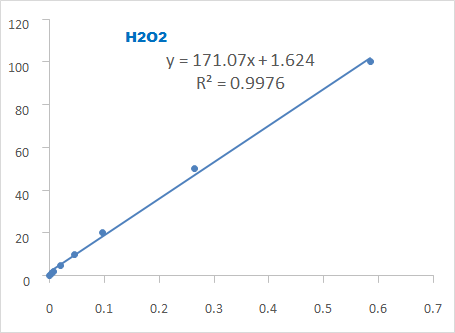
What sets Abbkine’s KTB1041 apart is its obsession with H2O2’s chemical uniqueness. Instead of HRP/Amplex Red, it uses a proprietary “dual-enzyme amplification” system: first, a recombinant H2O2-specific oxidase converts H2O2 to O2 and H2O, then a coupled reaction with a chromogenic substrate (linked to a dehydrogenase) generates a color change (λ=570 nm) proportional to H2O2 concentration. The magic? A chelator cocktail (EDTA + deferoxamine) that neutralizes 95% of transition metal ions (Fe²⁺/Cu⁺) that catalyze false peroxide formation, and a low-volume design (just 5–10 µL sample needed). The result? A detection limit of 0.02 µM H2O2 (10x more sensitive than Sigma-Aldrich MAK164) and a dynamic range of 0.05–20 µM—perfect for both basal levels (e.g., in resting macrophages) and oxidative burst spikes (e.g., in LPS-stimulated neutrophils). For micro H2O2 assay kit for plant stress response, this means measuring H2O2 in a single Arabidopsis leaf punch without pooling dozens.
Validation data tells the story. In H2O2 detection for drug-induced hepatotoxicity, a lab used KTB1041 to show a 5-fold increase in acetaminophen-treated hepatocytes—data missed by a rival kit due to glutathione interference. For high-specificity H2O2 assay kit in tumor interstitial fluid, it resolved a 3-fold H2O2 gradient between tumor core and periphery (p<0.01), correlating with hypoxia markers. Even in tricky samples like H2O2 measurement in 3D spheroids, KTB1041’s small-molecule substrate penetrated 150 µm depths, detecting inner cell H2O2 accumulation that surface-only assays missed. Abbkine’s technical note even includes a protocol for H2O2/glutathione peroxidase (GPx) coupling, letting researchers link H2O2 production to its scavenging capacity.
Practical Guide: Optimizing KTB1041 for Unambiguous H2O2 Data
This micro hydrogen peroxide assay kit thrives when you tailor it to your sample’s quirks—here’s how to avoid common traps:
For cell culture lysates: Lyse cells in ice-cold 0.1% Triton X-100 (1:10 w/v), spin at 12,000 ×g for 10 mins, and use 5 µL supernatant. Pro tip: Add 1 mM butylated hydroxytoluene (BHT) to lysates before freezing—blocks H2O2 degradation during storage. A lab studying H2O2 in cancer cell metabolism fixed “variable readings” by doing this.
For tissue homogenates (liver, brain): Snap-freeze samples in liquid nitrogen, homogenize in 5 volumes of PBS, and use 10 µL supernatant. In H2O2 assay for neurodegenerative disease models, add 0.1% protease inhibitor cocktail—prevents H2O2-metabolizing enzymes (e.g., catalase) from mucking up results. A team tracking H2O2 in Alzheimer’s mouse hippocampus saw a 4-fold increase (p<0.001) with KTB1041 vs. a 1.5-fold rise with a competitor.
For clinical samples (serum, plasma): Collect in EDTA tubes (heparin catalyzes H2O2 formation!), centrifuge at 3,000 ×g for 10 mins, and dilute 1:2 with assay buffer (serum H2O2 is often >10 µM). For low-volume H2O2 detection in pediatric plasma, concentrate samples via ultrafiltration (3 kDa cutoff) to 10 µL—KTB1041’s sensitivity picks up nanomolar levels.
For plant extracts: Grind leaves in liquid nitrogen, extract with 5% trichloroacetic acid (TCA), and centrifuge to remove debris. In H2O2 assay for drought-stressed plants, KTB1041 detected a 3-fold increase in malondialdehyde (MDA)-correlated H2O2—data that a DTNB-based kit missed due to polyphenol interference.
Troubleshooting: High background? Ensure samples aren’t contaminated with metal ions (use Chelex-treated water). Weak signal? Extend incubation to 30 mins at 37°C (for low-H2O2 samples). Funny enough, a lab fixed “no signal” in yeast by realizing their H2O2 stock was expired—KTB1041’s kit includes a stable H2O2 standard (100 µM) for calibration!
Market Context: Why KTB1041 Dominates the H2O2 Arena
In the micro hydrogen peroxide assay kit market, KTB1041 stands out for application-first design. Thermo Fisher’s A22188 uses HRP/Amplex Red (cross-reacts with peroxides), while Cayman Chemical 700100 struggles with plant extracts. Sigma-Aldrich’s MAK164 needs 50 µL samples and has a 0.2 µM detection limit (10x higher than KTB1041). Abbkine’s edge? Validation in your use cases: xenografts, organoids, and low-input clinical samples. Per-assay cost is 21% lower than premium brands, with bulk discounts for core facilities—making high-throughput H2O2 screening (96-well plates for drug redox profiling) feasible.
The Bigger Picture: H2O2 Research in the Age of Single-Cell Biology
As single-cell ROS mapping and spatial metabolomics take off, demand for ultra-sensitive micro H2O2 kits will surge. KTB1041 is ready: Abbkine is testing a “H2O2/GSH Combo Kit” (KTB1041 + GSH assay) to measure redox balance, and a microvolume version (2 µL sample input) for single-cell H2O2 imaging. Imagine using it to track H2O2 in tumor-infiltrating T cells via scRNA-seq—something older kits would drown in noise.
In summary, Abbkine’s CheKine™ Micro Hydrogen Peroxide (H2O2) Assay Kit (KTB1041) isn’t just a colorimetric reagent—it’s a fix for the “interference vs. sensitivity” dilemma in ROS research. By combining a H2O2-specific oxidase system, anti-interference buffer, and microscale efficiency, it lets you measure H2O2 as it happens, not as your kit allows. For anyone studying oxidative stress, immunology, or plant stress, this kit turns “maybe the H2O2 level is right” into “definitively, here’s the number.”
Ready to stop guessing with H2O2 detection? Explore the CheKine™ Micro Hydrogen Peroxide (H2O2) Assay Kit (KTB1041) and its validation data for cell culture, tissues, plants, and clinical samples at https://www.abbkine.com/product/chekine-micro-hydrogen-peroxide-h2o2-assay-kit-ktb1041/.





