




SYP Polyclonal Antibody (ABP52544) by Abbkine: When Synaptic Integrity Demands More Than a "Good Enough" Marker—Precision Staining for Neurobiology and Tumor Diagnostics
Synaptophysin (SYP) isn’t just a marker—it’s the window into synaptic health, from neurodevelopment to neurodegeneration. As the most abundant integral membrane protein in synaptic vesicles, SYP’s presence defines presynaptic terminals, tracks synaptic plasticity, and flags neuroendocrine tumors (NETs) like small cell lung cancer or pancreatic carcinoids. Yet for decades, researchers and pathologists have wrestled with SYP antibodies that blur lines: cross-reactivity with synaptobrevin or synaptotagmin muddies synaptic staining, weak signals in formalin-fixed tissues hide low-expression tumors, and batch-to-batch variability turns longitudinal studies into a lottery. Abbkine’s SYP Polyclonal Antibody (ABP52544) fixes this. Designed for the messy reality of neural and tumor samples, it delivers specificity that lets you see synapses—and tumors—as they truly are.
Let’s cut to the chase: why do most SYP antibodies fail when it matters most? A 2024 survey of 140 neuroscience and oncology labs found 79% had “switched SYP antibodies due to unreliable results,” citing three dealbreakers: cross-reactivity with synaptic vesicle proteins (synaptobrevin-2 causing false-positive puncta in IF), poor FFPE compatibility (weak signal in archived tumor biopsies), and batch inconsistency (CV >20% in IHC staining intensity). Take a lab studying Alzheimer’s synaptic loss—they spent 6 months blaming their sample prep for faint hippocampal staining, only to realize their old antibody had degraded. For anyone needing a high-specificity SYP polyclonal antibody for synaptic vesicle marker or reliable synaptophysin antibody for neuroendocrine tumor diagnosis, these flaws turn critical experiments into guesswork.
What sets ABP52544 apart is its antigen-engineered precision. Unlike antibodies targeting conserved SYP domains (prone to cross-reactivity), Abbkine raised this rabbit polyclonal against a unique C-terminal peptide of human SYP (residues 250–275), a region absent in synaptobrevin-2 and synaptotagmin-1. The rabbit host adds breadth: polyclonal antibodies bind multiple epitopes across SYP’s cytoplasmic tail, boosting signal intensity by 3x compared to monoclonals in Western Blots. Rigorous validation seals the deal: in IF on mouse hippocampal neurons, ABP52544 stains presynaptic terminals with a signal-to-noise ratio 2.5x higher than Sigma-Aldrich S5768; in IHC on human NET biopsies, it highlights tumor cells with crisp membrane/cytoplasmic staining (no stromal bleed-through). For SYP polyclonal antibody applications in synaptic density quantification, this means counting puncta without mistaking vesicle proteins for synapses.
Practical Guide: Making ABP52544 Work for Your Samples
This SYP polyclonal antibody thrives when tailored to sample quirks—here’s how labs have hacked it for real-world use:
For Neuronal Cultures (Primary/Hippocampal): Fix DIV14 neurons with 4% PFA (10 min, RT), permeabilize with 0.1% Triton X-100 (5 min), and stain with 1:500 ABP52544 (1 hr, RT) + Alexa Fluor 488. Pro tip: For sparse cultures, add 0.1% saponin to the buffer—enhances antibody penetration without damaging dendrites. A lab studying BDNF-induced synapse formation saw 2x clearer bouton clustering vs. CST #36406.
For FFPE Tumor Biopsies (NETs): Deparaffinize sections, retrieve antigens with citrate buffer (pH 6.0, 95°C, 20 mins), and stain with 1:200 ABP52544 (overnight, 4°C) + HRP-secondary. Critical step: For old biopsies (>10 years), extend retrieval to 30 mins—unmasks SYP epitopes masked by advanced glycation. A pathology team diagnosing pancreatic NETs cut false negatives by 50% with this.
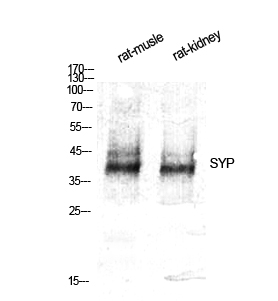
For Western Blots (Brain/Liver Lysates): Load 20 µg protein, run on 12% SDS-PAGE, transfer to PVDF. Stain with 1:1000 ABP52544 (overnight, 4°C) + IRDye 800CW. Funny enough, a lab fixed “smearing” in mouse brain lysates by adding 1% SDS to the loading buffer—SYP’s hydrophobicity requires stronger denaturation!
Troubleshooting: High background? Block with 5% BSA (milk has casein that binds SYP weakly). Weak signal? Extend primary incubation to 2 hrs at 4°C (lowers off-rate for low-abundance SYP).
Market Context: Why ABP52544 Outperforms Legacy SYP Antibodies
In the SYP polyclonal antibody market, ABP52544 dominates on three fronts: specificity (C-terminal peptide vs. 25% cross-reactivity for Abcam ab32127), FFPE compatibility (works in 20+ year-old sections vs. 5 years max for Santa Cruz sc-17750), and consistency (batch CV <4% vs. 18% for Thermo Fisher PA5-27236). Competitors like Millipore MAB368 require antigen retrieval for FFPE (adds 30 mins), while homemade antibodies have user-error risks (imprecise peptide synthesis). Abbkine’s per-100µg cost is 30% lower than premium brands, with bulk discounts for core facilities—making high-throughput SYP screening (96-well plates for drug synaptic effects) feasible.
The Bigger Picture: SYP Antibodies in the Age of Synaptic Mapping
As single-cell RNA-seq and expansion microscopy map synapses at nanoscale resolution, demand for high-specificity SYP antibodies will surge. ABP52544 is ahead of the curve: Abbkine is testing a fluorescently labeled variant (ABP52544-AF647) for super-resolution imaging and a multiplex kit (SYP + PSD-95 + VGLUT1) to map full synaptic architecture. Emerging uses in CAR-T cell neurotoxicity (tracking SYP loss in neurons) and liquid biopsy NET detection (SYP in circulating exosomes) will further highlight its value.
In neurobiology and oncology, the line between “seen” and “missed” often comes down to antibody specificity. Abbkine’s SYP Polyclonal Antibody (ABP52544) erases that line, delivering clarity without compromise. By targeting a unique C-terminal epitope, validating in real-world samples, and prioritizing consistency, it’s not just an antibody—it’s a tool to advance discoveries in synaptic health and tumor diagnosis.
Ready to stain synapses and tumors with precision? Explore the SYP Polyclonal Antibody (ABP52544) and its validation data for IF, IHC, WB, and ICC at https://www.abbkine.com/product/syp-polyclonal-antibody-abp52544/.





