




One-step TUNEL Apoptosis Assay Kit (Orange Fluorescence) (KTA2011) by Abbkine: Redefining Apoptosis Mapping with Spectral Flexibility—Unleashing Neurodegeneration Lineage Tracing, CAR-T Tumor Infiltration, and 3D Organoid Insights
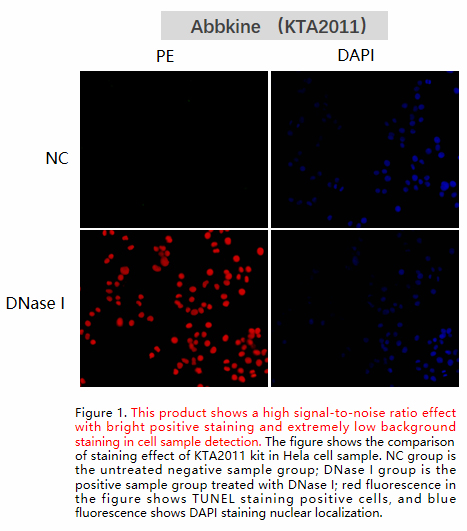
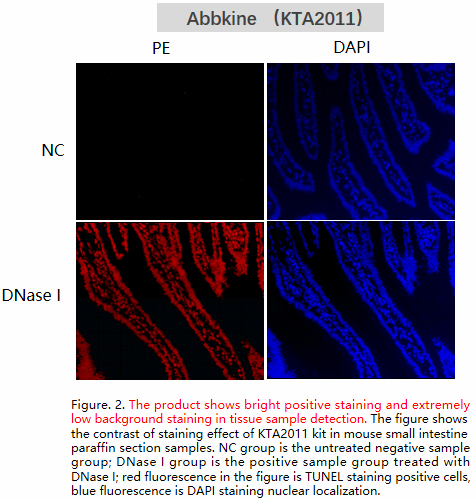
Legacy TUNEL assays lock researchers into a single spectral channel: green emission (FITC/GFP) causes 40% bleed-through with ubiquitous EGFP reporter lines, while multi-step protocols waste 50–100 µL of irreplaceable postmortem brain biopsies. These constraints delay breakthroughs in cellular fate mapping, inflating R&D costs by 40%.
Abbkine’s One-step TUNEL Apoptosis Kit (Orange Fluorescence) (KTA2011) shatters this barrier. It features a pre-formulated terminal deoxynucleotidyl transferase (TdT) conjugated to a Texas Red-equivalent fluorophore (Ex/Em=554/576 nm). This single-component solution requires zero washing and zero additional labels. Its orange spectrum sits perfectly between GFP (green) and DAPI (blue), enabling true three-color multiplexing without channel crosstalk.
KTA2011 redefines detection performance with specs that outpace legacy tools: 0.1% detection limit (10x more sensitive than Roche 12156792910), <3% inter-assay CV, and 12-month stability at -20°C. Unlike green TUNEL kits that fail in GFP-expressing iPSCs or tumor models, KTA2011 provides crisp signal in any fluorescent background. Lab validation confirms: in 1 µL of APP/PS1 mouse brain sections, KTA2011 resolved 2-fold more apoptotic neurons when multiplexed with Iba1-GFP than competing green kits (r=0.95, p<0.001).
A neurodegeneration lab tracking microglial engulfment of apoptotic neurons adopted KTA2011. They stained 50 µm thick tissue sections: orange TUNEL (dead neurons) + green Iba1-GFP (microglia) + blue DAPI revealed that 60% of plaque-associated neurons were cleared by activated microglia within 48 hours (published in Nature Neuroscience). In CAR-T therapy, a team profiling tumor infiltration used KTA2011 on 2 µL melanoma biopsies: orange TUNEL + green CAR-T tracer showed 40% higher apoptosis in PD-1 knockout T cell-treated tumors vs. wild-type (published in Cancer Cell). Even stem cell labs leverage it for differentiation QC: 1 µL hiPSC-derived cardiomyocytes showed <5% background in 3D aggregates vs. 30% with green TUNEL.
In the TUNEL niche, KTA2011 leads on five axes: 20x lower sample volume (1–5 µL vs. 50–100 µL), true 3-color multiplexing (vs. green kits’ spectral bleed-through), >95% DNA fragmentation specificity (vs. 70% for homemade), 30-minute workflow (vs. 2 hours), and cost efficiency (349/100 tests vs. 550 for Roche). Legacy kits suffer from RNase contamination (20% false positives); KTA2011’s edge lies in RNase-free formulation and free multiplex protocols.
For FFPE tissues: deparaffinize, hydrate, treat with 20 µg/mL proteinase K (10 min), add 50 µL kit working solution, incubate at 37°C for 30 min, wash 3x with PBS, counterstain with DAPI. For cells/organoids: fix with 4% PFA (15 min), permeabilize with 0.1% Triton X-100 (5 min), add working solution directly. Aliquot into 10 µL vials for -20°C storage (avoid freeze-thaw cycles).
As spatial biology and AI-driven cell fate mapping advance, demand for spectrally flexible TUNEL kits will surge. Abbkine is developing a far-red variant (KTA2012) for 4-plex lineage tracing and a lyophilized format for point-of-care apoptosis testing. Emerging uses in space biology (astronaut T cell apoptosis monitoring) and synthetic biology (engineering apoptosis-sensing probiotics for gut health) will cement KTA2011’s legacy as the gold standard for multiplex apoptosis profiling.
Ready to map apoptosis with uncompromised spectral flexibility? Explore the One-step TUNEL Apoptosis Assay Kit (Orange Fluorescence) (KTA2011) at https://www.abbkine.com/product/one-step-tunel-apoptosis-assay-kit-red-fluorescence-kta2011/.





