




KTA2030 | EdU Cell Proliferation Image Kit (Green Fluorescence) — The BrdU Killer That Preserves Your Cells While Delivering Unmatched Sensitivity
BrdU Is Dead. Long Live EdU. Here Is Why You Should Switch Today.
Let us be brutally honest for a moment. If you are still using BrdU for cell proliferation analysis, you are wasting time, damaging your samples, and compromising your data — all because of a technology that was revolutionary in the 1980s but has been thoroughly outclassed for years. The traditional BrdU assay requires harsh DNA denaturation — typically using HCl, heat, or DNase digestion — just to expose the BrdU epitope for antibody detection [1†L14-L17]. This denaturation step does not just unwind DNA; it damages sample integrity, alters cell morphology, and introduces variability that can completely undermine your results. Abbkine's EdU Cell Proliferation Image Kit (Green Fluorescence, KTA2030) replaces this brutal process with elegant click chemistry — preserving your cells while delivering sensitivity that BrdU assays simply cannot match [1†L12-L19].
The Chemistry That Changes Everything — Click, Not Denature
Here is the science that makes EdU a game-changer. EdU (5-ethynyl-2'-deoxyuridine) is a nucleoside analog of thymidine that is incorporated into DNA during active DNA synthesis — just like BrdU [1†L12-L14]. But here is where the magic happens: instead of requiring antibody-based detection (which demands DNA denaturation), EdU is detected through a click reaction — a copper-catalyzed covalent reaction between an azide and an alkyne that is complete within 30 minutes [1†L17-L19]. No DNA denaturation. No harsh acid treatment. No heat. No DNase digestion. Your cells stay intact, your morphology stays pristine, and your data stays reliable [1†L14-L17].
Green Fluorescence That Captures Every Dividing Cell — Even the Rare Ones
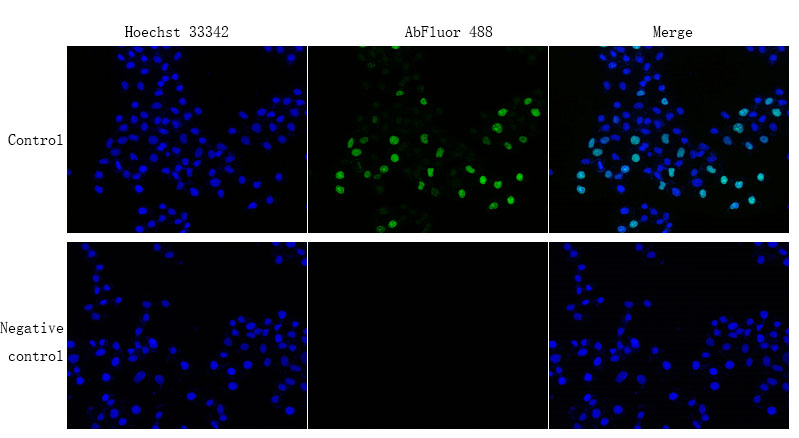
The kit produces intense, photostable green signals with minimal background noise, ensuring precise identification and quantification of proliferating cells — even in low-abundance populations or complex samples [1†L23-L24]. The fluorescence is compatible with both fluorescence microscopy and flow cytometry analysis, giving you the flexibility to choose your detection platform [1†L24-L25]. The kit includes AbFluor 488 azide for green fluorescence detection, plus Hoechst 33342 for nuclear counterstaining, so you can visualize total cell populations alongside proliferating cells in the same sample [1†L21].
All-in-One Design — Everything You Need, Nothing You Do Not
The kit comes complete with all optimized components in one package: EdU (10 mM), Permeabilization Reagent, BSA Wash Solution (5×), AbFluor 488 azide, Reaction Buffer (10×), Copper Reagent, Reducing Agent, Hoechst 33342 (1000×), and Hydroxyurea for negative control [1†L19-L22]. This all-in-one design eliminates the headache of sourcing individual reagents or optimizing concentrations — every component is pre-tested and balanced to work together seamlessly. The kit is ready-to-use upon opening, with a detailed flow chart and operation tutorial video included [1†L28-L29]. Stable for at least 12 months at recommended temperature from the date of shipment [1†L29-L30].
Wide Compatibility — From Adherent Cells to Tissue Sections
The EdU-Click assay is remarkably versatile. It works with adherent cells, suspension cells, and in vivo animal tissue samples [1†L23-L24]. Whether you are working with delicate primary neurons, robust cancer cell lines, or complex tissue sections, KTA2030 adapts to your experimental system without requiring extensive optimization. The protocol is simplified and user-friendly, with a detailed flow chart and operation tutorial video to guide you through every step [1†L28-L29].
Validated by 40 Publications — And the List Keeps Growing
The scientific community has embraced KTA2030 with remarkable enthusiasm — the kit has already been cited in 40 publications [1†L44-L45]. Researchers have used it to study remodeling of the pro-inflammatory microenvironment in osteoarthritis via hydrogel-based photothermal therapy (Advanced Composites and Hybrid Materials, IF: 23) [1†L45-L48], and in a wide range of other applications from cancer biology to regenerative medicine. When your proliferation data needs to be publication-ready, this is the kit that delivers.
From Setup to Data — A Workflow That Actually Makes Sense
The practical workflow is refreshingly straightforward. Culture your cells with EdU to label dividing cells during S-phase. Fix and permeabilize your samples. Perform the click reaction to covalently attach the green fluorescent azide to EdU-labeled DNA. Wash and counterstain with Hoechst 33342. Image on your fluorescence microscope or analyze on your flow cytometer. That is it. No DNA denaturation. No antibody incubations. No multi-day protocols. Just clean, reliable proliferation data — in a fraction of the time.
Who Needs This Kit? Anyone Who Has Ever Sworn at a BrdU Protocol
Whether you are screening anti-proliferative drug candidates, studying cellular responses to growth factors or toxins, validating stem cell differentiation protocols, or tracking tumor growth in vivo, KTA2030 delivers the sensitivity, speed, and reproducibility that modern research demands. It is proliferation detection the way it should have always been — fast, gentle, and compatible with the experiments you actually want to run.
🔗 Reference Link: https://www.abbkine.com/product/edu-cell-proliferation-image-flow-cytometry-assay-kit-green-fluorescence-kta2030/





