Mouse UCP1 ELISA Kit — Technical Comparison & Buying Guide for Thermogenesis and Metabolic Researchers
UCP1: The 32-kDa Proton Leak That Burns Fat Without Shivering
Uncoupling protein 1 (UCP1, thermogenin) is the defining molecular marker of brown adipose tissue (BAT) and beige adipocytes — the specialized fat depots that burn chemical energy as heat instead of storing it. UCP1 sits in the inner mitochondrial membrane and provides a proton leak pathway that bypasses ATP synthase, uncoupling oxidative phosphorylation from ATP production and releasing energy as heat[reference:43].
Since metabolically active BAT/beige fat was detected in adult humans in 2009, the field has exploded: researchers are racing to find ways to enhance BAT thermogenesis as a strategy for increasing energy expenditure and combating obesity[reference:44]. UCP1 protein levels are the gold-standard readout for brown/beige adipocyte differentiation, cold-induced thermogenesis, and diet-induced thermogenic capacity[reference:45].
Yet quantifying UCP1 in mouse tissues has remained deceptively difficult. Western blots for UCP1 are notoriously variable — the protein is highly hydrophobic, aggregates during sample preparation, and the linear range is narrow. Most ELISA kits report sensitivities in the 0.1–1 ng/mL range, which struggles with the low UCP1 levels in inguinal white adipose tissue (iWAT) beiging or serum.
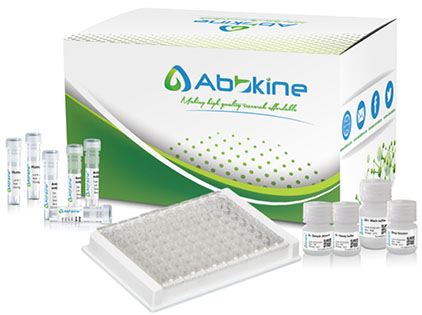
The Mouse Mitochondrial brown fat uncoupling protein 1 (UCP1) ELISA Kit (KTE70038) from Abbkine is engineered to resolve that sensitivity bottleneck.
Why Traditional UCP1 Detection Methods Fall Short
| Method | Limitation |
|---|---|
| Western Blot | Semi-quantitative; UCP1 is a hydrophobic membrane protein that aggregates; narrow linear range; poor reproducibility across blots |
| qPCR (Ucp1 mRNA) | mRNA does not always correlate with protein — post-transcriptional and post-translational regulation matter |
| Generic ELISA | Sensitivity ~0.1–1 ng/mL — misses low UCP1 in iWAT beiging and serum |
Abbkine KTE70038: Engineered for Low-Abundance UCP1 Precision
The kit uses a two-site sandwich ELISA with a UCP1-specific capture antibody pre-coated onto the microplate and an HRP-conjugated detection antibody[reference:46].
Key Specifications
| Parameter | KTE70038 |
|---|---|
| Calibration range | 5 pg/mL – 80 pg/mL |
| Limit of detection | 0.5 pg/mL |
| Sample types | Serum, plasma, cell culture supernatants, other biological fluids[reference:47] |
| Format | Two-site sandwich ELISA (colorimetric) |
| Specificity | No significant cross-reactivity with UCP1 analogues |
Head-to-Head Comparison: KTE70038 vs. Legacy Methods
| Feature | Abbkine KTE70038 | Western Blot | Generic UCP1 ELISA |
|---|---|---|---|
| Sensitivity | 0.5 pg/mL | Band-dependent | ~0.1–1 ng/mL |
| Quantitative | Yes (standard curve) | Semi-quantitative | Yes |
| Low-Abundance Samples | Validated (iWAT beiging, serum) | Often below detection | Often misses |
| Reproducibility | High (96-well format) | Variable | Variable |
| Throughput | 96-well plate | Low (gel-based) | 96-well plate |
Why Choose Abbkine KTE70038?
- Picogram Sensitivity: 0.5 pg/mL LOD — captures the low UCP1 levels in iWAT beiging and serum, not just the high levels in interscapular BAT
- Quantitative Readout: Converts UCP1 from a "band that looks darker" into a ng/mL value with error bars
- Broad Sample Compatibility: Serum, plasma, cell culture supernatants, and other biological fluids — including BAT homogenates and adipocyte culture media
- High Reproducibility: 96-well plate format with standardized reagents — far more consistent than Western blot
- Complete Kit: Microplate, standards, detection antibody, all buffers included[reference:48]
Who Should Buy This Kit?
✅ Buy KTE70038 if you:
- Study brown adipose tissue (BAT) and beige adipocyte biology
- Research thermogenesis, cold exposure, and diet-induced thermogenesis
- Investigate obesity and metabolic syndrome (UCP1 as a therapeutic target)
- Work on adipocyte differentiation (brown/beige adipogenesis)
- Study exercise-induced browning of white adipose tissue
- Need to quantify low-abundance UCP1 in iWAT beiging or serum
- Require quantitative, reproducible UCP1 protein measurement
- Want a complete, ready-to-use kit for high-throughput screening
❌ Consider alternatives if you:
- Only need Ucp1 mRNA levels (qPCR is more appropriate)
- Work with human samples — check Abbkine's human UCP1 offerings
- Require subcellular fractionation (mitochondrial vs. whole-cell UCP1) — pair with a fractionation protocol
📌 Reference Link: Mouse Mitochondrial brown fat uncoupling protein 1 (UCP1) ELISA Kit — KTE70038