EdU Cell Proliferation Image/Flow Cytometry Assay Kit (Green Fluorescence) (KTA2030): EdU vs BrdU Compared
EdU Cell Proliferation Image/Flow Cytometry Assay Kit (Green Fluorescence) (KTA2030): EdU vs BrdU Compared
DNA-denaturation steps are where many proliferation assays lose both time and sample integrity. The alternative chemistry here removes that step entirely.
The EdU Cell Proliferation Image/Flow Cytometry Assay Kit (Green Fluorescence) (KTA2030) is described on the page as a novel alternative to the BrdU assay. EdU (5-ethynyl-2´-deoxyuridine) is a thymidine nucleoside analog incorporated into DNA during active synthesis; detection uses a copper-catalyzed click reaction between an azide and an alkyne that is complete within 30 minutes.
No DNA Denaturation, Unlike BrdU
The difference is procedural and it is stated directly.
The page explains that EdU-Click assays are not antibody based and therefore "do not require DNA denaturation (typically using HCl or heat or digestion with DNase)" to detect the incorporated nucleoside. The background section notes that traditional direct DNA-synthesis measurement used [3H] thymidine detected by autoradiography, or 5-bromo-2′-deoxyuridine detected with an anti-BrdU antibody. Removing both the denaturation step and the antibody removes a set of variables from the staining workflow.
Click Chemistry Completes in 30 Minutes
The labeling reaction has a defined time budget.
Detection is based on a click reaction — a copper-catalyzed covalent reaction between an azide and an alkyne — which the page states "is complete within 30 minutes." The component list includes EdU (10 mM), AbFluor 488 azide, Reaction buffer (10×), Copper Reagent, and Reducing Agent, which together supply the reaction partners. The page does not state numeric excitation or emission wavelengths, so check the datasheet before setting filters.
Adherent, Suspension, and Tissue Samples
The same kit is positioned for several sample formats and two readout modes.
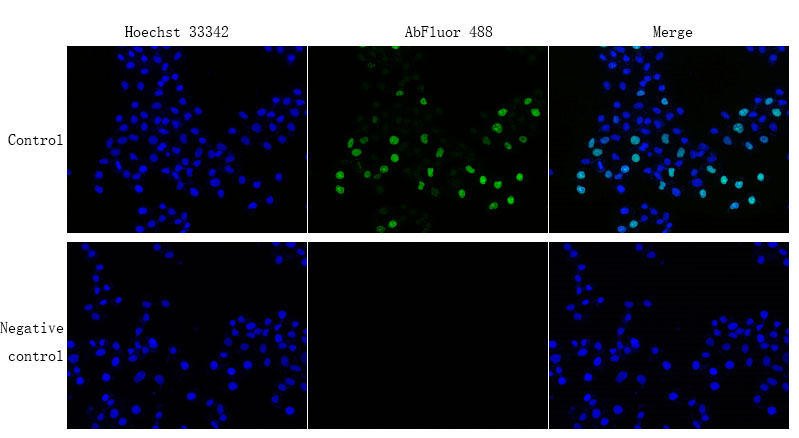
The Features section states "Wide Compatibility for Multiple Platforms": compatible with adherent cells, suspension cells and in vivo animal tissue samples, and suitable for detection via fluorescence microscopy and flow cytometry analysis. That covers both a well-plate imaging workflow and a population-level cytometer read. The demonstration image shows proliferating HeLa cells detected with the kit.
Nine Components, Including a Negative Control
The package is presented as complete on opening.
Components listed are EdU (10 mM), Permeabilization Reagent, BSA Wash Solution (5×), AbFluor 488 azide, Reaction buffer (10×), Copper Reagent, Reducing Agent, Hoechst 33342 (1000×), and Hydroxyurea. The page's "Complete Optimized Kit Components" benefit specifically names the hydroxyurea negative control and the Hoechst nuclear stain, and notes a detailed flow chart and operation tutorial video are included. Storage is at least 12 months at the recommended temperature from shipment, with gel pack and blue ice shipping. Formats are 200T and 1000T.
| Feature | This Product | Conventional / typical approach |
|---|---|---|
| Detection chemistry | Copper-catalyzed azide–alkyne click reaction | BrdU assays commonly use an antibody-based readout |
| DNA denaturation | Not required, according to the page | BrdU detection typically needs HCl, heat, or DNase |
| Labeling time | Click reaction complete within 30 minutes | varies by protocol |
| Sample types | Adherent cells, suspension cells, in vivo animal tissue | often restricted to one sample format |
| Readout | Fluorescence microscopy or flow cytometry | commonly optimized for one platform |
For proliferation work where preserving DNA morphology matters and a 30-minute labeling step fits the schedule, KTA2030 offers a clearly defined BrdU alternative. Confirm the optical settings against the datasheet and choose between the 200T and 1000T formats based on your sample count.
Reference: https://www.abbkine.com/product/edu-cell-proliferation-image-flow-cytometry-assay-kit-green-fluorescence-kta2030/
For research use only. Not for diagnostic or therapeutic use.
Prev:This is the latest article
Next:Cell Cycle Staining Kit (KTA2020): DNA-Content Resolution and Ready-to-Use Staining Compared