| Product name | SOCS-1 Polyclonal Antibody |
| Immunogen | Synthesized peptide derived from the Internal region of human SOCS-1 |
| Host | Rabbit |
| Reactivity | Human,Mouse,Rat |
| Applications | IF,WB,IHC,ELISA |
| Applications notes | Optimal working dilutions should be determined experimentally by the investigator. Suggested starting dilutions are as follows: IF 1:50-200;WB 1:500-2000;ELISA 1:10000-20000;IHC 1:50-300 |
| Clonality | Polyclonal |
| Preparation method | The antibody was affinity-purified from rabbit antiserum by affinity-chromatography using epitope-specific immunogen. |
| Alternative | SOCS1; SSI1; TIP3; Suppressor of cytokine signaling 1; SOCS-1; JAK-binding protein; JAB; STAT-induced STAT inhibitor 1; SSI-1; Tec-interacting protein 3; TIP-3 |
| Formulation | Liquid solution |
| Concentration | 1 mg/ml |
| Molecular weight | 38kD |
| Storage buffer | Liquid in PBS containing 50% glycerol, 0.5% BSA and 0.02% sodium azide. |
| Storage instructions | Stable for one year at -20°C from date of shipment. For maximum recovery of product, centrifuge the original vial after thawing and prior to removing the cap. Aliquot to avoid repeated freezing and thawing. |
| Shipping | Gel pack with blue ice. |
| Precautions | The product listed herein is for research use only and is not intended for use in human or clinical diagnosis. Suggested applications of our products are not recommendations to use our products in violation of any patent or as a license. We cannot be responsible for patent infringements or other violations that may occur with the use of this product. |
| Background | SOCS1 encodes a member of the STAT-induced STAT inhibitor (SSI), also known as suppressor of cytokine signaling (SOCS), family. SSI family members are cytokine-inducible negative regulators of cytokine signaling. The expression of this gene can be induced by a subset of cytokines, including IL2, IL3 erythropoietin (EPO), CSF2/GM-CSF, and interferon (IFN) -gamma. Suppressor of cytokine signaling 1 encoded by this gene functions downstream of cytokine receptors, and takes part in a negative feedback loop to attenuate cytokine signaling. Knockout studies in mice suggested the role of this gene as a modulator of IFN-gamma action, which is required for normal postnatal growth and survival. |
| Gene ID | 8651 |
| Alternative | SOCS1; SSI1; TIP3; Suppressor of cytokine signaling 1; SOCS-1; JAK-binding protein; JAB; STAT-induced STAT inhibitor 1; SSI-1; Tec-interacting protein 3; TIP-3 |
| Others | SOCS-1 Polyclonal Antibody detects endogenous levels of SOCS-1 protein. |
| Accession | O15524 |
| Observed Band(KD) | 38 |
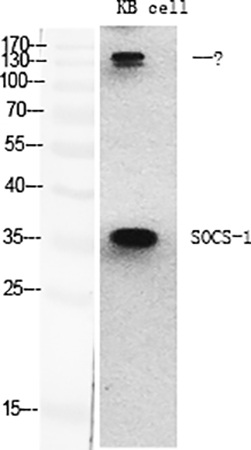
Fig.1. Western Blot analysis of various cells using SOCS-1 Polyclonal Antibody diluted at 1:2000.
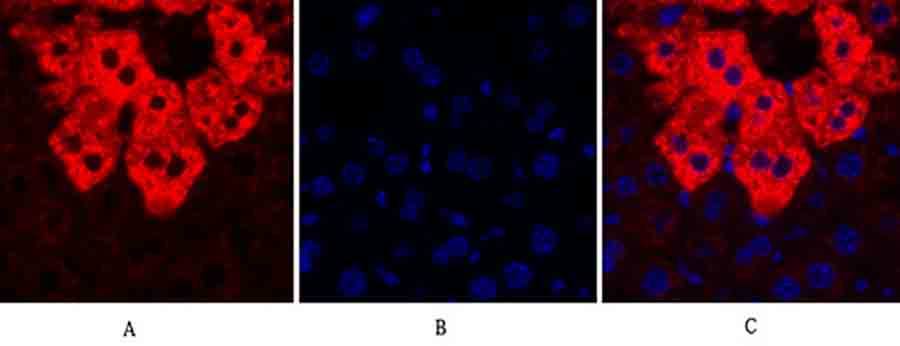
Fig.2. Immunofluorescence analysis of mouse liver tissue. 1, SOCS-1 Polyclonal Antibody (red) was diluted at 1:200 (4°C, overnight). 2, Cy3 Labeled secondary antibody was diluted at 1:300 (room temperature, 50min). 3, Picture B: DAPI (blue) 10min. Picture A: Target. Picture B: DAPI. Picture C: merge of A+B.
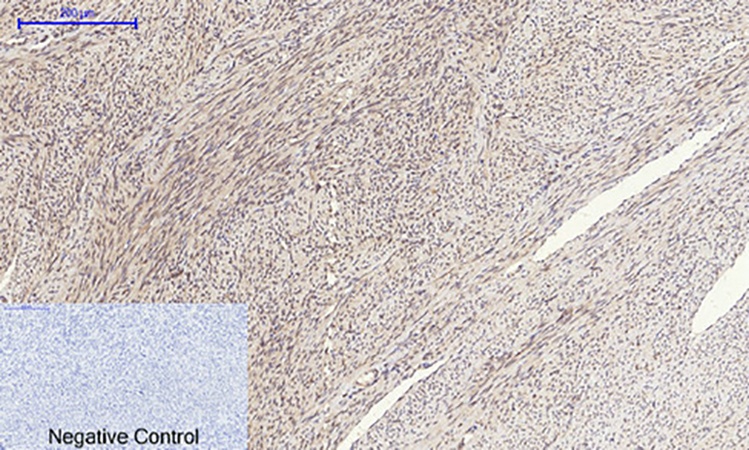
Fig.3. Immunohistochemical analysis of paraffin-embedded human uterus tissue. 1, SOCS-1 Polyclonal Antibody was diluted at 1:200 (4°C, overnight). 2, Sodium citrate pH 6.0 was used for antibody retrieval (>98°C, 20min). 3, secondary antibody was diluted at 1:200 (room temperature, 30min). Negative control was used by secondary antibody only.
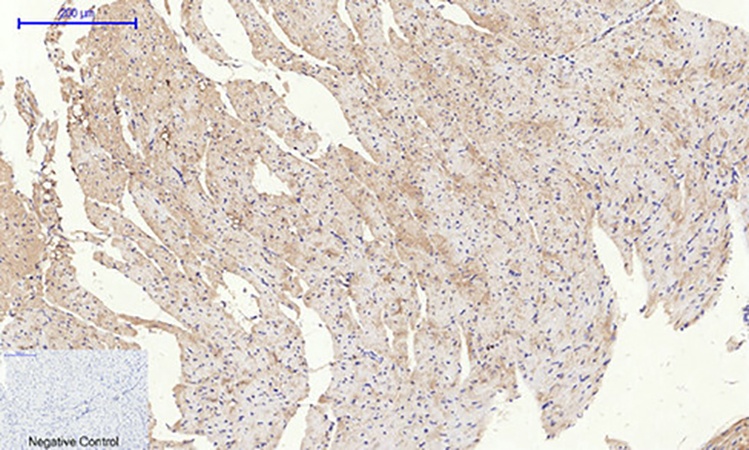
Fig.4. Immunohistochemical analysis of paraffin-embedded mouse heart tissue. 1, SOCS-1 Polyclonal Antibody was diluted at 1:200 (4°C, overnight). 2, Sodium citrate pH 6.0 was used for antibody retrieval (>98°C, 20min). 3, secondary antibody was diluted at 1:200 (room temperature, 30min). Negative control was used by secondary antibody only.
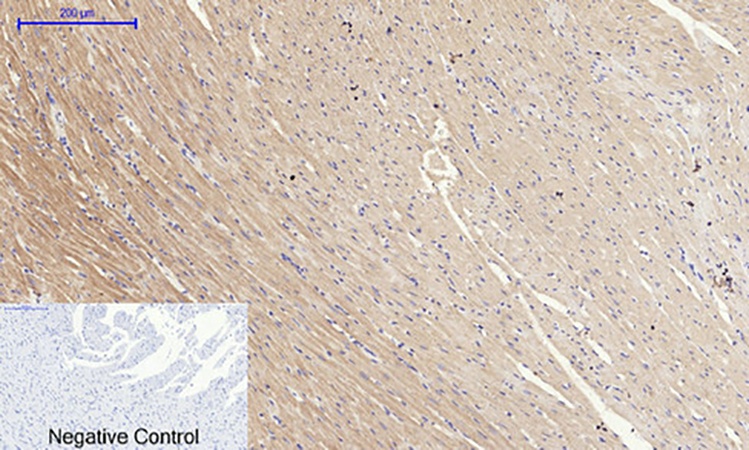
Fig.5. Immunohistochemical analysis of paraffin-embedded rat heart tissue. 1, SOCS-1 Polyclonal Antibody was diluted at 1:200 (4°C, overnight). 2, Sodium citrate pH 6.0 was used for antibody retrieval (>98°C, 20min). 3, secondary antibody was diluted at 1:200 (room temperature, 30min). Negative control was used by secondary antibody only.
Author:Feng‐Hua Yuan, You‐Lian Chen, Ying Zhao, et al Publication name:J Cell Physiol IF:4
You must be logged in to post a review.











Reviews
There are no reviews yet.