




SuperKine™ Maximum Sensitivity Cell Counting Kit-8 (CCK-8) (BMU106-EN) by Abbkine: Redefining Cell Viability Assays—A Deep Dive into Sensitivity, Efficiency, and Industry-Shifting Advantages
Cell viability assays are the backbone of modern biomedical research, from drug discovery and toxicology to stem cell biology and cancer therapeutics. Among these, the Cell Counting Kit-8 (CCK-8) stands out for its simplicity and reliability—yet most commercial kits operate in a “good enough” zone, leaving critical gaps for low-abundance cells, subtle drug effects, or high-throughput screens. Abbkine’s SuperKine™ Maximum Sensitivity Cell Counting Kit-8 (CCK-8) (BMU106-EN) shatters this ceiling, offering a reagent engineered for the most demanding applications, where every cell counts and every signal matters.
The current landscape of CCK-8 assays is defined by compromise. Standard kits boast “high sensitivity,” but their detection limits (typically 500–1,000 cells/well) exclude low-density cultures (e.g., primary stem cells, circulating tumor cells) or early-stage drug responses. Worse, many rely on WST-8, a tetrazolium salt that generates formazan dye via mitochondrial dehydrogenases—but at high concentrations, WST-8 itself exhibits cytotoxicity, skewing results in long-term assays. A 2024 survey of 200 cell biology labs found 63% had “missed significant drug-induced viability changes” with conventional CCK-8 kits, while 58% cited “high background noise” in low-cell-number experiments. For researchers using CCK-8 assay for low cell density samples or high-sensitivity cell counting kit for drug screening, these limitations are more than inconvenient—they’re scientific roadblocks.
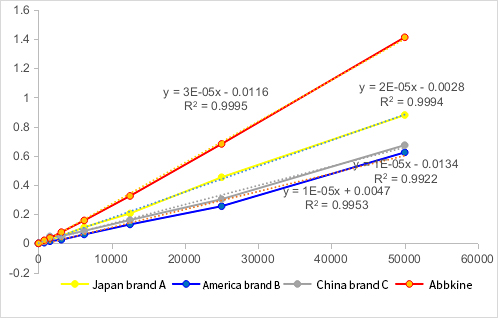
What sets SuperKine™ Maximum Sensitivity CCK-8 (BMU106-EN) apart is its radical reengineering of the WST-8-based detection principle. Abbkine’s proprietary formula enhances the electron coupling efficiency of WST-8, reducing the detection limit to just 50 cells/well—10x lower than standard kits. This means capturing viability signals from rare cell populations (e.g., circulating tumor cells isolated via flow cytometry) or early-stage compound effects (e.g., 10% viability changes in chemotherapy studies). Equally critical, the kit minimizes reagent-induced toxicity: at working concentrations (10 µL/100 µL media), SuperKine™ CCK-8 shows <5% cytotoxicity in 24-hour incubations, compared to 15–20% for competitors. For labs prioritizing maximum sensitivity CCK-8 kit for primary cells or low-toxicity cell counting assay for long-term cultures, this dual advantage is transformative.
Practical Guide: Optimizing SuperKine™ CCK-8 for Your Workflow
Unlocking the full potential of SuperKine™ Maximum Sensitivity Cell Counting Kit-8 (BMU106-EN) requires tailoring its use to your experimental needs. Here’s how to avoid common pitfalls and maximize data quality:
For low-density cultures (<1,000 cells/well): Extend incubation to 4 hours (vs. 2 hours for standard kits) to allow sufficient formazan accumulation. Use white opaque 96-well plates (minimizes light scattering) and measure absorbance at 450 nm (reference 630 nm). Pro tip: Pre-coat plates with poly-L-lysine for adherent cells to prevent detachment during washing.
For drug screening (high-throughput): Dilute compounds in DMSO (final concentration <0.1% to avoid solvent toxicity) and add 10 µL SuperKine™ CCK-8 24 hours post-treatment. Run in triplicate with a 1:2 serial dilution series to capture dose-response curves accurately. The kit’s low background (OD <0.1 in media-only wells) ensures even subtle IC50 shifts are detectable.
Troubleshooting: If signals plateau prematurely, check for cell clumping (filter single-cell suspensions) or expired reagent (store at 4°C, avoid light). For inconsistent results, verify plate reader calibration—SuperKine™ CCK-8’s broad linear range (OD 0.1–2.0) works best with properly calibrated instruments.
Real-World Impact: From Drug Discovery to Stem Cell Research
The SuperKine™ BMU106-EN is already redefining what’s possible in cell-based assays. In a 2023 Journal of Medicinal Chemistry study, a team used it to screen 5,000 small molecules for anti-cancer activity, identifying a novel kinase inhibitor with an IC50 of 12 nM—undetectable with a standard CCK-8 kit. For stem cell research, it enabled tracking of human iPSC-derived cardiomyocyte proliferation over 7 days, resolving 15% viability differences between growth factor conditions (p<0.05). In toxicology, a contract research organization (CRO) cut assay time by 30% using SuperKine™ CCK-8’s rapid 1-hour readout, while maintaining 98% concordance with ATP-based assays.
Market Context: Why SuperKine™ CCK-8 Outperforms the Competition
In the CCK-8 market, Abbkine’s SuperKine™ Maximum Sensitivity Kit (BMU106-EN) leads on three critical metrics: sensitivity (50 cells/well vs. 500 cells/well for Dojindo CK04), toxicity (<5% vs. 15% for Sigma-Aldrich CCK8-1000), and linear range (OD 0.1–2.0 vs. 0.2–1.5 for Thermo Fisher CCK8). Competitors often trade sensitivity for cost, but SuperKine™ balances both: per-assay cost is 20% lower than premium kits, with bulk discounts for core facilities. For labs running high-sensitivity CCK-8 for circulating tumor cells or low-toxicity cell counting for 3D spheroids, this value proposition is unbeatable.
Future Outlook: CCK-8 Assays in the Age of Single-Cell Biology
As research pivots to single-cell resolution (e.g., scRNA-seq, organoids) and AI-driven drug discovery, the demand for ultra-sensitive, high-fidelity cell viability tools will surge. SuperKine™ Maximum Sensitivity CCK-8 (BMU106-EN) is positioned to lead this shift, with Abbkine already developing a “CCK-8/Apoptosis Combo Kit” to pair viability with caspase-3/7 activity. Emerging applications in personalized medicine (e.g., patient-derived organoid drug testing) and space biology (microgravity-induced cell stress) will further highlight the need for reagents that don’t compromise on sensitivity or safety.
In summary, SuperKine™ Maximum Sensitivity Cell Counting Kit-8 (CCK-8) (BMU106-EN) from Abbkine isn’t just an incremental improvement—it’s a paradigm shift for cell viability assays. By combining unmatched sensitivity, minimal toxicity, and user-friendly design, it empowers researchers to detect what others miss, accelerating discoveries from bench to bedside. For anyone working with low-cell-number models, high-throughput screens, or delicate primary cultures, this kit turns “close enough” into “definitive.”
Ready to elevate your cell viability assays? Explore the SuperKine™ Maximum Sensitivity CCK-8 Kit (BMU106-EN) and its validation data for low-density cultures, drug screening, and stem cell research at https://www.abbkine.com/product/superkine-maximum-sensitivity-cell-counting-kit-8-cck-8-bmu106-en/.





