| Product name | PIP5KIII Polyclonal Antibody |
| Immunogen | Synthesized peptide derived from the N-terminal region of human PIP5KIII at AA range: 40-120 |
| Host | Rabbit |
| Reactivity | Human,Mouse |
| Applications | WB,IHC |
| Applications notes | Optimal working dilutions should be determined experimentally by the investigator. Suggested starting dilutions are as follows: WB 1:500-2000;IHC 1:50-300 |
| Clonality | Polyclonal |
| Preparation method | The antibody was affinity-purified from rabbit antiserum by affinity-chromatography using epitope-specific immunogen. |
| Alternative | PIKFYVE; KIAA0981; PIP5K3; 1-phosphatidylinositol 3-phosphate 5-kinase; Phosphatidylinositol 3-phosphate 5-kinase; FYVE finger-containing phosphoinositide kinase; PIKfyve; Phosphatidylinositol 3-phosphate 5-kinase type III; PIPkin-III; Type |
| Formulation | Liquid solution |
| Concentration | 1 mg/ml |
| Molecular weight | 237kD |
| Storage buffer | Liquid in PBS containing 50% glycerol, 0.5% BSA and 0.02% sodium azide. |
| Storage instructions | Stable for one year at -20°C from date of shipment. For maximum recovery of product, centrifuge the original vial after thawing and prior to removing the cap. Aliquot to avoid repeated freezing and thawing. |
| Shipping | Gel pack with blue ice. |
| Precautions | The product listed herein is for research use only and is not intended for use in human or clinical diagnosis. Suggested applications of our products are not recommendations to use our products in violation of any patent or as a license. We cannot be responsible for patent infringements or other violations that may occur with the use of this product. |
| Background | Phosphorylated derivatives of phosphatidylinositol (PtdIns) regulate cytoskeletal functions, membrane trafficking, and receptor signaling by recruiting protein complexes to cell- and endosomal-membranes. Humans have multiple PtdIns proteins that differ by the degree and position of phosphorylation of the inositol ring. PIKFYVE encodes an enzyme (PIKfyve; also known as phosphatidylinositol-3-phosphate 5-kinase type III or PIPKIII) that phosphorylates the D-5 position in PtdIns and phosphatidylinositol-3-phosphate (PtdIns3P) to make PtdIns5P and PtdIns(3,5)biphosphate. The D-5 position also can be phosphorylated by type I PtdIns4P-5-kinases (PIP5Ks) that are encoded by distinct genes and preferentially phosphorylate D-4 phosphorylated PtdIns. In contrast, PIKfyve preferentially phosphorylates D-3 phosphorylated PtdIns. In addition to being a lipid kinase, PIKfyve also has protein kinase activity. PIKfyve regulates endomembrane homeostasis and plays a role in the biogenesis of endosome carrier vesicles from early endosomes. Mutations in PIKFYVE cause corneal fleck dystrophy (CFD); an autosomal dominant disorder characterized by numerous small white flecks present in all layers of the corneal stroma. Histologically, these flecks appear to be keratocytes distended with lipid and mucopolysaccharide filled intracytoplasmic vacuoles. Alternative splicing results in multiple transcript variants encoding distinct isoforms. |
| Gene ID | 200576 |
| Alternative | PIKFYVE; KIAA0981; PIP5K3; 1-phosphatidylinositol 3-phosphate 5-kinase; Phosphatidylinositol 3-phosphate 5-kinase; FYVE finger-containing phosphoinositide kinase; PIKfyve; Phosphatidylinositol 3-phosphate 5-kinase type III; PIPkin-III; Type |
| Others | PIP5KIII Polyclonal Antibody detects endogenous levels of PIP5KIII protein. |
| Accession | Q9Y2I7 |
| Observed Band(KD) | 237 |
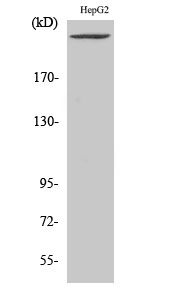
Fig. Western Blot analysis of various cells using PIP5KIII Polyclonal Antibody.
You must be logged in to post a review.











Reviews
There are no reviews yet.