| Product name | p53 (Acetyl-K305) Polyclonal Antibody |
| Immunogen | Synthesized peptide derived from part region of human p53 (Acetyl-K305) protein at amino acid sequence of K305 |
| Host | Rabbit |
| Reactivity | Human:K305 |
| Applications | WB,ELISA |
| Applications notes | Optimal working dilutions should be determined experimentally by the investigator. Suggested starting dilutions are as follows: WB 1:1000 |
| Clonality | Polyclonal |
| Preparation method | The antibody was affinity-purified from rabbit antiserum by affinity-chromatography using epitope-specific immunogen. |
| Alternative | Cellular tumor antigen p53; Antigen NY-CO-13; Phosphoprotein p53; Tumor suppressor p53 |
| Formulation | Liquid solution |
| Concentration | 1 mg/ml |
| Storage buffer | Liquid in PBS containing 50% glycerol, 0.5% BSA and 0.02% sodium azide. |
| Storage instructions | Stable for one year at -20°C from date of shipment. For maximum recovery of product, centrifuge the original vial after thawing and prior to removing the cap. Aliquot to avoid repeated freezing and thawing. |
| Shipping | Gel pack with blue ice. |
| Precautions | The product listed herein is for research use only and is not intended for use in human or clinical diagnosis. Suggested applications of our products are not recommendations to use our products in violation of any patent or as a license. We cannot be responsible for patent infringements or other violations that may occur with the use of this product. |
| Background | TP53 mutations are universal across cancer types. The loss of a tumor suppressor is most often through large deleterious events, such as frameshift mutations, or premature stop codons. In TP53 however, many of the observed mutations in cancer are found to be single nucleotide missense variants. These variants are broadly distributed throughout the gene, but with the majority localizing in the DNA binding domain. There is no single hotspot in the DNA binding domain, but a majority of mutations occur in amino acid positions 175, 245, 248, 273, and 282 (NM_000546) (Olivier et al. 2010). While a large proportion of cancer genomics research is focused on somatic variants, TP53 is also of note in the germline. Germline TP53 mutations are the hallmark of Li-Fraumeni syndrome, and many (both germline and somatic) variants have been found to have a prognostic impact on patient outcomes. The significance of many polymorphisms for susceptibility and prognosis of disease is still very much up for debate. |
| Gene ID | 7157 |
| Alternative | Cellular tumor antigen p53; Antigen NY-CO-13; Phosphoprotein p53; Tumor suppressor p53 |
| Others | The antibody detects endogenous levels of p53 (Acetyl-K305), while it doesn't react with total protein. |
| Accession | P04637 |
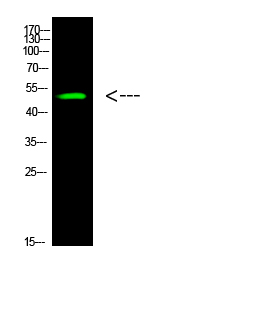
Fig.1. Western Blot analysis of Mouse-brain cells using primary antibody diluted at 1:1000 (4°C overnight). Goat Anti-rabbit IgG Dylight 800 (Cat #: A23920) secondary antibody was diluted at 1:5000 at 25°C for 1 hour.
You must be logged in to post a review.











Reviews
There are no reviews yet.