| Product name | EphB2 Polyclonal Antibody |
| Immunogen | Synthesized peptide derived from the C-terminal region of human EphB2 at AA rangle: 960-1040 |
| Host | Rabbit |
| Reactivity | Human,Mouse |
| Applications | WB,IHC,IF,ELISA |
| Applications notes | Optimal working dilutions should be determined experimentally by the investigator. Suggested starting dilutions are as follows: WB 1:500-1:2000;IHC 1:100-1:300;ELISA 1:5000;IF 1:50-200 |
| Clonality | Polyclonal |
| Preparation method | The antibody was affinity-purified from rabbit antiserum by affinity-chromatography using epitope-specific immunogen. |
| Alternative | EPHB2; DRT; EPHT3; EPTH3; ERK; HEK5; TYRO5; Ephrin type-B receptor 2; Developmentally-regulated Eph-related tyrosine kinase; ELK-related tyrosine kinase; EPH tyrosine kinase 3; EPH-like kinase 5; EK5; hEK5; Renal carcinoma antigen NY-REN-47 |
| Formulation | Liquid solution |
| Concentration | 1 mg/ml |
| Molecular weight | 117kD |
| Storage buffer | Liquid in PBS containing 50% glycerol, 0.5% BSA and 0.02% sodium azide. |
| Storage instructions | Stable for one year at -20°C from date of shipment. For maximum recovery of product, centrifuge the original vial after thawing and prior to removing the cap. Aliquot to avoid repeated freezing and thawing. |
| Shipping | Gel pack with blue ice. |
| Precautions | The product listed herein is for research use only and is not intended for use in human or clinical diagnosis. Suggested applications of our products are not recommendations to use our products in violation of any patent or as a license. We cannot be responsible for patent infringements or other violations that may occur with the use of this product. |
| Background | EPHB2 encodes a member of the Eph receptor family of receptor tyrosine kinase transmembrane glycoproteins. These receptors are composed of an N-terminal glycosylated ligand-binding domain, a transmembrane region and an intracellular kinase domain. They bind ligands called ephrins and are involved in diverse cellular processes including motility, division, and differentiation. A distinguishing characteristic of Eph-ephrin signaling is that both receptors and ligands are competent to transduce a signaling cascade, resulting in bidirectional signaling. This protein belongs to a subgroup of the Eph receptors called EphB. Proteins of this subgroup are distinguished from other members of the family by sequence homology and preferential binding affinity for membrane-bound ephrin-B ligands. Allelic variants are associated with prostate and brain cancer susceptibility. Alternative splicing results in multiple transcript variants. |
| Gene ID | 2048 |
| Alternative | EPHB2; DRT; EPHT3; EPTH3; ERK; HEK5; TYRO5; Ephrin type-B receptor 2; Developmentally-regulated Eph-related tyrosine kinase; ELK-related tyrosine kinase; EPH tyrosine kinase 3; EPH-like kinase 5; EK5; hEK5; Renal carcinoma antigen NY-REN-47 |
| Others | EphB2 Polyclonal Antibody detects endogenous levels of EphB2 protein. |
| Accession | P29323 |
| Observed Band(KD) | 117 |
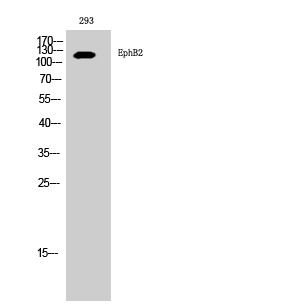
Fig. Western Blot analysis of 293 cells using EphB2 Polyclonal Antibody diluted at 1:1000.
You must be logged in to post a review.











Reviews
There are no reviews yet.