| Product name | CD40 Polyclonal Antibody |
| Immunogen | Synthesized peptide derived from the C-terminal region of human CD40 at AA range: 200-280 |
| Host | Rabbit |
| Reactivity | Human,Mouse,Monkey |
| Applications | WB,IHC,IF,ELISA |
| Applications notes | Optimal working dilutions should be determined experimentally by the investigator. Suggested starting dilutions are as follows: WB 1:500-1:2000;IHC 1:100-1:300;ELISA 1:10000;IF 1:50-200 |
| Clonality | Polyclonal |
| Preparation method | The antibody was affinity-purified from rabbit antiserum by affinity-chromatography using epitope-specific immunogen. |
| Alternative | CD40; TNFRSF5; Tumor necrosis factor receptor superfamily member 5; B-cell surface antigen CD40; Bp50; CD40L receptor; CDw40; CD antigen CD40 |
| Formulation | Liquid solution |
| Concentration | 1 mg/ml |
| Molecular weight | 30kD |
| Storage buffer | Liquid in PBS containing 50% glycerol, 0.5% BSA and 0.02% sodium azide. |
| Storage instructions | Stable for one year at -20°C from date of shipment. For maximum recovery of product, centrifuge the original vial after thawing and prior to removing the cap. Aliquot to avoid repeated freezing and thawing. |
| Shipping | Gel pack with blue ice. |
| Precautions | The product listed herein is for research use only and is not intended for use in human or clinical diagnosis. Suggested applications of our products are not recommendations to use our products in violation of any patent or as a license. We cannot be responsible for patent infringements or other violations that may occur with the use of this product. |
| Background | CD40 is a member of the TNF-receptor superfamily. The encoded protein (CD40 molecule) is a receptor on antigen-presenting cells of the immune system and is essential for mediating a broad variety of immune and inflammatory responses including T cell-dependent immunoglobulin class switching, memory B cell development, and germinal center formation. AT-hook transcription factor AKNA is reported to coordinately regulate the expression of this receptor and its ligand, which may be important for homotypic cell interactions. Adaptor protein TNFR2 interacts with this receptor and serves as a mediator of the signal transduction. The interaction of this receptor and its ligand is found to be necessary for amyloid-beta-induced microglial activation, and thus is thought to be an early event in Alzheimer disease pathogenesis. Mutations affecting this gene are the cause of autosomal recessive hyper-IgM immunodeficiency type 3 (HIGM3). Multiple alternatively spliced transcript variants of this gene encoding distinct isoforms have been reported. |
| Gene ID | 958 |
| Alternative | CD40; TNFRSF5; Tumor necrosis factor receptor superfamily member 5; B-cell surface antigen CD40; Bp50; CD40L receptor; CDw40; CD antigen CD40 |
| Others | CD40 Polyclonal Antibody detects endogenous levels of CD40 protein. |
| Accession | P25942 |
| Observed Band(KD) | 30 |
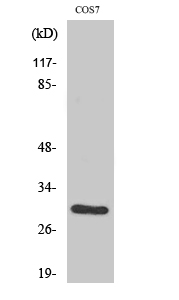
Fig. Western Blot analysis of various cells using CD40 Polyclonal Antibody.
You must be logged in to post a review.











Reviews
There are no reviews yet.