| Product name | Anti-DDDDK Tag Mouse Monoclonal Antibody (1B10) |
| Immunogen | Synthetic Peptide |
| Host | Mouse |
| Reactivity | Mammals, Bacteria |
| Applications | IF, IP, WB |
| Applications notes | Optimal working dilutions should be determined experimentally by the investigator. Suggested starting dilutions are as follows: WB (1:10000), IF (1:4000), IP (1:400). |
| Clonality | Monoclonal |
| Preparation method | The antibody was affinity-purified from mouse ascites by affinity-chromatography using specific immunogen |
| Alternative | DDDDK tag; DYKDDDDK tag; Flag tag; DYKDDDDK epitope; DDK epitope |
| Formulation | Liquid solution |
| Concentration | 1 mg/ml |
| Storage buffer | Liquid in PBS, pH 7.4, containing 0.02% Sodium Azide as preservative and 50% Glycerol. |
| Storage instructions | Stable for one year at -20°C from date of shipment. For maximum recovery of product, centrifuge the original vial after thawing and prior to removing the cap. Aliquot to avoid repeated freezing and thawing. |
| Shipping | Gel pack with blue ice. |
| Precautions | The product listed herein is for research use only and is not intended for use in human or clinical diagnosis. Suggested applications of our products are not recommendations to use our products in violation of any patent or as a license. We cannot be responsible for patent infringements or other violations that may occur with the use of this product. |
| Background | The DYKDDDDK peptide (Flag-tag) is a polypeptide protein tag that can be added to a protein using recombinant DNA technology. It can be used for affinity chromatography, and then used to separate recombinant, over expressed protein from wild-type protein expressed by the host organism. It can also be used in the isolation of protein complexes with multiple subunits. |
| Alternative | DDDDK tag; DYKDDDDK tag; Flag tag; DYKDDDDK epitope; DDK epitope |
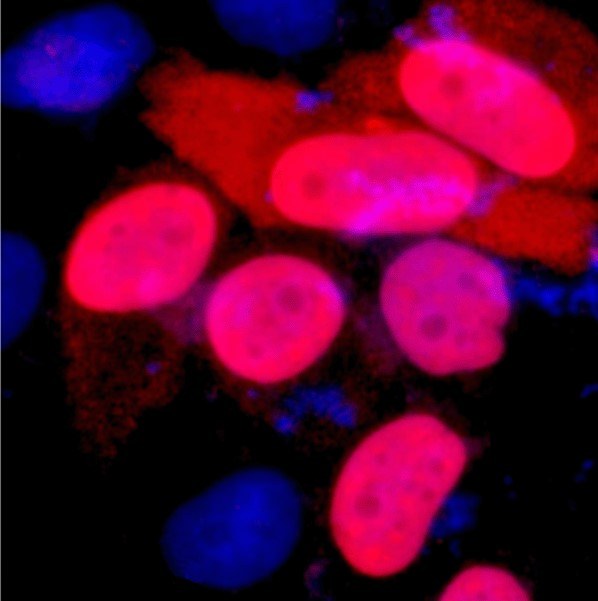
Fig.1. Immunofluorescence staining (1:4000) of Flag fusion protein in 293 cells and counterstained with DAPI.
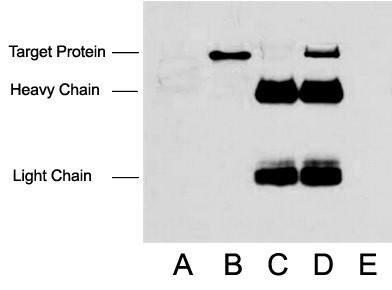
Fig.2. IP (1:400)-WB (1:10000) analysis of Flag fusion protein expression in 293 cells. Untransfected 293 cell lysate (lane A), transfected 293 cell lysate with Flag-tag protein (lane B), IP transfected 293 with normal Mouse IgG and Protein G agarose (lane C), IP transfected 293 with Anti Flag tag mAb and Protein G agarose (lane D), and IP transfected 293 with only Protein G agarose (lane E).
Author:Ling, Chengcheng, et al. Publication name:Nature Communications IF:15.7
Author:Meng, Li, et al. Publication name:Nature Communications IF:15.7
Author:Li, Ze-Min, et al. Publication name:Autophagy IF:15
Author:Song, Huifang, et al. Publication name: Advanced Science IF:14.1
Author:L Jiang, M Yue, Y Liu, N Zhang, Y Lin, ... Publication name:Journal of Virology IF:14
Author:Wang, Yingzhen, et al. Publication name:Advanced Science IF:14
Author:Jia, Hanli, et al. Publication name:Cell Discovery IF:12.5
Author:Jiang, Dong, et al. Publication name:Developmental Cell IF:11
Author:Cai, Hanyang, et al. Publication name:Developmental Cell IF:8.7
Author:Xie, Guoqing, et al. Publication name:Cell Death & Disease IF:8
Author:Wang, Fanlong, et al. Publication name:Cell Reports IF:6.9
Author:Yuan, Tian, et al. Publication name:Elife IF:6
Author:Huang, Xiao-Dong, et al. Publication name:Cell Death Discovery IF:6
Author:Pang, Pan‐Pan, et al. Publication name:Journal of the American Heart Association IF:5.3
Author:Zheng, Xiao-Li, et al. Publication name:American Journal of Cancer Research IF:4
You must be logged in to post a review.











Reviews
There are no reviews yet.