| Product name | Mitochondrial Membrane Potential Assay Kit (JC-1) |
| Applications notes | Abbkine Mitochondrial Membrane Potential Assay Kit (JC-1) provides a simple method for distinguishing between healthy and apoptotic cells by detecting the changes in the mitochondrial transmembrane potential, based on a carbocyanine dye, JC-1. In healthy cells, this dye accumulates and aggregates in the mitochondria, where it forms bright red fluorescent agglomerates. Any event that dissipates the mitochondrial membrane potential prevents the accumulation of the JC-1 dye in the mitochondria and thus, the dye remains in the cytoplasm in its monomer form, leading to a shift from red (agglomerated JC-1, Ex/Em = 585/590 nm) to green fluorescence (JC-1 monomers, Ex/Em = 510/527 nm). JC-1 can be used as an indicator of mitochondrial potential in a variety of cell types, including myocytes and neurons, as well as in intact tissues and isolated mitochondria. This kit contains CCCP that causes an uncoupling of the proton gradient, which established during the normal activity of electron carriers in the electron transport chain, and thus, dissipates the mitochondrial electrochemical potential and may be used as a control that prevents JC-1 aggregation. |
| Kit components | • JC-1 Stain(50×) • CCCP (10 mM) • PBS (10×) |
| Features & Benefits | • Measure mitochondrial membrane potential as an indicator of cell health. • Use JC-1, a fluorescent, lipophilic, cationic dye. • Red fluorescence indicates healthy mitochondria and green fluorescence indicates mitochondria in poor health. • Optimized for flow cytometery or fluorescent microscopy. • Contain CCCP (Potent mitochondrial oxidative phosphorylation uncoupler). |
| Usage notes | • JC-1 Stain is difficult to prepare due to its low solubility. Make sure JC-1 Stain is completely thawed and warmed to room temperature before using. • JC-1 Stain is light senstive. Incubations need to be done in the dark. |
| Storage instructions | Refer to list of materials supplied for storage conditions of individual components. Stable for at least 12 months at recommended temperature from date of shipment. |
| Shipping | Gel pack with blue ice. |
| Precautions | The product listed herein is for research use only and is not intended for use in human or clinical diagnosis. Suggested applications of our products are not recommendations to use our products in violation of any patent or as a license. We cannot be responsible for patent infringements or other violations that may occur with the use of this product. |
| Background | Mitochondria, the site of most energy production in eukaryotic cells, have a double membrane structure: an outer membrane and a folded inner membrane. Across the inner membrane of intact mitochondria there is a voltage gradient with the inside negative and the outside positive. Disruption of the mitochondrial transmembrane potential is one of the earliest intracellular events that occur following induction of apoptosis. |
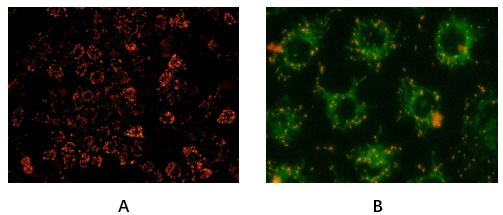
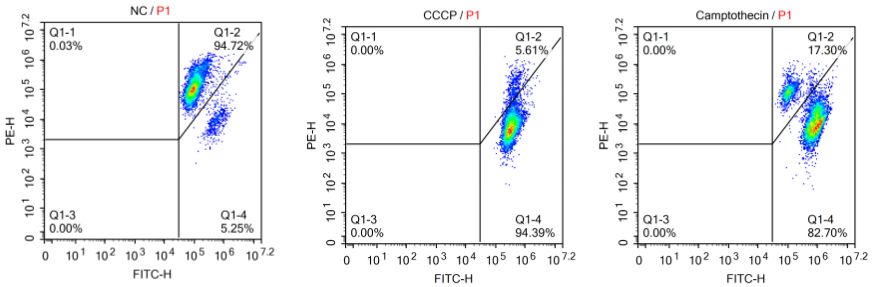
Fig. Hela cells stained with Abbkine Mitochondrial Membrane Potential Assay Kit (JC-1).
A: Red fluorescence indicates healthy mitochondria, B: Green fluorescence indicates mitochondria in poor health (30min incubation in 20uM CCCP).
Figure2. Flow cytometry results of Jurkat cells using the Mitochondrial Membrane Potential Assay Kit (JC-1). Normal Jurkat cells (NC, on the left) have a small amount of apoptosis, manifested by the presence of a few cells with reduced mitochondrial membrane potential. Cells treated with CCCP (CCCP, in the middle) have almost all their mitochondrial membrane potentials reduced. After 16 hours of treatment with 5 μM camptothecin on Jurkat cells (Camptothecin, on the right), a large number of cells with reduced mitochondrial membrane potential are observed.
Author:李晶 Publication name:Fish & Shellfish Immunology IF:26.8
Author:黄倩倩 Publication name:Frontiers in Psychiatry IF:14.1
Author:Wen, **gyi, et al. Publication name:Gut Microbes IF:12
Author:Yuxing Dai, Jiaying Yu, Gongyun He, et al. Publication name:Phytomedicine IF:8
Author:鲁佳琦 Publication name:PLoS Pathogens IF:7.4
Author:Wang, **g, et al. Publication name:Phytomedicine IF:7
Author:P Mao, Z Wang, J Duan, P Dong, C Yuan, ... Publication name:signal transduction and targeted therapy IF:6.2
Author:Huang, Huizhong, et al. Publication name:Food & Function IF:5
Author:MR Xu, CH Lin, HH Lee, SY Wang Publication name:Biochim Biophys Acta IF:4.8
Author:S Zhu, M Tang, J Chen, S Li, R Xue Publication name:Frontiers in immunology IF:4.1
Author:Özkaya Gül, Serap, et al. Publication name:Pharmaceuticals IF:4
Author:Kushwaha, Asha D., et al. Publication name:IUBMB life IF:4
Author:Teng, He, et al. Publication name:Bioengineered IF:4
Author:**e, Luhan, et al. Publication name:Cellular Signalling IF:4
Author:DQ Sun, MY Zhong, JH Zhang, H Tang, B Hu, JQ Shen, ... Publication name:Technology in Cancer Research & Treatment IF:3.7
Author:MZ Xie, JL Liu, QZ Gao, DY Bo, L Wang, XC Zhou, ... Publication name:ACS Applied Materials & Interfaces IF:3.3
Author:Zhao, Chensheng, et al. Publication name:Cell Biology International IF:3
Author:**e, Ming-Zhang, et al. Publication name: Clinical Proteomics IF:3
Author:Katiyar, Parul, et al. Publication name:Current Research in Toxicology IF:3
Author:Zhang, Yu‑Chao. Publication name: IF:
You must be logged in to post a review.











Reviews
There are no reviews yet.