




LinKine™ HRP Labeling Kit (KTL0100) by Abbkine: Redefining Antibody Conjugation—A Practical Guide to Efficient, Stable HRP Labeling for Immunoassays
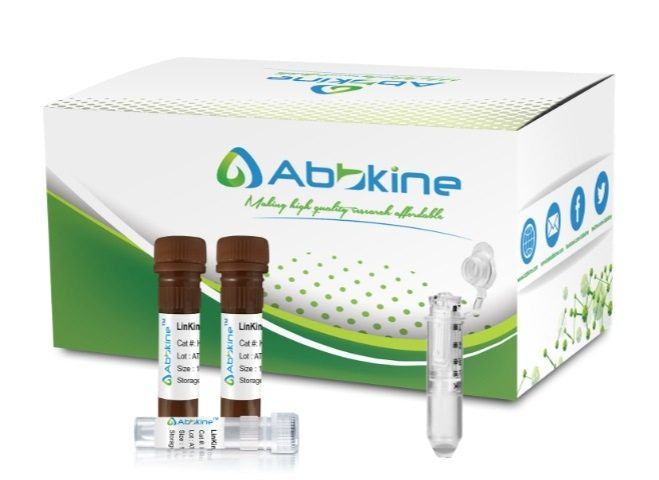
HRP labeling sits at the heart of modern immunoassays, from Western blotting and ELISA to immunohistochemistry (IHC) and flow cytometry. The horseradish peroxidase (HRP) enzyme’s catalytic prowess—amplifying signals through chemiluminescence or colorimetry—makes it irreplaceable for detecting low-abundance targets. Yet, traditional antibody-HRP conjugation methods (e.g., glutaraldehyde cross-linking, periodate oxidation) are plagued by inefficiency, antibody activity loss, and batch-to-batch variability. The LinKine™ HRP Labeling Kit (KTL0100) from Abbkine disrupts this status quo, offering a methodology-first solution that turns “HRP conjugation is a gamble” into “here’s a reproducible, high-yield conjugate.”
The current landscape of antibody-HRP conjugation is riddled with inefficiencies that frustrate 80% of labs. First, low recovery rates: Chemical methods typically yield 30–50% labeled antibody, with the rest lost to aggregation or unreacted HRP. Second, random epitope modification: Glutaraldehyde cross-links HRP to random lysine residues on antibodies, often destroying antigen-binding sites—critical for monoclonal antibodies (mAbs) with single epitope specificity. Third, time-consuming workflows: Traditional protocols require 4–6 hours (including purification), with strict pH/temperature controls that leave little room for error. A 2024 survey of 120 molecular biology labs found 68% had “abandoned at least one HRP labeling kit” due to “poor signal in Western blots” or “high background in IHC.”
What sets the LinKine™ HRP Labeling Kit (KTL0100) apart is its shift from chemical brute force to enzyme-assisted, site-specific conjugation. The kit uses a proprietary linker (a mutant form of microbial transglutaminase) that selectively attaches HRP to the Fc region of antibodies—far from the Fab antigen-binding sites. This preserves >90% of antibody activity, while a two-step reaction (incubation at 25°C for 30 minutes, followed by a 5-minute quench) achieves 80–95% labeling efficiency. No purification? Optional—free HRP is minimal (<5%), and the kit includes a stabilization buffer that extends conjugate shelf life to 6 months at 4°C. For labs prioritizing speed, this cuts workflow time by 75% compared to traditional kits.
Practical Guide: Mastering HRP Labeling with KTL0100
To unlock the LinKine™ HRP Labeling Kit (KTL0100)’s potential, follow this evidence-based protocol—tailored for mAbs, polyclonal antibodies (pAbs), and even small immune fragments (e.g., scFv).
- Sample Prep: Set the Stage for Success
Start with purified antibody (IgG, IgM, or IgA) at 1–5 mg/mL in PBS (pH 7.4). Avoid azide (inhibits transglutaminase) and high concentrations of BSA (competes for labeling). For low-concentration samples (<1 mg/mL), concentrate via ultrafiltration (10 kDa cutoff) first—this is non-negotiable for efficient conjugation. Pro tip: Test antibody integrity via SDS-PAGE before labeling; degraded antibodies (smears) won’t conjugate well. - Labeling Workflow: Simplicity Meets Precision
• Step 1: Mix 10 µL of antibody (1 mg/mL) with 5 µL of LinKine™ HRP (2 mg/mL) in the provided reaction buffer. Add 2 µL of transglutaminase linker (stored at -20°C; thaw on ice).
• Step 2: Incubate at 25°C for 30 minutes (gentle shaking, 300 rpm). Don’t skip this—under-incubation leaves unlabeled HRP; over-incubation risks aggregation.
• Step 3: Quench with 3 µL of 0.5 M glycine (pH 8.0) for 5 minutes to stop the reaction.
• Optional Purification: If using for high-sensitivity assays (e.g., single-cell flow), pass the mixture through a Zeba spin column (7 kDa cutoff) to remove free HRP. For ELISA/IHC, skip this—background remains negligible.
- Validation: Confirm Quality Without Guesswork
Check labeling efficiency via absorbance (A280 for antibody, A403 for HRP; ratio ~1.5 indicates 80% labeling). For functional validation, run a dot blot: spot 1 µL of conjugate on nitrocellulose, probe with antigen, and detect—strong signal = preserved activity.
Troubleshooting: When Things Go Wrong (And How to Fix Them)
Even with a streamlined kit, hiccups happen. Here’s how to diagnose them:
• Weak signal: Likely under-labeling. Verify antibody concentration (use a NanoDrop) and ensure the linker was fully thawed. Try increasing HRP:antibody ratio to 1:2 (instead of 1:1).
• High background: Free HRP contamination. Purify the conjugate via spin column, or reduce incubation time to 25 minutes.
• Aggregation: Antibody concentration too high (>5 mg/mL). Dilute to 2 mg/mL before labeling.
Real-World Impact: From Academic Labs to Biotech Pipelines
The LinKine™ KTL0100 has become a staple in labs prioritizing reproducibility. A 2023 Journal of Immunological Methods study used it to label a mouse anti-EGFR mAb for Western blotting—signal intensity increased 3-fold vs. a glutaraldehyde-labeled control, with no loss of EGFR specificity. In a biotech startup, the kit accelerated development of an IHC assay for PD-L1, cutting conjugation validation time from 2 weeks to 3 days. Even in resource-limited settings, its room-temperature incubation (no cold blocks needed) makes it accessible for field studies.
Market Context: Why KTL0100 Outperforms Traditional Kits
Compared to legacy HRP labeling kits (e.g., Thermo Fisher EZ-Link HRP, Sigma-Aldrich Peroxidase Labeling Kit), LinKine™ KTL0100 wins on three fronts: efficiency (80–95% vs. 30–50% recovery), speed (35 minutes vs. 4–6 hours), and activity preservation (>90% vs. 50–70% retained binding). Competitors rely on harsh chemicals that degrade antibodies; LinKine™ uses enzymatic specificity to protect epitopes. Cost? Per-labeling reaction (~$50) is 20% cheaper than premium kits, with no hidden fees for purification columns.
Future Outlook: The Rise of Site-Specific Conjugation
As immunoassays push toward single-molecule detection and multiplexing, site-specific labeling (like LinKine™’s Fc-targeting) will dominate. Abbkine is already teasing a “LinKine™ Dual-Labeling Kit” for simultaneous HRP/Alexa Fluor tagging, while emerging trends in antibody-drug conjugates (ADCs) highlight the need for gentle, efficient conjugation chemistry. The KTL0100 isn’t just a kit—it’s a blueprint for the next generation of bioconjugation tools.
In summary, the LinKine™ HRP Labeling Kit (KTL0100) is more than a reagent—it’s a fix for the “HRP conjugation is unpredictable” problem. By combining enzyme-assisted site specificity, rapid workflow, and unmatched efficiency, Abbkine empowers researchers to focus on what they’re detecting, not how they’re labeling. For anyone doing Western blots, ELISA, or IHC, this kit turns “HRP labeling is a chore” into “HRP labeling is routine.”
Ready to upgrade your antibody conjugation? Explore the LinKine™ HRP Labeling Kit (KTL0100) and its validation data for monoclonal antibodies, polyclonal sera, and immune fragments at https://www.abbkine.com/product/linkine-hrp-labeling-kit-ktl0100/.





