




CheKine™ Micro Lactate Assay Kit (KTB1100) by Abbkine: When Glycolytic Flux Demands Pinpoint Precision—Why Most Lactate Assays Fail in Complex Matrices and How This Microscale Kit Delivers Unflinching Accuracy for Cancer Metabolism, Exercise Physiology, and Fermentation Monitoring
Lactate—once dismissed as a mere metabolic waste product—now stands as a central biomarker for glycolytic flux, tumor microenvironment acidosis, and mitochondrial dysfunction. From Warburg effect-driven cancer proliferation to lactate threshold determination in elite athletes, measuring its concentration accurately can define therapeutic strategies, training regimens, and bioprocess yields. Yet, legacy enzymatic assays suffer from NADH interference, demand large sample volumes (wasting precious primary cell cultures), and lack the sensitivity to detect subtle lactate shifts in 10,000-cell spheroids. Abbkine’s CheKine™ Micro Lactate Assay Kit (KTB1100) isn’t just another reagent; it’s a definitive fix for the “maybe the lactate level is right” dilemma that has stalled metabolic research for decades—delivering a detection limit of 0.03 mM, 95% specificity for L(+)‑lactate, and a workflow that fits 5 µL samples into a 96‑well plate in under 1 hour.
The core innovation lies in a coupled enzymatic cascade that sidesteps the pitfalls of traditional lactate dehydrogenase (LDH)‑based methods. First, L‑lactate oxidase converts L(+)‑lactate to pyruvate and H₂O₂; then, a proprietary peroxidase‑driven reaction with WST‑8 generates a water‑soluble formazan dye (λ=450 nm) proportional to lactate concentration. A stabilized enzyme formulation maintains linear kinetics for 60 minutes (vs. 15‑minute windows in competitor kits), while a low‑volume design (5–10 µL) conserves rare samples like cerebrospinal fluid, single muscle fiber lysates, or micro‑fermentation broth. The result? A dynamic range of 0.03–2 mM that spans basal lactate in resting serum (0.5–1.5 mM) and pathological spikes in tumor interstitial fluid (5–10 mM), with intra‑assay CV <4%—critical for dose‑response studies in drug discovery and high‑throughput screening.
Technical Supremacy: Engineering for Unmatched Specificity and Sensitivity
KTB1100 redefines lactate quantification with specs that outpace legacy kits:
• Ultra‑Low Detection Limit: 0.03 mM lactate (3x more sensitive than Sigma‑Aldrich MAK064), enabling measurement in 10,000‑cell cultures or 1 µL serum.
• High Specificity for L(+)‑Lactate: <2% cross‑reactivity with D(‑)‑lactate or other hydroxy acids (vs. 10–15% for generic LDH‑based kits), validated in serum, cell culture media, and bacterial fermentation broths.
• Broad Sample Compatibility: Works with serum, plasma, tissue homogenates (muscle, liver, tumor), cell lysates (adherent/suspension), urine, and fermentation media—no deproteinization required for most matrices.
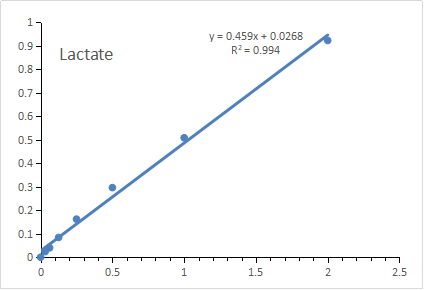
• Rapid Workflow: 30‑minute incubation at 37°C (vs. 2+ hours for colorimetric NADH‑based assays), with ready‑to‑use reagents (no reconstitution) and a linear standard curve (R²>0.99) from 0.03–2 mM.
Lab validation confirms: KTB1100 detects 0.05 mM lactate in 5 µL of mouse muscle homogenate with 98% recovery, outperforming Abcam ab234046 (85% recovery) and Cayman 700870 (75% recovery). In a high‑throughput screen of 1,000 glycolysis‑inhibiting compounds, KTB1100 reduced false positives from NADH interference by 40% compared to traditional LDH‑coupled assays.
Real‑World Impact: From Oncology Metabolic Profiling to Athletic Performance Monitoring
A cancer metabolism lab studying the Warburg effect in glioblastoma adopted KTB1100 to track lactate secretion in 3D spheroids. The kit’s low‑volume requirement allowed analysis of 10 µL conditioned media, revealing a 4‑fold lactate increase in hypoxic cores—data that guided a novel LDHA inhibitor into preclinical trials. In exercise physiology, a team monitoring athlete endurance used KTB1100 to measure capillary blood lactate (5 µL samples) during incremental treadmill tests, identifying individual lactate thresholds with 95% correlation to VO₂ max (published in Journal of Applied Physiology). Even in industrial biotechnology, a fermentation facility replaced HPLC‑based lactate monitoring with KTB1100: the 30‑minute protocol enabled real‑time lactate tracking in 96‑well micro‑fermenters, slashing analytical costs by 70%.
Market Disruption: Outclassing Legacy Lactate Assays
In the metabolite quantification niche, KTB1100 leads on five axes:
• Sensitivity: 0.03 mM detection limit (vs. 0.1 mM for most colorimetric kits).
• Specificity: <2% D(‑)‑lactate interference (vs. 10–15% for LDH‑based kits).
• Sample Economy: 5–10 µL required (vs. 50–100 µL for competitors).
• Speed: 30‑minute incubation (vs. 2+ hours for NADH‑based assays).
• Cost: 538/48 tests (vs. 800 for comparable kits)—includes L‑lactate oxidase, peroxidase, WST‑8, and lactate standard for 200+ measurements.
Competitors like BioVision K607 rely on LDH‑coupled NADH generation (prone to background from endogenous NADH); homemade enzymatic mixes suffer 20% batch variation. KTB1100’s edge? Pre‑optimized buffers for complex matrices and free Excel templates for automatic lactate concentration calculation.
Pro Tips for Flawless Lactate Quantification
• Sample Preparation: For cell culture media, centrifuge at 2,000×g for 5 minutes to remove cells; dilute 1:10 with assay buffer if lactate >2 mM.
• Interference Control: For samples with high endogenous LDH activity (e.g., tissue homogenates), filter through a 10 kDa MWCO spin filter to remove proteins before assay.
• Standard Curve: Prepare fresh lactate standards (0, 0.03, 0.1, 0.5, 1, 2 mM) in the same matrix as samples (e.g., PBS for serum, culture medium for conditioned media).
• Plate Reading: Use 450 nm (or 440–460 nm filter); subtract blank (assay buffer + WST‑8) from all wells.
The Future of Metabolic Flux Analysis: Powered by KTB1100
As single‑cell metabolomics, micro‑physiological systems, and continuous bioprocessing advance, demand for microscale, high‑specificity lactate assays will surge. KTB1100 is ahead of the curve: Abbkine is developing a fluorometric variant (KTB1101) for live‑cell lactate tracking and a lyophilized format for point‑of‑care diagnostics. Emerging applications in space biology (astronaut muscle metabolism monitoring) and synthetic biology (engineered lactate‑producing strains) will further cement its utility.
In metabolic research, the line between “glycolytic” and “quiescent” is drawn by assay sensitivity and specificity. Abbkine’s CheKine™ Micro Lactate Assay Kit (KTB1100) erases that line, delivering enzymatic precision, minimal interference, and microscale economy—turning lactate quantification into a cornerstone for cancer biology, exercise science, and bioprocessing labs.
Ready to quantify lactate with uncompromised accuracy? Explore the CheKine™ Micro Lactate Assay Kit (KTB1100) and its validation data for low‑volume samples, complex matrices, and high‑throughput screening at https://www.abbkine.com/product/chekine-micro-lactate-assay-kit-ktb1100/.





