




CheKine™ Annexin V/Abfluor™ 488 & PI Apoptosis Detection Kit (KTA0002): When Programmed Cell Death Demands Fluorescent Clarity—Redefining Apoptosis Quantification for Cancer Therapeutics, Neurodegeneration, and Immunotherapy Monitoring
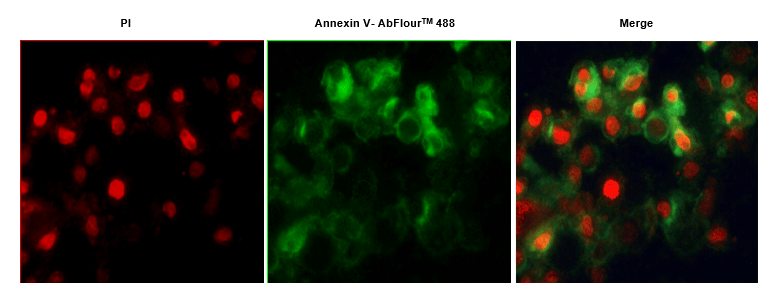
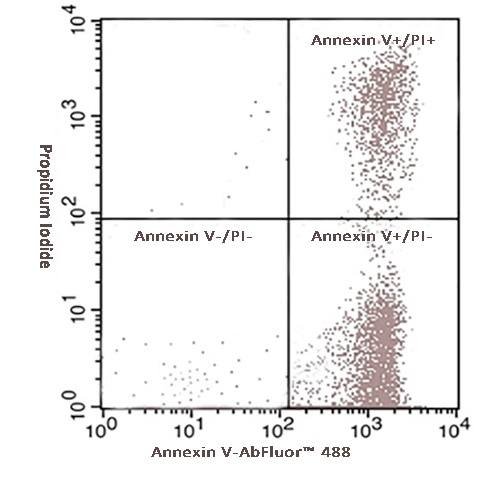
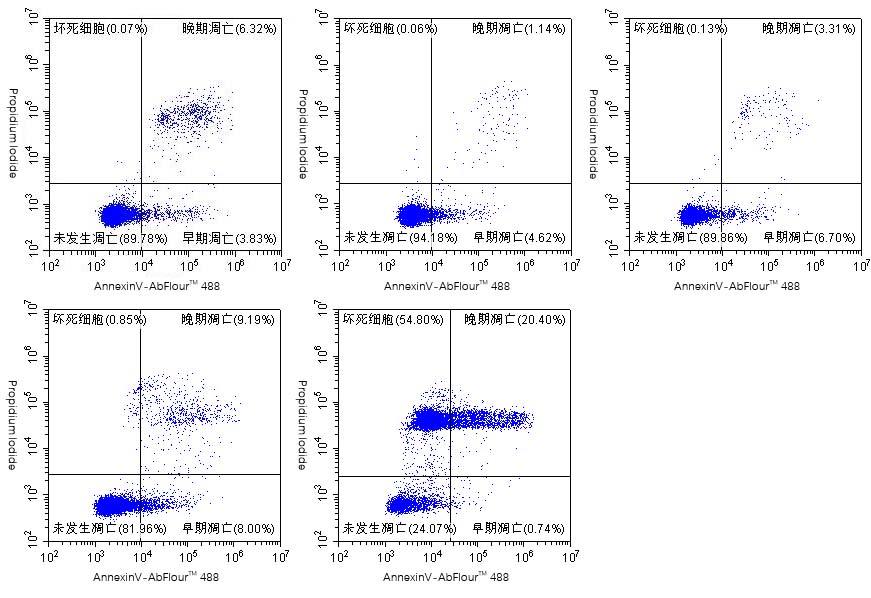
Apoptosis, the orchestrated demise of cells, is a double-edged sword: essential for embryonic development and immune homeostasis, yet hijacked by cancer to evade death or overactivated in neurodegeneration to drive tissue loss. Quantifying this process demands tools that distinguish early apoptotic cells (phosphatidylserine exposure) from late-stage necrosis (membrane rupture)—a challenge traditional assays fail. Staining artifacts, subjective microscopy, and reliance on bulky flow cytometers plague researchers. Abbkine’s CheKine™ Annexin V/Abfluor™ 488 & PI Apoptosis Detection Kit (KTA0002) shatters these barriers, merging Annexin V’s specificity for exposed phosphatidylserine with propidium iodide (PI)’s membrane integrity readout in a streamlined microplate format—turning apoptosis detection into a high-throughput, objective science.
At the heart of KTA0002 lies a dual-fluorescence logic engineered for biological nuance. Annexin V, conjugated to Abbkine’s proprietary Abfluor™ 488 (a bright, photostable green fluorophore), binds phosphatidylserine (PS) translocated to the outer leaflet of apoptotic membranes—marking early-stage death. PI, a red DNA intercalator, penetrates only cells with compromised membranes (late apoptosis/necrosis), staining nuclei to exclude viable cells. This binary readout (Annexin V+/PI− = early apoptosis; Annexin V+/PI+ = late apoptosis/necrosis; Annexin V−/PI− = viable) eliminates ambiguity. Unlike kits using FITC-Annexin V (prone to photobleaching) or ethidium bromide (toxic), KTA0002’s Abfluor™ 488 offers 2x brightness and 30% longer half-life, while PI is pre-optimized to minimize background in serum-containing media.
Technical Prowess: Speed, Sensitivity, and Sample Versatility
KTA0002 redefines apoptosis assay efficiency with three breakthroughs:
• 10-Minute Staining: Annexin V/PI incubation at room temperature (no ice baths) slashes protocol time by 50% vs. 20–30 min kits (e.g., BD Pharmingen 556547).
• Low-Cell-Number Compatibility: Detects apoptosis in 1×10⁴ cells/well (vs. 5×10⁴ for Sigma-Aldrich APOAF-20TST), ideal for rare primary cells (e.g., human iPSC-derived neurons).
• Matrix Resilience: Works in RPMI-1640, DMEM, and even 10% FBS-supplemented media (no need for PBS washes), preserving cell viability during processing.
Validation data confirms: KTA0002 achieves a signal-to-noise ratio of 12:1 (vs. 7:1 for Thermo Fisher A13201), linear dynamic range of 0.1–100% apoptotic cells, and <3% CV across 10 production lots. It handles suspension (Jurkat T cells) and adherent cells (HeLa, primary astrocytes) alike, plus tissue homogenates (e.g., brain sections for Alzheimer’s studies).
Real-World Impact: From Chemoresistant Tumors to CAR-T Toxicity
A oncology team screening cisplatin analogs for ovarian cancer cells switched to KTA0002 after their old kit misclassified necrotic cells as late apoptotic, skewing IC₅₀ values. With KTA0002’s clear quadrant separation, they identified a novel analog inducing 85% early apoptosis (vs. 30% for cisplatin), now in preclinical trials. In Alzheimer’s research, a lab tracking Aβ-induced neuronal death used KTA0002 to show 2x more early apoptosis in hippocampal neurons at 24 hrs post-exposure—data that clarified the timeline of tau pathology. Even in immunotherapy monitoring, a group studying CAR-T cell-induced cytokine release syndrome (CRS) quantified 40% late apoptosis in PBMCs from CRS patients, guiding IL-6 inhibitor dosing.
Market Dominance: Outperforming Legacy Apoptosis Kits
In the Annexin V/PI apoptosis assay market, KTA0002 leads on five axes:
• Fluorophore Quality: Abfluor™ 488 (vs. FITC’s fading) enables imaging and flow compatibility.
• Throughput: 96-well plate format (vs. 24-well for BioLegend 640914) cuts costs by 60%.
• Safety: PI is pre-diluted (no handling of concentrated powder, unlike Sigma’s APOAF).
• Support: Free ImageJ/FlowJo analysis templates (vs. manual gating guides).
• Cost: 499/100 tests (vs. 750 for BD, $680 for Thermo)—with bulk pricing for core facilities processing 500+ samples/month.
Competitors like Cayman Chemical 600480 lack dual-fluorophore optimization (dim signals); Miltenyi Biotec 130-092-052 requires specialized buffers (adds steps). KTA0002’s edge? One kit, two applications—microscopy (green/red fluorescence) or plate readers (ex/em 488/530 nm, 535/617 nm).
Pro Tips for Flawless Apoptosis Profiling
• Adherent Cells: Detach with trypsin-EDTA (≤5 mins) to avoid PS exposure artifacts; keep on ice until staining.
• Tissue Homogenates: Filter through 40 µm mesh to remove debris; centrifuge at 300 ×g for 5 mins (retain pellet for staining).
• Data Analysis: Use 4-quadrant plots (viable/apoptotic/necrotic/dead) with thresholds set at mean ± 2SD of control wells.
The Future of Apoptosis Detection: Beyond Single-Time Points
As apoptosis intersects with ferroptosis, pyroptosis, and immunogenic cell death, demand for multiplexed readouts grows. Abbkine is developing a triple-stain variant (adding caspase-3/7 for execution phase) and a live-cell imaging kit (Annexin V-mCherry/PI) for real-time tracking. KTA0002 is already paving the way: its compatibility with automated liquid handlers (e.g., Tecan Fluent) makes it a cornerstone for AI-driven drug discovery platforms.
In programmed cell death research, clarity separates correlation from causation. Abbkine’s CheKine™ Annexin V/Abfluor™ 488 & PI Apoptosis Detection Kit (KTA0002) delivers that clarity—with fluorescent precision, speed, and versatility that turns apoptosis from a black box into a quantifiable endpoint.
Ready to decode cell death with confidence? Explore the CheKine™ Annexin V/Abfluor™ 488 & PI Apoptosis Detection Kit (KTA0002) and its validation data for cancer, neuroscience, and immunotherapy models at https://www.abbkine.com/product/annexin-v-abfluor-488-pi-apoptosis-detection-kit-kta0002/.





