




Unravel Metabolic Homeostasis with Uncompromising Precision: Abbkine KTB1020 CheKine™ Micro Coenzyme Ⅰ NAD(H) Assay Kit
In the intricate and dynamically regulated landscape of cellular metabolism, nicotinamide adenine dinucleotide (NAD⁺) and its reduced counterpart (NADH) stand as foundational coenzymes and multifunctional signaling molecules, governing an expansive spectrum of essential biological processes. These processes span core energy metabolism—encompassing glycolysis, the tricarboxylic acid (TCA) cycle, and oxidative phosphorylation—as well as redox balance regulation, DNA repair mechanisms, epigenetic modulation of gene expression, and the orchestration of cellular senescence and stress response pathways. The dynamic equilibrium of the NAD⁺/NADH ratio serves as a critical metabolic readout, offering direct insights into cellular physiological status, metabolic flux dynamics, and pathological perturbations associated with a wide array of diseases, including metabolic syndrome, neurodegenerative disorders (e.g., Alzheimer’s and Parkinson’s diseases), various forms of cancer, cardiovascular diseases, and age-related decline. For researchers engaged in deciphering the complexities of metabolic mechanisms with rigorous precision and reproducibility, the Abbkine CheKine™ Micro Coenzyme Ⅰ NAD(H) Assay Kit (Catalog No.: KTB1020) represents a state-of-the-art analytical tool. It enables the accurate, reliable, and simultaneous detection of NAD⁺, NADH, and their critical ratio in a diverse array of biological samples, thereby facilitating in-depth investigations into metabolic homeostasis, its dysregulation in disease, and the development of targeted therapeutic interventions.
The Fundamental Significance of NAD(H) in Metabolic and Translational Research
NAD⁺ and NADH function as central electron and proton carriers in cellular metabolic pathways, establishing an indispensable link between catabolic processes that generate adenosine triphosphate (ATP) and anabolic reactions responsible for the synthesis of lipids, nucleic acids, and proteins. Beyond their core metabolic roles, NAD⁺ serves as a co-substrate for a diverse family of enzymes, including sirtuins (SIRT1–7), poly(ADP-ribose) polymerases (PARPs), and ADP-ribosyltransferases, which mediate vital signaling cascades regulating cell survival, DNA damage repair, circadian rhythms, and aging-related processes. Dysregulation of the NAD⁺/NADH pool—marked by decreased NAD⁺ bioavailability, elevated NADH levels, or altered ratio dynamics—is closely intertwined with the pathogenesis of numerous diseases. For instance, reduced NAD⁺ levels in aged tissues impair mitochondrial function and sirtuin-mediated cellular protection, contributing to the progression of age-related disorders. In diabetes, chronic hyperglycemia leads to increased NADH production via glycolysis, disrupting redox balance and promoting oxidative stress, which exacerbates insulin resistance and vascular complications. In cancer, rapidly proliferating tumor cells often exhibit altered NAD⁺/NADH ratios to support enhanced metabolic demands, making this balance a potential therapeutic target.Historically, the quantification of NAD⁺, NADH, and their ratio has presented significant technical challenges. Conventional analytical methods, such as high-performance liquid chromatography (HPLC) and enzymatic cycling assays, are often constrained by low sensitivity, cumbersome sample preparation procedures, extended analysis times, cross-reactivity with other nucleotides (e.g., NADP⁺, NADPH), and susceptibility to redox imbalance during sample processing. These limitations can lead to inaccurate measurements, irreproducible results, and compromised data interpretation, hindering progress in metabolic research. The Abbkine KTB1020 kit addresses these critical shortcomings through a specialized, microplate-based assay design integrating optimized enzymatic reactions and proprietary reagent formulations, delivering consistent, reproducible, and biologically relevant results that underpin impactful metabolic and translational research endeavors.
Core Technical Attributes and Performance Advantages of the KTB1020 Assay Kit
- Dual Target Detection and Precise Ratio Quantification: A defining feature of the KTB1020 kit is its unique ability to enable the simultaneous and specific quantification of both NAD⁺ and NADH within the same sample, thereby facilitating the direct calculation of the NAD⁺/NADH ratio—a parameter of paramount importance for assessing cellular metabolic status and redox balance. The kit’s optimized enzymatic reaction system employs a highly specific dehydrogenase-coupled assay that selectively targets NAD(H) species, effectively minimizing interference from structurally similar molecules such as NADP⁺, NADPH, and other pyridine nucleotides. This high specificity ensures the accurate determination of each component’s concentration and the precise characterization of their dynamic balance, eliminating the need for separate assays for NAD⁺ and NADH and reducing experimental variability.
- Comprehensive Sample Compatibility and Robustness: Designed to accommodate the diverse needs of metabolic research across multiple model systems, the KTB1020 kit demonstrates exceptional compatibility with a wide range of biological samples, including mammalian cell lysates (adherent and suspension cultures), tissue homogenates (liver, muscle, brain, heart, and adipose tissue), serum, plasma, cerebrospinal fluid, and microbial cultures (bacteria and yeast). The kit’s rigorously optimized sample preparation protocol incorporates redox-stabilizing agents and protease inhibitors, preserving the structural and redox integrity of NAD⁺ and NADH during lysis and processing—even in complex matrices with high proteolytic activity or oxidative potential. This versatility renders the kit suitable for application across diverse research areas, spanning basic metabolic biology, disease model characterization, drug discovery, and preclinical studies.
- Microplate Format for High-Throughput Capability and Efficiency: Featuring a 48T/48S microplate configuration, the KTB1020 kit is specifically tailored to support high-throughput screening initiatives, large-scale experimental designs, and time-course studies—key requirements in modern metabolic research and drug development. This format offers multiple operational advantages: it reduces sample volume requirements (to as low as 1–5 μl per reaction), conserving valuable and often limited biological materials; enables parallel analysis of up to 48 samples in a single assay run, significantly accelerating data acquisition; and integrates seamlessly with standard microplate readers, eliminating the need for specialized equipment. The streamlined workflow—from sample preparation to signal detection—minimizes hands-on time and experimental variability, ensuring robust consistency across technical and biological replicates, which is critical for meeting the statistical rigor required in peer-reviewed research.
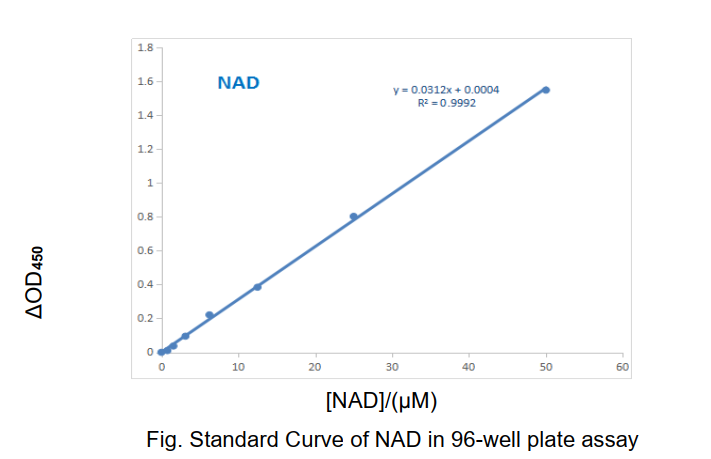
- Superior Sensitivity, Linearity, and Reproducibility: Manufactured using high-purity, quality-controlled reagents and subjected to rigorous optimization of reaction conditions (pH, temperature, cofactor concentrations), the KTB1020 kit exhibits exceptional sensitivity, with a detection limit as low as 0.1 μM for both NAD⁺ and NADH. This enables the reliable quantification of low-abundance NAD(H) levels in samples with limited metabolic activity or small sample volumes, such as primary cells or rare tissue specimens. The assay also demonstrates excellent linearity over a broad dynamic range (0.1 μM to 100 μM), ensuring accurate measurements across physiological and pathological concentration ranges. Each production batch undergoes comprehensive quality control testing, including assessments of specificity, sensitivity, linearity, precision (intra-assay and inter-assay CV < 5%), and lot-to-lot consistency, ensuring that the results generated are reliable, accurate, and compliant with the stringent standards of peer-reviewed research and regulatory requirements. Priced at $149 for 48 tests, the kit offers substantial cost-effectiveness for academic research laboratories, biotechnology enterprises, and pharmaceutical research and development teams engaged in metabolic research, drug screening, and preclinical studies.
- User-Friendly Protocol and Flexibility: The KTB1020 kit is designed with a user-centric workflow that minimizes technical barriers, making it accessible to researchers of varying expertise levels. The protocol involves straightforward steps: sample lysis (using the kit’s provided lysis buffer), reagent addition, incubation at 37°C for a fixed period, and absorbance measurement at a specific wavelength (typically 450 nm) using a standard microplate reader. No specialized training or equipment is required, and the entire assay can be completed within 60–90 minutes, enabling rapid data generation. Additionally, the kit offers flexibility in experimental design, allowing researchers to adjust sample volumes and reaction conditions to accommodate specific sample types or research objectives, further enhancing its utility across diverse applications.
Abbkine: A Trusted Partner in Advancing Metabolic and Translational Research
As a leading provider of high-performance life science research tools, Abbkine is committed to addressing unmet scientific needs through innovation, technical excellence, and rigorous quality standards. The CheKine™ Micro Coenzyme Ⅰ NAD(H) Assay Kit (KTB1020) embodies the brand’s dedication to delivering solutions that combine advanced assay chemistry with user-friendly protocols, simplifying complex metabolic analysis without compromising data integrity or scientific rigor. Abbkine’s manufacturing facilities adhere to ISO 9001 quality management systems, ensuring that each kit is produced under controlled conditions and subjected to comprehensive quality assurance testing. Furthermore, the brand provides extensive technical support, including detailed protocol guides, troubleshooting resources, and expert consultation, to assist researchers in optimizing their experiments and maximizing the value of the kit. This commitment to quality and customer support has established Abbkine as a trusted partner for researchers worldwide, enabling advancements in metabolic biology, disease mechanism research, and therapeutic development.
Advance Your Metabolic Research with the KTB1020 Assay Kit
To overcome the limitations of conventional NAD(H) quantification methods and enhance the precision, efficiency, and reproducibility of metabolic analysis, researchers are invited to adopt the Abbkine KTB1020 CheKine™ Micro Coenzyme Ⅰ NAD(H) Assay Kit. Whether investigating metabolic dysfunction in disease models (e.g., obesity, diabetes, neurodegeneration, cancer), screening small-molecule compounds or natural products that modulate NAD(H) levels or ratio, exploring the role of NAD(H) in aging and age-related disorders, or evaluating the efficacy of metabolic-targeted therapeutics in preclinical studies, this kit provides the analytical rigor, versatility, and reliability required for cutting-edge metabolic and translational research.For detailed technical specifications, comprehensive protocol guides, batch-specific quality control data, or to initiate a purchase, please visit the official product page: https://www.abbkine.com/?s_type=productsearch&s=KTB1020
Join the global community of researchers who trust Abbkine’s innovative tools to advance metabolic research. With the KTB1020 kit, each experiment brings scientists closer to unraveling the intricate complexities of metabolic homeostasis, identifying novel therapeutic targets for diseases associated with NAD(H) dysregulation, and accelerating the translation of basic research findings into clinical applications that improve human health.





