




Unlocking Fluorescence: A Deep Dive into Abbkine's FITC-Conjugated Goat Anti-Rabbit IgG (A22120) for Precision Immunofluorescence
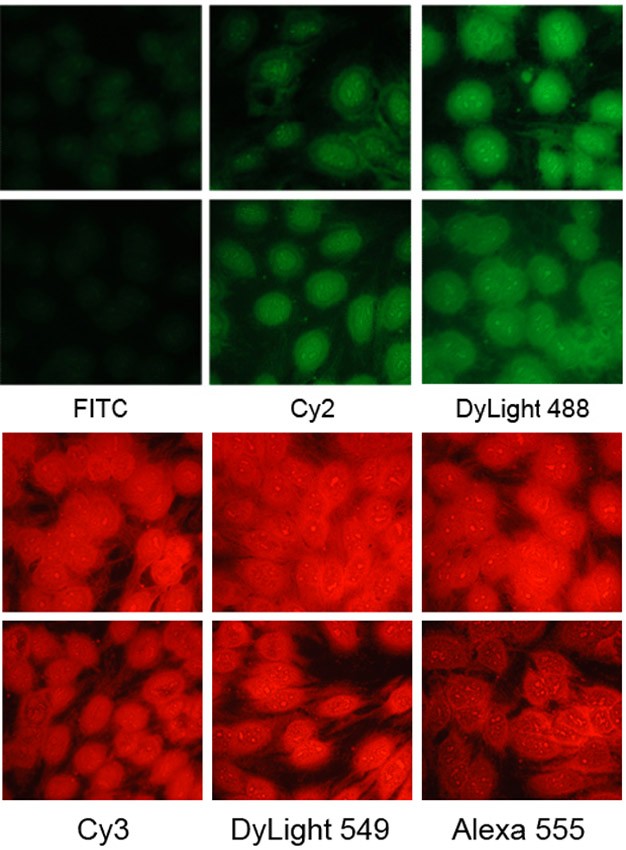
In the intricate world of immunofluorescence microscopy and flow cytometry, the choice of secondary antibody can make or break experimental outcomes. Among the myriad options available, Abbkine’s FITC-conjugated Goat Anti-Rabbit IgG (Catalog #A22120) has emerged as a standout performer, offering researchers a blend of specificity, brightness, and reliability. This article explores why this reagent is becoming indispensable in modern life science labs—and how it aligns with evolving industry demands for high-fidelity detection tools.
Beyond Basic Binding: The Science Behind FITC-Conjugated Secondaries
Fluorescein isothiocyanate (FITC), a classic fluorophore, remains a cornerstone in fluorescence-based assays due to its bright green emission (~520 nm) and compatibility with standard filter sets. When conjugated to highly purified goat anti-rabbit IgG, the resulting reagent acts as a molecular bridge, binding specifically to rabbit-derived primary antibodies attached to target antigens. What sets Abbkine’s A22120 apart is its rigorous purification process, which minimizes cross-reactivity with non-target species—a critical factor in multiplexed experiments where background noise can obscure results. For labs working with complex tissue samples or low-abundance targets, this specificity translates to clearer images and more accurate quantification.
Why Abbkine A22120 Stands Out in a Crowded Market
The global market for secondary antibodies is saturated, yet Abbkine’s A22120 has carved a niche through three key strengths. First, its batch-to-batch consistency: unlike many competitors, Abbkine employs stringent quality control measures, including SDS-PAGE and ELISA validation, ensuring that each lot delivers uniform labeling efficiency. This reliability is particularly valuable in longitudinal studies, where inconsistent reagents can introduce confounding variables. Second, the conjugate’s high molar ratio of FITC to IgG maximizes signal intensity without compromising specificity—ideal for detecting weak primary antibodies or visualizing subtle cellular structures. Third, Abbkine’s commitment to affordability makes advanced fluorescence accessible to academic labs with limited budgets, democratizing access to premium-grade reagents.
Real-World Applications: From Bench to Breakthrough
Consider a researcher studying neuronal apoptosis using a rabbit polyclonal anti-caspase-3 primary antibody. With A22120, the FITC signal clearly delineates activated caspase-3 in dying neurons, even in thick brain sections where autofluorescence might otherwise interfere. In flow cytometry, the reagent enables simultaneous detection of multiple markers when paired with Alexa Fluor® or Cy™ dyes, supporting high-dimensional analyses of immune cell subsets. Its utility extends to ELISA and Western blotting as well, though its true potential shines in applications requiring spatial resolution—like confocal microscopy, where precise localization of proteins in organelles demands a clean, bright signal.
Industry Trends: The Rise of Multiplexing and High-Content Screening
As life science research pivots toward systems biology and precision medicine, the demand for multiplexable, high-sensitivity reagents is surging. FITC-conjugated secondaries like A22120 are at the heart of this shift. For instance, in cancer immunotherapy studies, researchers often co-stain tumor samples with multiple rabbit-derived antibodies (e.g., anti-PD-L1, anti-Ki-67) using different fluorophores. A22120’s compatibility with such workflows allows simultaneous visualization of proliferative and immune checkpoint markers, accelerating insights into treatment response. Moreover, with advances in AI-driven image analysis, the need for uniformly labeled, high-contrast samples has never been greater—making A22120 a strategic investment for labs aiming to stay ahead of the curve.
Optimizing Your Workflow: Tips for Maximizing Performance
To get the most out of A22120, consider these best practices. Always validate the reagent with your specific primary antibody and sample type, as fixation methods (e.g., paraformaldehyde vs. methanol) can affect epitope accessibility. When using in flow cytometry, titrate the secondary antibody to avoid over-labeling, which can cause false-positive aggregates. For imaging, pair A22120 with mounting media containing antifade agents (e.g., DAPI for nuclear counterstaining) to preserve fluorescence over time. And don’t overlook storage: keep the lyophilized powder at -20°C, and reconstituted aliquots at 4°C with minimal light exposure—small steps that extend shelf life and maintain performance.
Looking Ahead: The Future of Fluorescence Reagents
While FITC remains a workhorse fluorophore, the next generation of secondary antibodies will likely integrate brighter, photostable dyes (e.g., Alexa Fluor® 488). Yet, Abbkine’s A22120 continues to hold relevance thanks to its cost-effectiveness and compatibility with legacy equipment. As labs increasingly adopt open-source imaging platforms and collaborative data-sharing initiatives, standardized reagents like A22120 become even more critical for reproducibility—a cornerstone of scientific rigor.
For researchers seeking a trusted, high-performance secondary antibody, Abbkine’s FITC-Goat Anti-Rabbit IgG (A22120) offers a compelling balance of quality, versatility, and value. Whether you’re mapping protein expression in developing embryos or profiling immune cells in disease models, this reagent empowers you to see the invisible—one fluorescent signal at a time. Explore its full specifications and user testimonials https://www.abbkine.com/?s_type=productsearch&s=A22120 to discover how it can elevate your next experiment.





