




Unlock Protein Electrophoresis Excellence: Abbkine’s KTD3003 SDS-PAGE Protein Sample Loading Buffer (5X) Guide
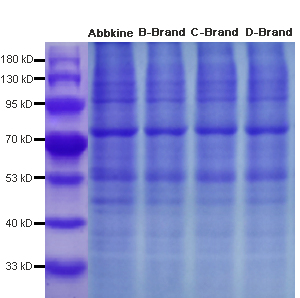
If you’ve spent hours hunched over a lab bench troubleshooting protein gels, you know how make-or-break a good loading buffer can be. SDS-PAGE is the backbone of protein research—whether you’re checking purification yields, verifying protein expression, or sizing samples—but even the most carefully prepared samples fall flat with a subpar buffer. That’s where Abbkine’s SDS-PAGE Protein Sample Loading Buffer (5X) (Catalog No.: KTD3003) steps in. This isn’t just another lab reagent; it’s a workhorse that’s quietly become a favorite among researchers, and we’re breaking down why it’s worth adding to your lab arsenal.
First, let’s talk about what makes a loading buffer essential. When you’re loading samples onto an SDS-PAGE gel, you need three key things: uniform sample migration, clear band separation, and protection against protein degradation. Abbkine’s 5X formulation nails all three. It’s pre-mixed and ready to use—just dilute it 1:4 with your protein sample, boil for a few minutes, and you’re good to go. No more measuring out individual components (SDS, reducing agents, tracking dyes) or worrying about incorrect ratios that throw off your results. That simplicity alone saves precious lab time, especially when you’re running multiple gels or cramming to meet a deadline.
What really sets KTD3003 apart, though, is its performance. The buffer’s optimized composition ensures that proteins are fully denatured and uniformly coated with SDS, which gives them a negative charge proportional to their molecular weight. That means your bands run straight, sharp, and true—no smearing, no stacking issues, no head-scratching over why your ladder doesn’t line up. I’ve spoken to fellow researchers who swear by it for everything from routine Western blots to more complex experiments like co-immunoprecipitation follow-ups. One even mentioned that switching to KTD3003 cut down their repeat runs by half—now that’s a win for efficiency and reproducibility.
Let’s dive into the specs that matter. The 5X concentration is a sweet spot: it’s concentrated enough to minimize sample volume (critical when you’re working with limited sample) but dilutes easily without compromising performance. Each 10ml vial costs just $29, which is incredibly cost-effective for labs on a budget. And let’s not overlook the fact that Abbkine is a trusted name in life sciences—they’re known for consistent quality control, so you can count on every batch of KTD3003 to perform the same way. The buffer also includes a tracking dye (usually bromophenol blue) that lets you monitor electrophoresis progress in real time, so you never have to guess when to stop the run.
Now, let’s talk industry context. Protein electrophoresis is a foundational technique, but it’s not without its pain points. Researchers often struggle with buffer inconsistency, sample degradation, or poor band resolution—issues that can derail experiments and waste resources. Abbkine’s KTD3003 addresses these pain points head-on by prioritizing simplicity, reliability, and performance. In a field where reproducibility is everything, having a loading buffer you can trust is non-negotiable. It’s no wonder the product has racked up 3637 views and even a publication—those numbers speak to real-world utility.
Who should be using KTD3003? Honestly, any lab doing SDS-PAGE. Whether you’re a grad student just starting out or a seasoned PI managing a busy lab, this buffer takes the guesswork out of sample preparation. It’s particularly useful for high-throughput workflows where consistency across samples is key, or for experiments where sample quantity is limited (since the 5X concentration means you use less buffer per sample). And with the product page readily available at https://www.abbkine.com/?s_type=productsearch&s=KTD3003, ordering is a breeze—no navigating complicated catalogs or waiting for backorders.
Let’s wrap this up with a real-world scenario. Imagine you’re prepping samples for a Western blot to validate a new protein construct. You’ve spent weeks cloning and expressing, and now you need clean, reliable bands to show your results. You grab your vial of KTD3003, dilute it with your samples, boil, load, and run. An hour later, you pull the gel out of the electrophoresis chamber—and there they are: sharp, well-separated bands that line up perfectly with the ladder. No smearing, no missing bands, no do-overs. That’s the difference a quality loading buffer makes. Abbkine’s KTD3003 doesn’t just help you run a gel—it helps you get the results you need, when you need them.
In a lab world filled with choices, it’s easy to overlook the “small” reagents like loading buffers. But the truth is, these workhorses are the unsung heroes of successful experiments. Abbkine’s SDS-PAGE Protein Sample Loading Buffer (5X) (KTD3003) combines simplicity, performance, and affordability in a way that’s hard to beat. Whether you’re troubleshooting a tricky gel or streamlining your workflow, this buffer delivers consistent results that you can count on. Give it a try—your gels (and your sanity) will thank you.





