




Unlock DNA Damage Detection: Why Abbkine’s KTA3040 Comet Assay Kit (3-Well Slides) Is a Game-Changer for Researchers
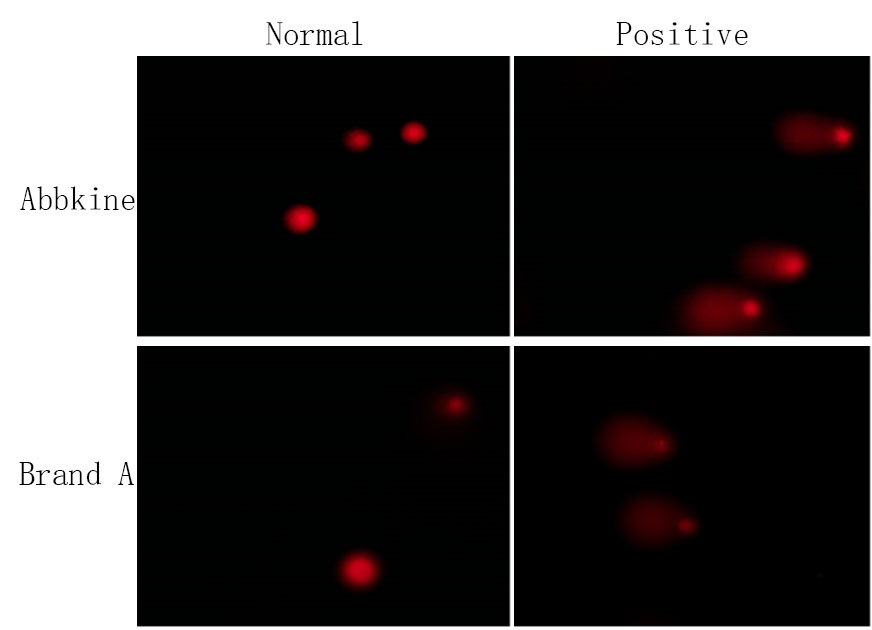
If you’re deep into cell biology or toxicology research, you know how critical it is to spot DNA damage accurately—and fast. Traditional methods? They’re often clunky, time-consuming, or lack the sensitivity needed for early-stage detection. That’s where Abbkine’s Comet Assay Kit (3-Well Slides) comes in, with its handy KTA3040. This isn’t just another lab tool; it’s a streamlined solution that’s quietly revolutionizing how researchers approach single-cell DNA damage analysis. Let’s break down why it’s become a must-have for labs worldwide.
First off, let’s get back to the basics: what even is a comet assay? For those who might need a quick refresher, it’s short for Single Cell Gel Electrophoresis (SCGE)—a technique that visualizes DNA breaks in individual cells. Imagine each cell as a tiny nucleus; when DNA is damaged, the broken fragments migrate away from the core during electrophoresis, forming a “comet tail.” The length and intensity of that tail? They tell you exactly how much damage there is. But here’s the thing: not all comet assay kits are created equal. Abbkine’s KTA3040 stands out because it’s built for practicality—3-well slides mean you can run multiple samples (or controls) side by side without juggling extra equipment. No more wasting time on complicated setups or dealing with slides that don’t fit standard lab gear. It’s designed to work with what you already have, which is a huge win for busy researchers.
What really sells this kit, though, is its speed and sensitivity. Let’s be real—research deadlines wait for no one. The KTA3040 delivers rapid results without cutting corners on accuracy. Unlike some kits that require overnight incubations or tedious sample prep, this one streamlines the process so you can get from sample to data faster. And sensitivity? It picks up even subtle DNA damage that might slip through the cracks with less advanced tools. That’s a big deal for fields like toxicology, where detecting low-level damage can mean the difference between a breakthrough and a missed insight. Whether you’re studying environmental toxins, drug effects, or disease mechanisms, having a kit that can reliably spot small changes in DNA integrity is invaluable.
Let’s talk about real-world application, because that’s what matters most. Labs using the KTA3040 have reported smoother workflows and more consistent results. The 3-well slide design is a small detail that makes a big difference—you can test multiple conditions in one go, reducing variability and saving on reagents. And since it’s from Abbkine, a brand known for quality in life science tools, you don’t have to worry about batch-to-batch inconsistencies. Researchers have used this kit to study everything from the effects of nanoparticles on cell DNA to DNA repair mechanisms in cancer cells. The versatility here is key; it’s not limited to one field or application, which makes it a smart investment for labs with diverse research goals.
Pricing is another factor to consider, and the KTA3040 hits a sweet spot at $299 for 15 tests. When you compare it to other high-sensitivity comet assay kits on the market, which can easily run $400 or more for fewer tests, this is a cost-effective option without sacrificing performance. For labs working with tight budgets (let’s be honest, most are), getting more tests for less money means you can expand your experiments or run more replicates—something that directly boosts the reliability of your data. It’s not just about saving cash; it’s about enabling better research.
Now, let’s touch on why this kit matters for the broader scientific community. DNA damage detection is foundational to so many areas: understanding disease progression, developing new therapeutics, assessing environmental risks. Tools like the KTA3040 make this foundational work more accessible. Early-career researchers don’t have to struggle with overly complex kits to get meaningful results, and established labs can increase their throughput without compromising on quality. In an era where scientific progress relies on speed and reproducibility, Abbkine’s KTA3040 checks both boxes. It’s a tool that empowers researchers to ask bigger questions and get answers faster.
If you’re on the fence about trying it, just look at the product page (https://www.abbkine.com/?s_type=productsearch&s=KTA3040) for yourself. The kit’s simplicity, combined with its powerful performance, has earned it positive feedback from researchers across disciplines. It’s not often that a lab tool manages to be both user-friendly and highly sensitive, but the KTA3040 pulls it off. Whether you’re a seasoned researcher or just starting out, this comet assay kit takes the hassle out of DNA damage detection so you can focus on what really matters—your research.
In the end, Abbkine’s KTA3040 Comet Assay Kit (3-Well Slides) isn’t just a product; it’s a solution to a common pain point in labs everywhere. It’s fast, sensitive, cost-effective, and designed with the researcher in mind. As the demand for reliable single-cell analysis grows, tools like this will keep driving scientific progress forward. If you haven’t tried it yet, now’s the time—your experiments (and your deadlines) will thank you.





