| Product name | TTR Mouse Monoclonal Antibody (1D7) |
| Immunogen | Recombinant Protein of TTR |
| Host | Mouse |
| Reactivity | Human |
| Applications | IF,WB,IHC |
| Applications notes | Optimal working dilutions should be determined experimentally by the investigator. Suggested starting dilutions are as follows: IF 1:50-200;WB 1:500-2000;IHC 1:50-300 |
| Clonality | Monoclonal |
| Preparation method | The antibody was affinity-purified from mouse antiserum by affinity-chromatography using epitope-specific immunogen. |
| Alternative | Transthyretin; ATTR; Prealbumin; TBPA |
| Formulation | Liquid solution |
| Concentration | 1 mg/ml |
| Molecular weight | 16kD |
| Storage buffer | Liquid in PBS containing 50% glycerol, 0.5% BSA and 0.02% sodium azide. |
| Storage instructions | Stable for one year at -20°C from date of shipment. For maximum recovery of product, centrifuge the original vial after thawing and prior to removing the cap. Aliquot to avoid repeated freezing and thawing. |
| Shipping | Gel pack with blue ice. |
| Precautions | The product listed herein is for research use only and is not intended for use in human or clinical diagnosis. Suggested applications of our products are not recommendations to use our products in violation of any patent or as a license. We cannot be responsible for patent infringements or other violations that may occur with the use of this product. |
| Background | TTR (transthyretin) encodes transthyretin, one of the three prealbumins including alpha-1-antitrypsin, transthyretin and orosomucoid. Transthyretin is a carrier protein; it transports thyroid hormones in the plasma and cerebrospinal fluid, and also transports retinol (vitamin A) in the plasma. The protein consists of a tetramer of identical subunits. More than 80 different mutations in TTR have been reported; most mutations are related to amyloid deposition, affecting predominantly peripheral nerve and/or the heart, and a small portion of the gene mutations is non-amyloidogenic. The diseases caused by mutations include amyloidotic polyneuropathy, euthyroid hyperthyroxinaemia, amyloidotic vitreous opacities, cardiomyopathy, oculoleptomeningeal amyloidosis, meningocerebrovascular amyloidosis, carpal tunnel syndrome, etc. |
| Gene ID | 7276 |
| Alternative | Transthyretin; ATTR; Prealbumin; TBPA |
| Others | The antibody detects endogenous TTR protein. |
| Accession | P02766 |
| Observed Band(KD) | 16 |
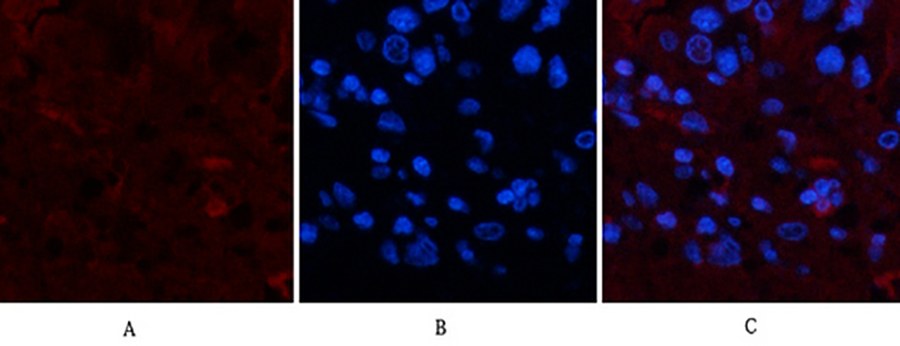
Fig.1. Immunofluorescence analysis of human liver cancer tissue. 1, TTR Mouse Monoclonal Antibody (1D7) (red) was diluted at 1:200 (4°C, overnight). 2, Cy3 Labeled secondary antibody was diluted at 1:300 (room temperature, 50min). 3, Picture B: DAPI (blue) 10min. Picture A: Target. Picture B: DAPI. Picture C: merge of A+B.
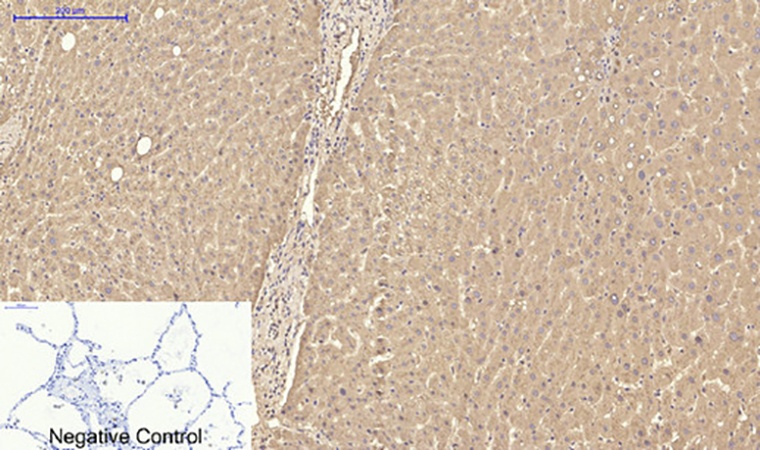
Fig.2. Immunohistochemical analysis of paraffin-embedded human lung tissue. 1, TTR Mouse Monoclonal Antibody (1D7) was diluted at 1:200 (4°C, overnight). 2, Sodium citrate pH 6.0 was used for antibody retrieval (>98°C, 20min). 3, secondary antibody was diluted at 1:200 (room temperature, 30min). Negative control was used by secondary antibody only.
You must be logged in to post a review.











Reviews
There are no reviews yet.