| Product name | Ran Polyclonal Antibody |
| Immunogen | Synthesized peptide derived from the C-terminal region of human Ran at AA range: 140-220 |
| Host | Rabbit |
| Reactivity | Human,Mouse,Rat |
| Applications | WB,IHC,IF,ELISA |
| Applications notes | Optimal working dilutions should be determined experimentally by the investigator. Suggested starting dilutions are as follows: WB 1:500-1:2000;IHC 1:100-1:300;ELISA 1:10000;IF 1:50-200 |
| Clonality | Polyclonal |
| Preparation method | The antibody was affinity-purified from rabbit antiserum by affinity-chromatography using epitope-specific immunogen. |
| Alternative | RAN; ARA24; OK/SW-cl.81; GTP-binding nuclear protein Ran; Androgen receptor-associated protein 24; GTPase Ran; Ras-like protein TC4; Ras-related nuclear protein |
| Formulation | Liquid solution |
| Concentration | 1 mg/ml |
| Molecular weight | 25kD |
| Storage buffer | Liquid in PBS containing 50% glycerol, 0.5% BSA and 0.02% sodium azide. |
| Storage instructions | Stable for one year at -20°C from date of shipment. For maximum recovery of product, centrifuge the original vial after thawing and prior to removing the cap. Aliquot to avoid repeated freezing and thawing. |
| Shipping | Gel pack with blue ice. |
| Precautions | The product listed herein is for research use only and is not intended for use in human or clinical diagnosis. Suggested applications of our products are not recommendations to use our products in violation of any patent or as a license. We cannot be responsible for patent infringements or other violations that may occur with the use of this product. |
| Background | RAN (ras-related nuclear protein) is a small GTP binding protein belonging to the RAS superfamily that is essential for the translocation of RNA and proteins through the nuclear pore complex. The RAN protein is also involved in control of DNA synthesis and cell cycle progression. Nuclear localization of RAN requires the presence of regulator of chromosome condensation 1 (RCC1). Mutations in RAN disrupt DNA synthesis. Because of its many functions, it is likely that RAN interacts with several other proteins. RAN regulates formation and organization of the microtubule network independently of its role in the nucleus-cytosol exchange of macromolecules. RAN could be a key signaling molecule regulating microtubule polymerization during mitosis. RCC1 generates a high local concentration of RAN-GTP around chromatin which, in turn, induces the local nucleation of microtubules. RAN is an androgen receptor (AR) coactivator that binds differentially with different lengths of polyglutamine within the androgen receptor. Polyglutamine repeat expansion in the AR is linked to Kennedy's disease (X-linked spinal and bulbar muscular atrophy). RAN coactivation of the AR diminishes with polyglutamine expansion within the AR, and this weak coactivation may lead to partial androgen insensitivity during the development of Kennedy's disease. |
| Gene ID | 5901 |
| Alternative | RAN; ARA24; OK/SW-cl.81; GTP-binding nuclear protein Ran; Androgen receptor-associated protein 24; GTPase Ran; Ras-like protein TC4; Ras-related nuclear protein |
| Others | Ran Polyclonal Antibody detects endogenous levels of Ran protein. |
| Accession | P62826 |
| Observed Band(KD) | 25 |
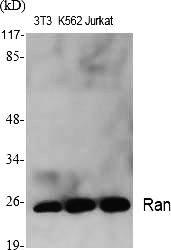
Fig. Western Blot analysis of various cells using Ran Polyclonal Antibody diluted at 1:2000.
You must be logged in to post a review.











Reviews
There are no reviews yet.