| Product name | p16 (phospho Ser326) Polyclonal Antibody |
| Immunogen | Synthesized peptide derived from human p16 around the phosphorylation site of S326 |
| Host | Rabbit |
| Reactivity | Human, |
| Applications | WB,IHC,IF,ELISA |
| Applications notes | Optimal working dilutions should be determined experimentally by the investigator. Suggested starting dilutions are as follows: WB 1:500-1:2000;IHC 1:100-1:300;ELISA 1:5000;IF 1:50-200 |
| Clonality | Polyclonal |
| Preparation method | The antibody was affinity-purified from rabbit antiserum by affinity-chromatography using epitope-specific immunogen. |
| Alternative | CDKN2A; CDKN2; MTS1; Cyclin-dependent kinase inhibitor 2A; isoforms 1/2/3; Cyclin-dependent kinase 4 inhibitor A; CDK4I; Multiple tumor suppressor 1; MTS-1; p16-INK4a; p16-INK4; p16INK4A |
| Formulation | Liquid solution |
| Concentration | 1 mg/ml |
| Molecular weight | 20kD |
| Storage buffer | Liquid in PBS containing 50% glycerol, 0.5% BSA and 0.02% sodium azide. |
| Storage instructions | Stable for one year at -20°C from date of shipment. For maximum recovery of product, centrifuge the original vial after thawing and prior to removing the cap. Aliquot to avoid repeated freezing and thawing. |
| Shipping | Gel pack with blue ice. |
| Precautions | The product listed herein is for research use only and is not intended for use in human or clinical diagnosis. Suggested applications of our products are not recommendations to use our products in violation of any patent or as a license. We cannot be responsible for patent infringements or other violations that may occur with the use of this product. |
| Background | CDKN2A generates several transcript variants which differ in their first exons. At least three alternatively spliced variants encoding distinct proteins have been reported, two of which encode structurally related isoforms known to function as inhibitors of CDK4 kinase. The remaining transcript includes an alternate first exon located 20 Kb upstream of the remainder of the gene; this transcript contains an alternate open reading frame (ARF) that specifies a protein which is structurally unrelated to the products of the other variants. This ARF product functions as a stabilizer of the tumor suppressor protein p53 as it can interact with, and sequester, the E3 ubiquitin-protein ligase MDM2, a protein responsible for the degradation of p53. In spite of the structural and functional differences, the CDK inhibitor isoforms and the ARF product encoded by this gene, through the regulatory roles of CDK4 and p53 in cell cycle G1 progression, share a common functionality in cell cycle G1 control. This gene is frequently mutated or deleted in a wide variety of tumors, and is known to be an important tumor suppressor gene. |
| Gene ID | 1029 |
| Alternative | CDKN2A; CDKN2; MTS1; Cyclin-dependent kinase inhibitor 2A; isoforms 1/2/3; Cyclin-dependent kinase 4 inhibitor A; CDK4I; Multiple tumor suppressor 1; MTS-1; p16-INK4a; p16-INK4; p16INK4A |
| Others | Phospho-p16 (S326) Polyclonal Antibody detects endogenous levels of p16 protein only when phosphorylated at S326. |
| Accession | P42771 |
| Observed Band(KD) | 20 |
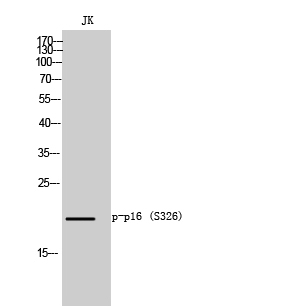
Fig.1. Western Blot analysis of JK cells using Phospho-p16 (S326) Polyclonal Antibody diluted at 1:500.
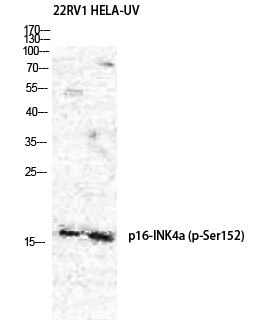
Fig.2. Western Blot analysis of 22RV1 HELA cells using Phospho-p16 (S326) Polyclonal Antibody diluted at 1:500.
You must be logged in to post a review.











Reviews
There are no reviews yet.