| Product name | FGFR-4 Polyclonal Antibody |
| Immunogen | Synthesized peptide derived from the Internal region of human FGFR-4 |
| Host | Rabbit |
| Reactivity | Human,Rat,Mouse, |
| Applications | WB,ELISA |
| Applications notes | Optimal working dilutions should be determined experimentally by the investigator. Suggested starting dilutions are as follows: WB 1:500-1:2000;ELISA 1:10000;Not yet tested in other applications. |
| Clonality | Polyclonal |
| Preparation method | The antibody was affinity-purified from rabbit antiserum by affinity-chromatography using epitope-specific immunogen. |
| Alternative | FGFR4; JTK2; TKF; Fibroblast growth factor receptor 4; FGFR-4; CD334 |
| Formulation | Liquid solution |
| Concentration | 1 mg/ml |
| Molecular weight | 85kD |
| Storage buffer | Liquid in PBS containing 50% glycerol, 0.5% BSA and 0.02% sodium azide. |
| Storage instructions | Stable for one year at -20°C from date of shipment. For maximum recovery of product, centrifuge the original vial after thawing and prior to removing the cap. Aliquot to avoid repeated freezing and thawing. |
| Shipping | Gel pack with blue ice. |
| Precautions | The product listed herein is for research use only and is not intended for use in human or clinical diagnosis. Suggested applications of our products are not recommendations to use our products in violation of any patent or as a license. We cannot be responsible for patent infringements or other violations that may occur with the use of this product. |
| Background | The protein encoded by FGFR4 (fibroblast growth factor receptor 4) is a member of the fibroblast growth factor receptor family, where amino acid sequence is highly conserved between members and throughout evolution. FGFR family members differ from one another in their ligand affinities and tissue distribution. A full-length representative protein would consist of an extracellular region, composed of three immunoglobulin-like domains, a single hydrophobic membrane-spanning segment and a cytoplasmic tyrosine kinase domain. The extracellular portion of the protein interacts with fibroblast growth factors, setting in motion a cascade of downstream signals, ultimately influencing mitogenesis and differentiation. The genomic organization of FGFR4, compared to members 1-3, encompasses 18 exons rather than 19 or 20. Although alternative splicing has been observed, there is no evidence that the C-terminal half of the IgIII domain of this protein varies between three alternate forms, as indicated for members 1-3. This particular family member preferentially binds acidic fibroblast growth factor and, although its specific function is unknown, it is overexpressed in gynecological tumor samples, suggesting a role in breast and ovarian tumorigenesis. |
| Gene ID | 2264 |
| Alternative | FGFR4; JTK2; TKF; Fibroblast growth factor receptor 4; FGFR-4; CD334 |
| Others | FGFR-4 Polyclonal Antibody detects endogenous levels of FGFR-4 protein. |
| Accession | P22455 |
| Observed Band(KD) | 85 |
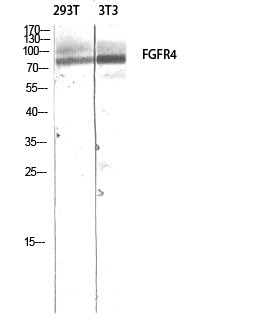
Fig. Western blot analysis of 293T 3T3 lysis using FGFR4 antibody. Antibody was diluted at 1:500. Secondary antibody (catalog#: A21020) was diluted at 1:20000.
You must be logged in to post a review.











Reviews
There are no reviews yet.