| Product name | FBN1 Polyclonal Antibody |
| Immunogen | Synthesized peptide derived from the C-terminal region of human FBN1 at AA rangle: 2780-2860 |
| Host | Rabbit |
| Reactivity | Human,Mouse,Rat |
| Applications | WB,IHC,IF,ELISA |
| Applications notes | Optimal working dilutions should be determined experimentally by the investigator. Suggested starting dilutions are as follows: WB 1:500-1:2000;IHC 1:100-1:300;ELISA 1:20000;IF 1:50-200 |
| Clonality | Polyclonal |
| Preparation method | The antibody was affinity-purified from rabbit antiserum by affinity-chromatography using epitope-specific immunogen. |
| Alternative | FBN1; FBN; Fibrillin-1 |
| Formulation | Liquid solution |
| Concentration | 1 mg/ml |
| Storage buffer | Liquid in PBS containing 50% glycerol, 0.5% BSA and 0.02% sodium azide. |
| Storage instructions | Stable for one year at -20°C from date of shipment. For maximum recovery of product, centrifuge the original vial after thawing and prior to removing the cap. Aliquot to avoid repeated freezing and thawing. |
| Shipping | Gel pack with blue ice. |
| Precautions | The product listed herein is for research use only and is not intended for use in human or clinical diagnosis. Suggested applications of our products are not recommendations to use our products in violation of any patent or as a license. We cannot be responsible for patent infringements or other violations that may occur with the use of this product. |
| Background | FBN1 encodes a member of the fibrillin family of proteins. The encoded preproprotein is proteolytically processed to generate two proteins including the extracellular matrix component fibrillin-1 and the protein hormone asprosin. Fibrillin-1 is an extracellular matrix glycoprotein that serves as a structural component of calcium-binding microfibrils. These microfibrils provide force-bearing structural support in elastic and nonelastic connective tissue throughout the body. Asprosin, secreted by white adipose tissue, has been shown to regulate glucose homeostasis. Mutations in this gene are associated with Marfan syndrome and the related MASS phenotype, as well as ectopia lentis syndrome, Weill-Marchesani syndrome, Shprintzen-Goldberg syndrome and neonatal progeroid syndrome. |
| Gene ID | 2200 |
| Alternative | FBN1; FBN; Fibrillin-1 |
| Others | FBN1 Polyclonal Antibody detects endogenous levels of FBN1 protein. |
| Accession | P35555 |
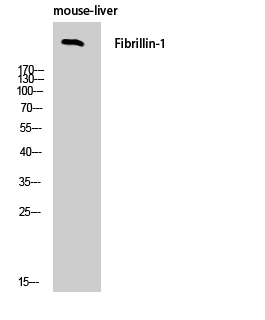
Fig. Western Blot analysis of Mouse-liver cells using FBN1 Polyclonal Antibody.
You must be logged in to post a review.











Reviews
There are no reviews yet.