| Product name | CD72 Polyclonal Antibody |
| Immunogen | Synthesized peptide derived from the Internal region of human CD72 |
| Host | Rabbit |
| Reactivity | Human,Mouse |
| Applications | WB,IHC,IF,ELISA |
| Applications notes | Optimal working dilutions should be determined experimentally by the investigator. Suggested starting dilutions are as follows: IHC: 100-300;WB 1:500-1:2000;ELISA 1:10000;IF 1:50-200 |
| Clonality | Polyclonal |
| Preparation method | The antibody was affinity-purified from rabbit antiserum by affinity-chromatography using epitope-specific immunogen. |
| Alternative | CD72; B-cell differentiation antigen CD72; Lyb-2; CD72 |
| Formulation | Liquid solution |
| Concentration | 1 mg/ml |
| Molecular weight | 40kD |
| Storage buffer | Liquid in PBS containing 50% glycerol, 0.5% BSA and 0.02% sodium azide. |
| Storage instructions | Stable for one year at -20°C from date of shipment. For maximum recovery of product, centrifuge the original vial after thawing and prior to removing the cap. Aliquot to avoid repeated freezing and thawing. |
| Shipping | Gel pack with blue ice. |
| Precautions | The product listed herein is for research use only and is not intended for use in human or clinical diagnosis. Suggested applications of our products are not recommendations to use our products in violation of any patent or as a license. We cannot be responsible for patent infringements or other violations that may occur with the use of this product. |
| Background | CD5 has been identified as a transmembrane glycoprotein that is expressed on 70% of normal peripheral blood lymphocytes and on virtually all T lymphocytes in thymus and peripheral blood. Activation of T cells through the T cell receptor (TCR) results in tyrosine phosphorylation of CD5, and the absence of CD5 renders T cells hyper-responsive to TCR-mediated activation. CD5 associates with the TCR/CD3 ζ chain, and with the Src family kinase, Lck p56. The C-type lectin superfamily member CD72 is a cell surface negative regulator of B cell activation from the pro-B through the mature B cell stage. CD72 serves as a receptor for CD5. The ability of lymphocytes to respond to antigenic or mitogenic stimulation utilizes both positive and negative regulatory proteins that influence the threshold for responsiveness. The human CD72 gene maps to chromosome 9p13.3 and encodes a transmembrane glycoprotein that contains an immunoreceptor tyrosine-based inhibition motif (ITIM). Upon tyrosine phosphorylation, the CD72 ITIM recruits SH2-containing phosphatases such as SHP-1, resulting in downregulation of cell activation. CD72-/- mice contain hyperproliferative B cells. |
| Gene ID | 971 |
| Alternative | CD72; B-cell differentiation antigen CD72; Lyb-2; CD72 |
| Others | CD72 Polyclonal Antibody detects endogenous levels of CD72 protein. |
| Accession | P21854 |
| Observed Band(KD) | 40 |
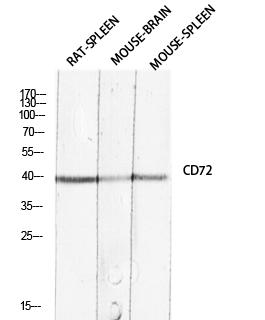
Fig.1. Western blot analysis of RAT-SPLEEN Mouse-BRAIN Mouse-SPLEEN lysis using CD72 antibody. Antibody was diluted at 1:2000. Secondary antibody (catalog#: A21020) was diluted at 1:20000.
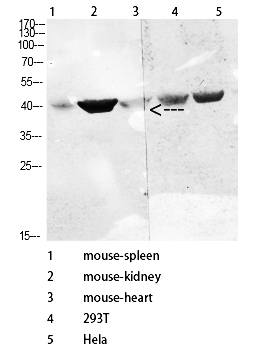
Fig.2. Western Blot analysis of various cells using Antibody diluted at 1:1000. Secondary antibody (catalog#: A21020) was diluted at 1:20000.
You must be logged in to post a review.











Reviews
There are no reviews yet.