| Product name | ATG5 Mouse Monoclonal Antibody (3C7) |
| Immunogen | Recombinant Protein of ATG5 |
| Host | Mouse |
| Reactivity | Human,Mouse, |
| Applications | WB,IF,ELISA |
| Applications notes | Optimal working dilutions should be determined experimentally by the investigator. Suggested starting dilutions are as follows: WB 1:500-2000;IF 1:100-500;ELISA 1:1000-5000 |
| Clonality | Monoclonal |
| Preparation method | Protein G |
| Alternative | Autophagy protein 5; APG5-like; Apoptosis-specific protein |
| Formulation | Liquid solution |
| Concentration | 1 mg/ml |
| Molecular weight | 55kD |
| Storage buffer | PBS, 50% glycerol, 0.05% Proclin 300, 0.05%BSA |
| Storage instructions | Stable for one year at -20°C from date of shipment. For maximum recovery of product, centrifuge the original vial after thawing and prior to removing the cap. Aliquot to avoid repeated freezing and thawing. |
| Shipping | Gel pack with blue ice. |
| Precautions | The product listed herein is for research use only and is not intended for use in human or clinical diagnosis. Suggested applications of our products are not recommendations to use our products in violation of any patent or as a license. We cannot be responsible for patent infringements or other violations that may occur with the use of this product. |
| Background | ATG5, also named as APG5L and ASP, belongs to the ATG5 family. It is required for autophagy. It plays an important role in the apoptotic process, possibly within the modified cytoskeleton. Its expression is a relatively late event in the apoptotic process, occurring downstream of caspase activity. Autophagy is a catabolic process for the autophagosomic-lysosomal degradation of bulk cytoplasmic contents. Formation of the autophagosome involves a ubiquitin-like conjugation system in which Atg12 is covalently bound to Atg5 and targeted to autophagosome vesicles. It mediates autophagosome-independent host protection. |
| Gene ID | 9494 |
| Alternative | Autophagy protein 5; APG5-like; Apoptosis-specific protein |
| Others | The antibody detects endogenous ATG5 protein. |
| Accession | Q9H1Y0 |
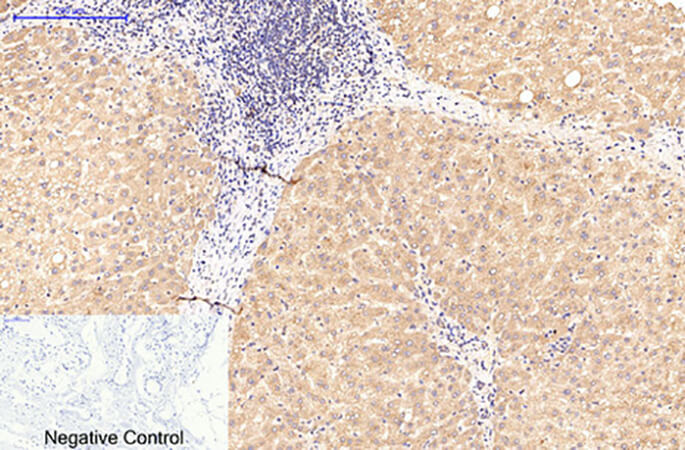
Fig.1. Immunohistochemical analysis of paraffin-embedded human breast tissue. 1, ATG5 Mouse Monoclonal Antibody (3C7) was diluted at 1:200 (4°C, overnight). 2, Sodium citrate pH 6.0 was used for antibody retrieval (>98°C, 20min). 3, secondary antibody was diluted at 1:200 (room temperature, 30min). Negative control was used by secondary antibody only.
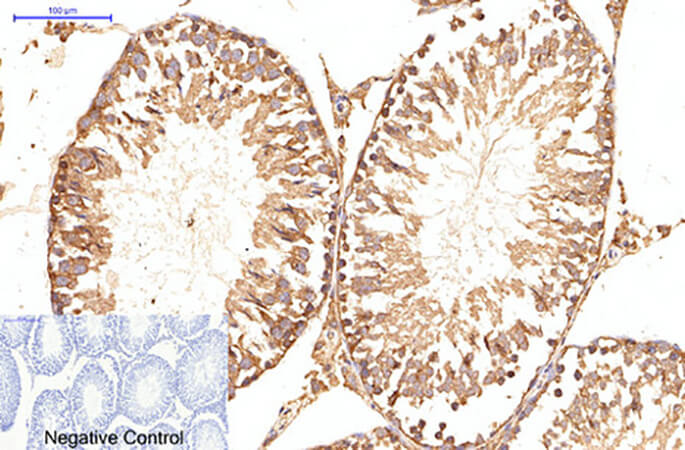
Fig.2. Immunohistochemical analysis of paraffin-embedded rat testis tissue. 1, ATG5 Mouse Monoclonal Antibody (3C7) was diluted at 1:200 (4°C, overnight). 2, Sodium citrate pH 6.0 was used for antibody retrieval (>98°C, 20min). 3, secondary antibody was diluted at 1:200 (room temperature, 30min). Negative control was used by secondary antibody only.
You must be logged in to post a review.











Reviews
There are no reviews yet.