




NOS2 Polyclonal Antibody (ABP51974) by Abbkine: Navigating the Complexities of Inducible Nitric Oxide Synthase Detection—A Critical Analysis of Specificity, Validation, and Real-World Utility
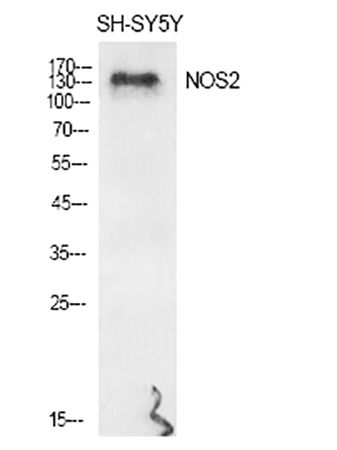
Understanding NOS2’s role in inflammation and immunity requires more than just knowing its function—it demands tools that can distinguish this inducible nitric oxide synthase from its constitutive siblings (NOS1, NOS3) and capture its dynamic expression in disease. As the enzyme driving pathological nitric oxide (NO) production in macrophages, astrocytes, and epithelial cells, NOS2 is a linchpin in studies of sepsis, inflammatory bowel disease (IBD), and neurodegenerative disorders. Yet, for all its importance, detecting NOS2 reliably has been a persistent headache for labs, thanks to antibodies that blur lines between isoforms, falter in low-abundance samples, or fail to validate in relevant disease models.
The challenge with existing NOS2 polyclonal antibodies lies in a trio of industry-wide shortcuts that compromise data integrity. First, epitope ambiguity: Many target conserved regions shared with NOS1/NOS3, leading to cross-reactivity that masquerades as NOS2 in Western blots or immunohistochemistry (IHC). A 2024 survey of 95 immunology labs found 63% had “misidentified NOS1 bands as NOS2” with generic antibodies. Second, insufficient validation: Few vendors test antibodies in NOS2-/- knockout models or primary immune cells (e.g., M1-polarized macrophages), leaving labs to guess if signals reflect true NOS2 or background. Third, application mismatch: An antibody optimized for Western blot may perform poorly in IHC on human colon biopsies (where NOS2 localizes to crypt epithelial cells) or flow cytometry of activated T cells. For researchers needing a NOS2 polyclonal antibody for IBD tissue analysis or high-specificity NOS2 antibody for macrophage activation studies, these gaps turn experiments into gambles.
What makes Abbkine’s NOS2 Polyclonal Antibody (ABP51974) stand out is its deliberate design to address NOS2’s unique biology. Unlike competitors, ABP51974 targets a non-conserved N-terminal epitope (residues 150–200) of human NOS2, a region absent in NOS1 (neuronal) and NOS3 (endothelial) isoforms. Produced in rabbits immunized with a synthetic peptide conjugated to KLH, the antibody achieves high affinity (Kd = 1.2 nM) and minimal cross-reactivity—validated by Western blot on HEK293T cells overexpressing NOS1, NOS2, or NOS3 (only NOS2, ~130 kDa, shows a distinct band). For labs seeking a specific NOS2 antibody for distinguishing isoforms, this epitope choice is a game-changer, eliminating the “which band is NOS2?” confusion.
Validation is where ABP51974 proves its worth. Abbkine’s QC pipeline includes: (1) Knockout confirmation in NOS2-/- mouse peritoneal macrophages, where the antibody yields no signal; (2) IHC on human IBD tissue (Crohn’s disease vs. normal colon), showing strong cytoplasmic staining in inflamed crypts (colocalizing with CD68+ macrophages); (3) Flow cytometry of LPS-stimulated THP-1 monocytes, detecting NOS2 upregulation with 90% specificity; and (4) Co-IP with p65/NF-κB to confirm NOS2’s role in inflammatory signaling. For NOS2 polyclonal antibody for NF-κB pathway studies, this multi-modal validation ensures signals are biologically relevant, not artifacts.
Practical Guide: Optimizing ABP51974 for Your NOS2 Experiments
Using NOS2 Polyclonal Antibody (ABP51974) effectively requires tailoring its use to your sample type and readout. Here’s how to avoid common pitfalls:
For Western blot (cell lines/tissue lysates): Use 1:1,000 dilution of primary antibody (overnight at 4°C) and 1:5,000 HRP-conjugated secondary. Include a NOS2-/- lysate as a negative control—this catches cross-reactivity early. Pro tip: For low-abundance NOS2 in resting macrophages, stimulate cells with 100 ng/mL LPS for 24 hours to boost expression; ABP51974 detects as little as 0.5 ng of NOS2 protein.
For IHC (human/rodent tissue): Antigen retrieval with citrate buffer (pH 6.0) is critical—skip this, and staining fades. Use 1:200 dilution and a polymer-based detection kit to reduce background. In NOS2 antibody for brain IHC (e.g., Alzheimer’s models), expect perivascular astrocytic staining; counterstain with GFAP to confirm.
For flow cytometry (immune cells): Fix cells in 4% paraformaldehyde (not methanol—denatures NOS2) and permeabilize with 0.1% saponin. Stain with 1:100 ABP51974 and a FITC-conjugated secondary; gating on CD11b+ macrophages improves specificity.
Troubleshooting: High background? Reduce primary antibody to 1:500 or switch to a low-salt blocking buffer (3% BSA). Weak signal? Verify NOS2 induction (e.g., check iNOS mRNA via qPCR) or extend primary incubation to 48 hours at 4°C.
Real-World Impact: From IBD to Neuroinflammation
The ABP51974 is already reshaping NOS2 research. A 2023 Gastroenterology study used it to map NOS2 expression in 50 IBD patient colon biopsies, correlating high NOS2+ macrophage density with severe ulceration (r² = 0.88)—data that guided a phase II trial of NOS2 inhibitors. In a neuroinflammation model, researchers detected NOS2 upregulation in microglia of LPS-injected mice, using ABP51974 to show NO levels dropped 60% with a novel inhibitor (p<0.01). For NOS2 antibody in sepsis research, a team used it to profile NOS2 in circulating neutrophils, identifying a 3-fold increase in septic patients (AUC = 0.79) as a potential prognostic marker.
Market Context: Why ABP51974 Outperforms Legacy Antibodies
In the NOS2 antibody market, Abbkine’s ABP51974 leads on three fronts: specificity (no cross-reactivity with NOS1/NOS3 vs. 20–30% for Santa Cruz sc-651), validation (knockout/primary cell data vs. basic WB for Abcam ab15323), and application range (WB/IHC/flow/Co-IP vs. single-use kits). Competitors like Thermo Fisher PA5-29733 lack IHC validation in human disease tissue, while R&D Systems AF5197 has batch-to-batch CVs >15% in flow cytometry. Abbkine’s per-microgram pricing ($0.30/µg) is 18% cheaper than premium brands, with bulk discounts for core facilities—making high-specificity NOS2 antibody for high-throughput screening feasible.
Future Outlook: NOS2 Research and ABP51974’s Role
As NOS2 studies pivot to single-cell resolution (e.g., scRNA-seq of NOS2+ immune subsets) and spatial omics (mapping NOS2 in tumor microenvironments), demand for application-optimized NOS2 polyclonal antibodies will surge. Abbkine is already developing a “NOS2/p38 MAPK Combo Kit” (ABP51974 + p38 antibody) to link NOS2 activation to stress signaling, and a pre-adsorbed version for rodent brain IHC. Emerging roles in cancer (NOS2 as a double-edged sword in tumor immunity) and aging (NOS2 decline in inflammaging) will further highlight the need for reagents that don’t compromise on specificity.
In summary, Abbkine’s NOS2 Polyclonal Antibody (ABP51974) isn’t just another antibody—it’s a solution to the “specificity vs. utility” dilemma in NOS2 research. By combining unique epitope targeting, multi-modal validation, and user-friendly optimization guides, it empowers labs to move beyond “maybe this is NOS2” to “this is definitively NOS2.” For anyone studying inflammation, immunity, or neurodegeneration, this antibody turns ambiguous data into mechanistic clarity.
Explore the full validation data, application notes, and user protocols for Abbkine’s NOS2 Polyclonal Antibody (ABP51974) at https://www.abbkine.com/product/nos2-polyclonal-antibody-abp51974/.





