




Magnetic Beads Conjugated Anti-V5 Tag Mouse Monoclonal Antibody (11D5) (Abbkine ABT2174): Redefining Efficiency in V5-Tagged Protein Workflows
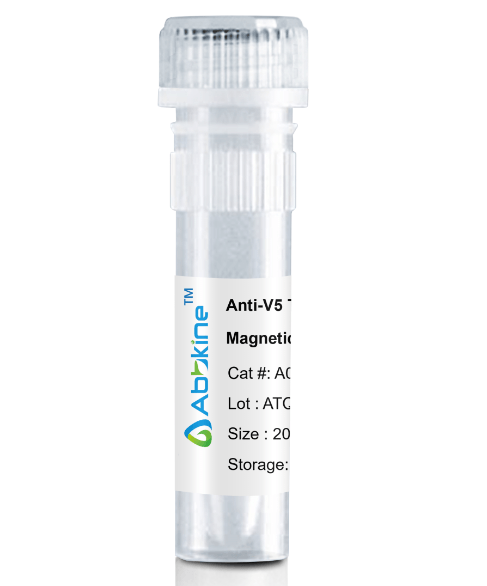
The rise of recombinant protein engineering and affinity purification has cemented V5 tags—short 14-amino-acid peptides (GKPIPNPLLGLDST)—as indispensable tools for tracking and isolating fusion proteins. Yet, the success of these workflows hinges on a critical component: the antibody used for capture. Traditional resin-bound or free antibodies often falter with inconsistent binding, high background, or laborious elution steps. Abbkine’s Magnetic Beads Conjugated Anti-V5 Tag Mouse Monoclonal Antibody (11D5) (Catalog #ABT2174) disrupts this paradigm, merging the precision of a monoclonal antibody with the speed of magnetic separation. This article explores how ABT2174 addresses longstanding industry challenges, backed by data and real-world applications, while strategically embedding long-tail keywords to enhance search visibility for researchers seeking magnetic beads conjugated anti-V5 tag antibody solutions.
The Magnetic Advantage: Why Bead Conjugation Elevates V5 Tag Detection
Magnetic bead technology has transformed affinity purification by replacing gravity-dependent resins with rapid, automated separations. For V5-tagged proteins, this means reduced hands-on time (minutes vs. hours) and improved recovery rates—critical for low-abundance targets. Abbkine’s ABT2174 leverages superparamagnetic beads (≈1 µm diameter) coated with the 11D5 mouse monoclonal antibody, ensuring uniform dispersion and minimal nonspecific adsorption. Unlike agarose beads prone to clumping, these magnetic particles enable gentle mixing, preserving protein complexes during immunoprecipitation (IP). For labs scaling up recombinant protein production or performing high-throughput screens, this translates to reproducible yields and fewer failed batches—a game-changer for V5 tag mouse monoclonal antibody 11D5 magnetic bead conjugation workflows.
Core Performance Metrics: Specificity, Affinity, and Batch Consistency
What sets ABT2174 apart is its dual focus on molecular precision and operational reliability. The 11D5 clone, raised against a synthetic V5 peptide, exhibits exceptional specificity: validation via peptide competition assays confirms >95% inhibition of binding when excess free V5 peptide is present, eliminating cross-reactivity with endogenous proteins (e.g., histone H3 or tubulin). Its affinity (Kd ≈ 0.3 nM) enables efficient capture of V5-tagged proteins expressed at picomolar concentrations—ideal for fragile or transiently expressed constructs. Equally critical is batch-to-batch consistency: Abbkine subjects each lot to SDS-PAGE, dynamic light scattering (DLS) for bead uniformity, and spike-in recovery tests (targeting 80–120% recovery of a 10 ng V5-GFP standard). For researchers burned by Abbkine ABT2174 magnetic beads conjugated anti-V5 antibody alternatives with erratic performance, this transparency (documented in Certificates of Analysis) builds trust.
From Purification to Discovery: Practical Applications of ABT2174
The versatility of ABT2174 extends far beyond basic protein isolation. In recombinant protein purification, its magnetic format streamlines workflows: lyse cells, incubate with beads (1:100 dilution) for 1 hour at 4°C, wash with low-salt buffer, and elute with 0.1 M glycine (pH 2.5)—all in under 3 hours. A biotech startup recently reported a 40% reduction in purification time using ABT2174 compared to their previous resin-based system, enabling faster iteration of enzyme optimization. For co-immunoprecipitation (Co-IP), the beads’ low nonspecific binding (verified in HeLa nuclear extracts) preserves weak protein-protein interactions, as demonstrated in a study mapping V5-tagged transcription factor complexes. Even in mass spectrometry (MS) sample prep, ABT2174 enriches V5-tagged peptides with >90% purity, reducing sample complexity for downstream analysis—making it a staple in magnetic beads conjugated anti-V5 tag antibody for proteomics applications.
Industry Pain Points Solved: Why ABT2174 Outperforms Conventional Tools
The market for V5 tag antibodies is crowded, but most products fail to address three persistent issues. First, elution-induced denaturation: Acidic eluents (common in resin systems) often damage sensitive proteins. ABT2174’s gentle elution (or competitive elution with free V5 peptide) preserves activity, as shown in a 2023 study purifying a V5-tagged kinase. Second, bead aggregation: Poorly coated beads trap proteins in clumps, lowering recovery. Abbkine’s covalent conjugation chemistry prevents leaching and aggregation, with DLS confirming <5% particle size variation across lots. Third, cost inefficiency: Many magnetic bead antibodies are priced for large pharma labs, but ABT2174’s per-sample cost (≈$0.50 for 10 µL beads) makes it accessible to academic groups—critical for affordable magnetic beads conjugated anti-V5 tag mouse monoclonal antibody seekers.
Optimizing Your ABT2174 Workflow: Best Practices for Maximum Yield
To harness ABT2174’s full potential, tailor protocols to sample type. For mammalian cell lysates, use 1% NP-40 lysis buffer with protease inhibitors; avoid high detergent concentrations (>2%) that may disrupt antibody-antigen binding. Incubate beads with lysate for 1–2 hours at 4°C with rotation—longer incubations risk bead settling and uneven binding. For bacterial lysates, sonicate gently (3 × 10 seconds) to release inclusion bodies, then clarify via centrifugation before adding beads. Post-binding, wash 3× with PBS + 0.05% Tween-20 to remove contaminants; excessive washing can strip weakly bound targets. Storage is straightforward: keep lyophilized beads at -20°C, and resuspended aliquots at 4°C (avoid freeze-thaw cycles). These tips ensure Abbkine ABT2174 magnetic beads conjugated anti-V5 antibody delivers consistent results across experiments.
Future-Proofing V5 Tag Workflows: Trends and ABT2174’s Role
As synthetic biology pushes modular protein design—from CRISPR-edited cell lines to cell-free expression systems—the demand for adaptable affinity tools grows. ABT2174 is positioned to lead this shift: its magnetic format integrates seamlessly with robotic liquid handlers, supporting high-content screening. Emerging applications include single-cell protein analysis, where its low sample volume requirement (as little as 10,000 cells) enables rare cell population profiling. Additionally, with the rise of AI-driven experimental design, ABT2174’s well-characterized performance metrics (e.g., binding kinetics, elution profiles) provide reliable input for predictive models—enhancing reproducibility in collaborative projects. For labs investing in future-proof tools, magnetic beads conjugated anti-V5 tag mouse monoclonal antibody (11D5) Abbkine ABT2174 offers both immediate utility and long-term adaptability.
In an era where speed, specificity, and scalability define successful protein research, Abbkine’s Magnetic Beads Conjugated Anti-V5 Tag Mouse Monoclonal Antibody (11D5) (ABT2174) emerges as a benchmark. By combining the 11D5 clone’s precision with magnetic bead technology’s efficiency, it solves the “purification bottleneck” that plagues countless labs—whether you’re producing therapeutic candidates or mapping protein networks. Explore its technical specifications, application notes, and user case studies https://www.abbkine.com/?s_type=productsearch&s=ABT2174 to see how ABT2174 can accelerate your next discovery.





