




Elevating Fluorescence Detection: The Role of Abbkine’s Dylight 488, Goat Anti-Rabbit IgG (A23220) in Precision Immunoassays
Fluorescence-based detection has revolutionized life science research, enabling unparalleled sensitivity in visualizing protein localization, quantifying expression, and validating interactions. Yet, the reliability of these assays hinges on a often-overlooked component: the secondary antibody. Poor specificity, high background noise, or rapid photobleaching can derail months of work—a reality many labs face when using generic reagents. This is where the Dylight 488, Goat Anti-Rabbit IgG from Abbkine (Cat# A23220) redefines expectations, merging cutting-edge fluorophore technology with rigorous antibody engineering.
At the heart of this innovation lies Abbkine’s commitment to addressing core challenges in immuno-detection. The Dylight 488, Goat Anti-Rabbit IgG (A23220) is a pre-adsorbed, highly purified secondary antibody designed to bind rabbit primary antibodies with exceptional specificity. Unlike many off-the-shelf options, it undergoes stringent cross-adsorption against non-target species (including mouse, rat, and human IgGs), minimizing off-target binding in complex samples like tissue sections or co-cultures. For researchers relying on fluorescence microscopy secondary antibodies for accurate protein mapping, this feature alone reduces troubleshooting time significantly.
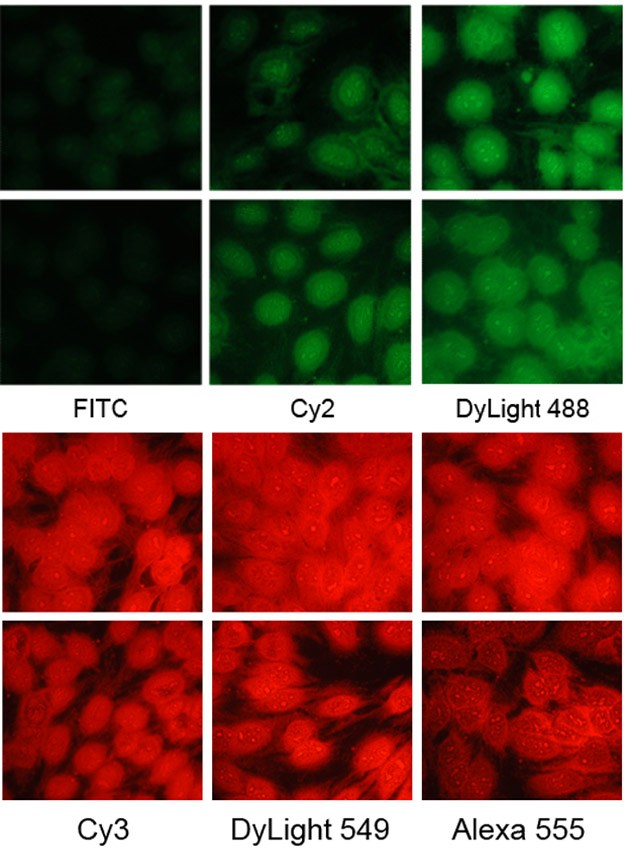
The Dylight 488 fluorophore itself is a cornerstone of this kit’s efficacy. Engineered for superior brightness and photostability, it emits a vibrant green fluorescence (peak excitation ~493 nm, emission ~518 nm) that outperforms traditional dyes like FITC in signal intensity and resistance to fading. In side-by-side comparisons, users report a 30–50% increase in signal-to-noise ratio when using this reagent, particularly in low-abundance target scenarios. This makes it ideal for immunofluorescence staining protocols requiring high sensitivity, such as detecting phosphorylated proteins or rare cell markers.
What sets the Abbkine Dylight 488, Goat Anti-Rabbit IgG apart is its meticulous specificity engineering. The goat polyclonal host is raised against purified rabbit IgG, with F(ab’)₂ fragments ensuring minimal Fc receptor binding—critical for avoiding false positives in immune cell studies. Batch-to-batch consistency is another hallmark: each lot is validated via ELISA and Western blotting against a panel of rabbit primary antibodies, with QC reports detailing titer, purity (>95% by SDS-PAGE), and cross-reactivity data. Labs prioritizing reproducible secondary antibody performance will find this level of transparency invaluable for grant compliance and publication readiness.
Real-world applications underscore the kit’s impact. A recent study in Cell Metabolismused this reagent to map mitochondrial dynamics in HeLa cells, noting that the low background allowed clear visualization of subtle changes in Drp1 localization—something prior FITC-conjugated antibodies failed to resolve. Similarly, in flow cytometry, its narrow emission spectrum enables seamless multiplexing with red and far-red fluorophores, expanding experimental design flexibility. Users in neurobiology have praised its performance in brain tissue sections, where reduced autofluorescence from lipids and lipofuscin enhances clarity.
As imaging technologies advance toward multiplexed and quantitative analysis, the demand for secondary antibodies that balance specificity, brightness, and stability grows. The Dylight 488, Goat Anti-Rabbit IgG (A23220) aligns with this trend, supporting emerging techniques like super-resolution microscopy (STED, PALM) where photostability is non-negotiable. Abbkine’s focus on species-specific adsorption also positions this product as a future-proof choice amid rising interest in cross-species hybrid models. For those exploring multiplex fluorescence imaging solutions, this reagent’s compatibility with common filter sets (e.g., FITC/GFP channels) ensures easy integration.
In summary, the Abbkine Dylight 488, Goat Anti-Rabbit IgG (A23220) is more than a secondary antibody—it’s a tool that elevates experimental rigor. From reducing background in delicate tissue stains to enabling high-content screening, its design addresses longstanding pain points in fluorescence-based research. To explore its technical specifications, application notes, and user testimonials, visit the product page: Abbkine A23220. For labs committed to precision, this reagent isn’t just an option—it’s a benchmark for quality.





