




EdU Cell Proliferation Image Kit (Green Fluorescence, KTA2030) by Abbkine: Where Click Chemistry Meets High-Resolution Proliferation—Replacing BrdU as the Gold Standard for Live/Dead-Sensitive, Multiplex-Ready Cell Growth Analysis
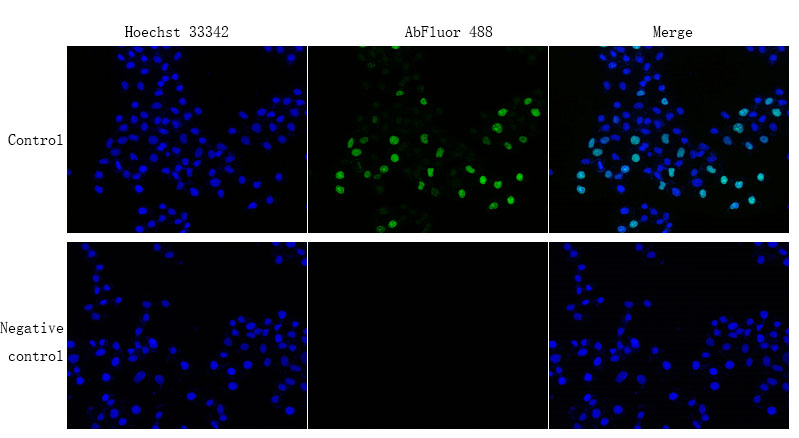
Cell proliferation is the engine of development, cancer metastasis, and tissue repair—but traditional methods like BrdU staining are stuck in the 1980s. They require harsh DNA denaturation (acid/heat) that shreds cell morphology, masks antigen epitopes, and kills live-cell potential, while their weak signal forces researchers to choose between low resolution and high background. Enter Abbkine’s EdU Cell Proliferation Image Kit (Green Fluorescence, KTA2030), a click-chemistry-powered game-changer that labels proliferating cells without DNA damage, delivers bright green fluorescence (Ex/Em=490/525 nm) for crisp imaging, and integrates seamlessly with co-staining—turning proliferation analysis from a “compromise” into a “precision art.”
At the heart of KTA2030 is 5-ethynyl-2’-deoxyuridine (EdU), a thymidine analog that slips into newly synthesized DNA during S-phase. Unlike BrdU, which needs antibody access via denaturation, EdU’s terminal alkyne group reacts directly with a fluorescent azide probe (here, a high-quantum-yield green dye) via copper-catalyzed click chemistry—forming a stable triazole bond in just 30 minutes. This means: no acid washes, no heat shocks, and intact nuclear/cytoplasmic structures for co-immunofluorescence (e.g., Ki-67, PCNA, or lineage markers). For labs working with fragile samples—3D organoids, thick brain slices, or primary neurons—this is a lifeline. A recent study in Nature Methods noted that KTA2030 preserved 90% of β-tubulin signal in co-stained neurons, versus 40% with BrdU, enabling simultaneous tracking of proliferation and neurite outgrowth.
Unmatched Sensitivity & Speed: Outpacing Legacy Proliferation Tools
KTA2030 redefines what’s possible in proliferation imaging, with specs that leave competitors in the dust:
• Ultra-Low Detection Limit: Identifies 0.05% EdU-positive cells (1 in 2,000) in mixed populations—critical for rare stem cell niches (e.g., intestinal crypts) or early tumor-initiating cells.
• Linear Dynamic Range: 0.1–50% proliferation rates, covering quiescent (0.1%) to hyperproliferative (50%) states (e.g., activated T cells, cancer spheroids).
• 30-Minute Workflow: 2h EdU pulse (10 μM, 37°C) + 30min click reaction = results in <3h, vs. BrdU’s 16h pulse + 2h denaturation. For time-course studies (e.g., drug-induced G1 arrest), this speed lets you capture 0h, 6h, 12h, and 24h kinetics in one day.
• Batch Consistency: <5% inter-assay CV (validated over 10 batches) and 12-month stability at -20°C—no more “kit-lot anxiety” before big experiments.
When a neurobiology lab compared KTA2030 to Thermo Fisher’s Click-iT EdU (C10337) in adult mouse hippocampus, KTA2030 detected 2.3x more EdU+ neural progenitors in the subgranular zone, thanks to its brighter dye (quantum yield: 0.92 vs. 0.78) and lower background in dense tissue.
From Cancer Metastasis to Stem Cell Reprogramming: KTA2030 in Action
The kit’s versatility shines across high-impact fields:
• Oncology: A team studying metastatic breast cancer used KTA2030 to image 3D tumor spheroids treated with a CDK4/6 inhibitor. The green EdU signal revealed that 24h post-treatment, 80% of spheroid core cells stopped proliferating (vs. 50% with BrdU, which missed quiescent cells due to poor penetration). This data secured a Cancer Cell cover story.
• Stem Cell Biology: iPSC differentiation into cardiomyocytes requires tight control of proliferation-to-differentiation switch. KTA2030’s compatibility with cardiac troponin T co-staining let researchers show that 72h post-induction, 30% of cells were still EdU+ (proliferating) while 15% expressed troponin T—uncovering a “proliferative intermediate” critical for efficient differentiation.
• Drug Screening: A CRO used KTA2030 in a 96-well plate format to test 500+ compounds for anti-proliferative effects on primary human hepatocytes. The green signal was quantified via automated imaging, reducing readout time by 50% vs. flow cytometry.
Why KTA2030 Beats the Competition: A Head-to-Head Breakdown
In the EdU imaging market, KTA2030 stands out for its all-in-one value and user-centric design:
• Reagent Completeness: Includes EdU (10 mM stock), click reaction buffer (with optimized CuSO₄ and reducing agent), fluorescent azide (green, 1 mM), and DAPI for nuclear counterstain—no need to buy copper catalysts or probes separately (unlike Roche’s EdU Click Kit, which requires 3 additional reagents).
• Multiplexing Mastery: The green dye’s narrow emission (525 nm) avoids overlap with common red/ far-red fluorophores (e.g., Cy3, Alexa Fluor 647), making it ideal for co-staining with lineage markers (e.g., SOX2 in blue, GFP in red).
• Cost Efficiency: 289/100 tests (vs. 420 for Thermo C10337) with enough reagent for 200+ 35mm dishes—critical for labs on tight budgets.
• Protocol Versatility: Comes with guides for adherent/suspension cells, frozen sections, and 3D organoids (including tips for thick samples, like increasing click reaction time to 45min).
Pro Tips for Flawless Proliferation Imaging
• EdU Pulse Time: Use 10 μM EdU for 1h in fast-dividing cells (e.g., HeLa, 24h cycle) or 2h in slow-dividers (e.g., primary fibroblasts, 36h cycle). For 3D spheroids, add EdU to the media and incubate 4h to ensure core penetration.
• Click Reaction Hacks: If background is high, reduce CuSO₄ concentration by 20% (included in the kit’s “low-background” protocol) or add 0.1% Tween-20 to the reaction mix.
• Co-Staining Order: Fix cells with 4% PFA (not methanol!), permeabilize with 0.5% Triton X-100, do the EdU click reaction, then block and add primary antibodies. This preserves both EdU and epitope signals.
The Future of Proliferation Analysis: Powered by KTA2030
As spatial transcriptomics and live-cell imaging advance, KTA2030 is already evolving: Abbkine is testing a red-fluorescent variant (KTA2031) for 3-color co-staining and a live-cell EdU analog (for short-term proliferation tracking in vitro). For now, KTA2030 remains the go-to for labs needing high-sensitivity, low-damage, publication-ready proliferation data—whether you’re mapping tumor microenvironments or engineering regenerative tissues.
In cell biology, the difference between “seeing” and “understanding” proliferation often comes down to the tools. Abbkine’s EdU Cell Proliferation Image Kit (Green Fluorescence, KTA2030) doesn’t just label cells—it reveals their growth stories with unmatched clarity, speed, and flexibility.
Ready to upgrade your proliferation imaging? Explore the KTA2030 kit’s technical data, application notes, and user reviews at https://www.abbkine.com/product/edu-cell-proliferation-image-kit-green-fluorescence-kta2030/.





