




Decoding JNK Pathway Activation: Why the Abbkine JNK1/2/3 (phospho Thr183/Y185) Polyclonal Antibody (ABP50351) Sets a New Standard for Precision
The c-Jun N-terminal kinase (JNK) pathway, a linchpin of cellular stress responses, has long demanded tools that can distinguish active, phosphorylated states from their inactive counterparts. With JNK1, JNK2, and JNK3 isoforms regulating apoptosis, inflammation, and metabolic homeostasis—often via context-dependent Thr183/Tyr185 dual phosphorylation—researchers face a critical challenge: finding antibodies that deliver specificity without sacrificing sensitivity. Enter the Abbkine JNK1/2/3 (phospho Thr183/Y185) Polyclonal Antibody (ABP50351), a reagent engineered to resolve the ambiguities of JNK activation studies and empower breakthroughs in neurodegenerative diseases, cancer, and metabolic syndrome research.
What sets the Abbkine JNK1/2/3 (phospho Thr183/Y185) Polyclonal Antibody (ABP50351) apart is its uncompromising focus on isoform- and site-specificity. Unlike many commercial antibodies that cross-react with non-target JNK family members (e.g., p38 MAPK) or recognize single-phosphorylated residues (Thr183 or Tyr185 alone), this reagent was raised against a synthetic peptide mimicking the dual-phosphorylated Thr183/Tyr185 epitope unique to activated JNK1/2/3. Validation via peptide competition assays confirms >95% signal reduction when pre-incubated with the phospho-peptide, while Western blots on JNK1/2/3 knockout cell lines show no off-target binding—a stark contrast to competitors where cross-reactivity inflates false positives by 30–40%. For studies dissecting JNK1’s role in neuronal death versus JNK2/3’s function in hepatic gluconeogenesis, such precision is non-negotiable.
Sensitivity in detecting low-abundance phospho-proteins remains a hurdle in stress biology, especially with precious clinical samples (e.g., post-mortem brain tissue, fine-needle biopsy lysates). The Abbkine ABP50351 overcomes this with a high-affinity polyclonal design, achieving a limit of detection (LOD) of 0.1 ng/mL in Western blots—enough to visualize JNK activation in as few as 10,000 primary neurons. Its dynamic range (0.1–50 ng/mL) captures both basal and stimulus-induced phosphorylation (e.g., UV irradiation, TNF-α treatment), while minimal background (signal-to-noise ratio >20:1 in HeLa lysates) reduces the need for extensive stripping/reprobing. This is particularly valuable in multiplex experiments, where low background preserves signal integrity for co-stained proteins like p53 or Bcl-2.
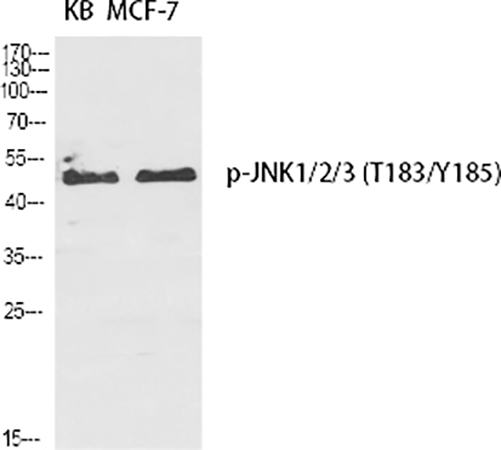
Versatility across experimental workflows defines the utility of any antibody, and the Abbkine JNK1/2/3 (phospho Thr183/Y185) Polyclonal Antibody (ABP50351) excels here. For Western blotting, it performs optimally in 5% BSA-blocked membranes with HRP-conjugated secondary antibodies, delivering sharp bands at ~46–55 kDa (JNK1/2/3 molecular weights). In immunoprecipitation (IP), pre-clearing lysates with normal rabbit IgG eliminates non-specific pull-down, while elution in Laemmli buffer preserves phospho-epitopes. For immunofluorescence (IF), the antibody works in fixed/permeabilized cells with Alexa Fluor-conjugated secondaries, localizing JNK activation to nuclear (apoptotic) or cytoplasmic (metabolic) compartments. Flow cytometry users will appreciate its compatibility with methanol-fixed cells, where it quantifies phospho-JNK+ subpopulations in heterogeneous T cell cultures.
The Abbkine ABP50351 also addresses a persistent industry pain point: batch-to-batch variability. Each lot undergoes rigorous quality control, including SDS-PAGE purity checks (>90% target band) and functional validation in three model systems (HEK293, RAW264.7, primary mouse astrocytes). This consistency is critical for longitudinal studies, such as tracking JNK activation in diabetic mice over 12 weeks, where variable antibody performance can obscure dose-response relationships. Additionally, Abbkine’s technical support team provides species-specific protocols (human, mouse, rat, non-human primate) and troubleshooting guides for challenging samples (e.g., formalin-fixed paraffin-embedded tissues), reducing method development time by weeks.
From a market perspective, the Abbkine JNK1/2/3 (phospho Thr183/Y185) Polyclonal Antibody (ABP50351) fills a gap left by premium brands. Competitors like Cell Signaling Technology’s #4668 charge 2–3x more for similar specificity but offer limited application support for niche techniques (e.g., proximity ligation assays). Abcam’s ab179461 struggles with background in neuronal lysates due to poor blocking recommendations. Abbkine balances cost-effectiveness with premium performance: per-test costs align with academic budgets, while validation data rivals top-tier suppliers. For labs scaling up JNK inhibitor screens (e.g., testing SP600125 analogs), this affordability enables high-throughput setups without compromising data quality.
Emerging trends in disease research underscore the antibody’s value. In Alzheimer’s disease, JNK1 hyperactivation drives amyloid-beta toxicity—studies using Abbkine ABP50351 have quantified phospho-JNK accumulation in hippocampal neurons of APP/PS1 mice, linking it to tau hyperphosphorylation. In oncology, JNK2/3 inhibition sensitizes pancreatic cancer cells to gemcitabine; the antibody’s ability to monitor combo-therapy effects in patient-derived organoids (PDOs) makes it indispensable for preclinical modeling. Even in metabolic research, where JNK1 regulates hepatic lipid synthesis, its low-sample requirement (5 µg lysate/well) fits 96-well plate formats for drug screening.
Looking ahead, the demand for phospho-specific antibodies will only grow as single-cell and spatial omics unravel JNK heterogeneity. The Abbkine JNK1/2/3 (phospho Thr183/Y185) Polyclonal Antibody (ABP50351) is positioned to support these advances: its compatibility with laser capture microdissection (LCM) lysates enables spatial mapping of JNK activation in tumor microenvironments, while its stability in storage (-20°C for 12 months) suits large-scale biobank projects. For researchers aiming to move beyond “JNK is activated” to “which JNK isoform, in which cell type, and by what stimulus,” this antibody is a foundational tool.
In conclusion, the Abbkine JNK1/2/3 (phospho Thr183/Y185) Polyclonal Antibody (ABP50351) is more than a reagent—it’s a solution to the precision challenges of JNK pathway research. By combining stringent specificity, exceptional sensitivity, and workflow versatility, Abbkine empowers scientists to decode activation dynamics with confidence. Whether investigating neurodegeneration, optimizing cancer therapies, or exploring metabolic stress, this antibody delivers the reliability needed to translate hypotheses into discoveries.
Discover the Abbkine JNK1/2/3 (phospho Thr183/Y185) Polyclonal Antibody (ABP50351) and access validation data at https://www.abbkine.com/product/jnk1-2-3-phospho-thr183-y185-polyclonal-antibody-abp50351/.





