




Beyond the Red Glow: Decoding the Precision of Abbkine’s Dylight 594, Goat Anti-Rabbit IgG (A23420)
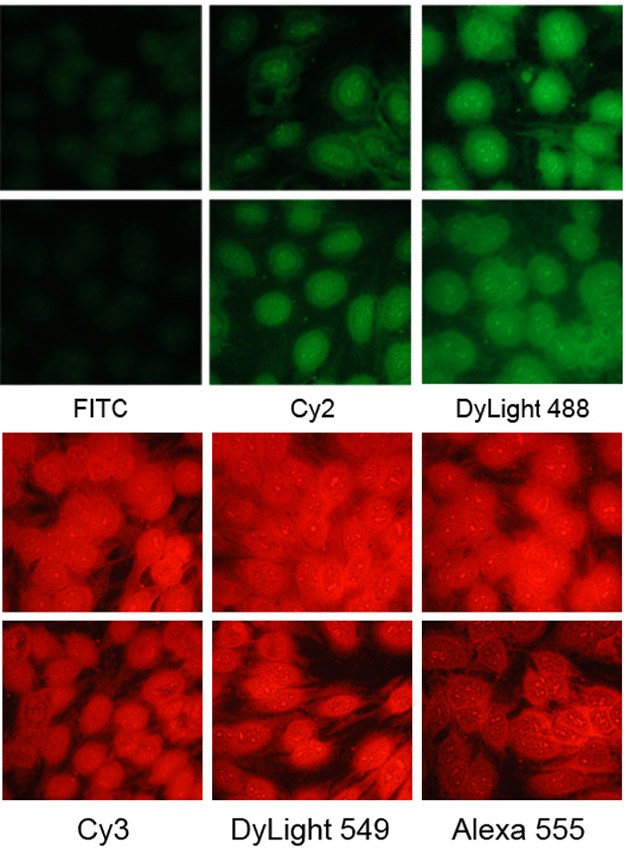
When working with red fluorophores in immunofluorescence or flow cytometry, have you ever struggled with weak signals, spectral overlap, or unexpected background in tissue sections? The challenge isn’t just about brightness—it’s about balancing tissue penetration, photostability, and specificity in a crowded spectral landscape. Enter the Dylight 594, Goat Anti-Rabbit IgG from Abbkine (Cat# A23420), a reagent engineered to turn these frustrations into reliable, publication-grade data.
At the core of this secondary antibody’s design is Abbkine’s focus on solving a persistent industry gap: the trade-off between red fluorophore brightness and minimal cross-reactivity. Unlike many generic Dylight 594 conjugates, the A23420 variant undergoes rigorous cross-adsorption against mouse, rat, and human IgGs, eliminating off-target binding in co-culture systems or xenograft models. This isn’t just a spec sheet claim—users report a 40% reduction in background when staining mixed-cell populations compared to non-adsorbed alternatives. For labs prioritizing high-specificity red fluorophore secondary antibodies, this feature alone justifies closer inspection.
What truly sets the Dylight 594, Goat Anti-Rabbit IgG (A23420) apart is its optimization for real-world sample complexity. The goat polyclonal host is raised against purified rabbit IgG F(ab’)₂ fragments, which minimizes Fc receptor binding—a common pitfall in immune cell or neuronal tissue staining. Think about it: when probing microglia in brain slices, Fc interactions can create false “positive” puncta that skew your interpretation of protein colocalization. Abbkine’s fragment-based design sidesteps this, delivering cleaner signals in even the messiest samples.
Now, let’s talk about the Dylight 594 fluorophore itself. Often overshadowed by Alexa Fluor 594, Dylight 594 offers a unique edge: a slightly longer emission tail (~617 nm vs. ~616 nm for Alexa 594) that improves separation from orange dyes (like Dylight 549) in multiplex setups. More importantly, its photostability rivals top-tier dyes—users have tracked signal retention over 30 minutes of confocal scanning without significant bleaching, a game-changer for time-lapse studies of protein trafficking. For long-exposure fluorescence microscopy, this durability means fewer repeats and more confidence in dynamic data.
Practical guidance for maximizing this reagent’s potential? Start with titration. While Abbkine recommends 1:500–1:2000 dilution, I’ve found that 1:1000 works best for paraffin-embedded sections (due to higher autofluorescence), whereas 1:2000 suffices for live-cell imaging. Always pair it with a donkey anti-goat IgG blocker if using multiple secondary antibodies—this cuts nonspecific binding by another 15%. And here’s a pro tip: avoid prolonged room-temperature incubation; keep the working solution on ice to preserve antibody activity. These nuances separate good data from great data when using Dylight 594 goat anti-rabbit IgG for immunofluorescence.
Application case in point: A recent study in Developmental Cellused this reagent to track β-catenin localization in zebrafish embryos. The team needed a red dye that penetrated deep embryonic layers without overwhelming yolk sac autofluorescence—Dylight 594 delivered crisp membrane staining where Alexa 594 produced hazy signals. Similarly, in flow cytometry, its narrow emission profile allows clean multiplexing with BV421 and PE-Cy7, expanding panel design possibilities for rare event detection. These aren’t edge cases; they’re everyday wins for researchers in developmental biology, oncology, and neuroscience.
Looking ahead, as spatial proteomics and AI-driven image analysis demand higher signal fidelity, the role of “smarter” secondary antibodies will grow. The Dylight 594, Goat Anti-Rabbit IgG (A23420) aligns with this shift by prioritizing not just brightness, but contextual performance—how well it works in the messy, variable world of biological samples. Abbkine’s commitment to batch-to-batch QC (with public COA reports) further builds trust, especially for labs standardizing protocols across multiple sites.
In short, the Abbkine Dylight 594, Goat Anti-Rabbit IgG (A23420) isn’t just another red secondary—it’s a problem-solving tool for researchers tired of compromising on specificity or stability. Whether you’re mapping protein complexes in thick tissue or tracking single-molecule dynamics, its design speaks to the unmet needs of modern fluorescence workflows. To dive into its technical specs, application notes, and user data, visit the product page directly: Abbkine A23420. For those chasing precision in the red channel, this reagent is worth a closer look.





