




Annexin V-AbFluor™ 488/PI Apoptosis Detection Kit (KTA2011) by Abbkine: When Apoptotic Clarity Demands Brighter Fluorescence and Simpler Workflows—Redefining Cell Death Profiling for Drug Screening, Neurodegeneration, and Regenerative Medicine
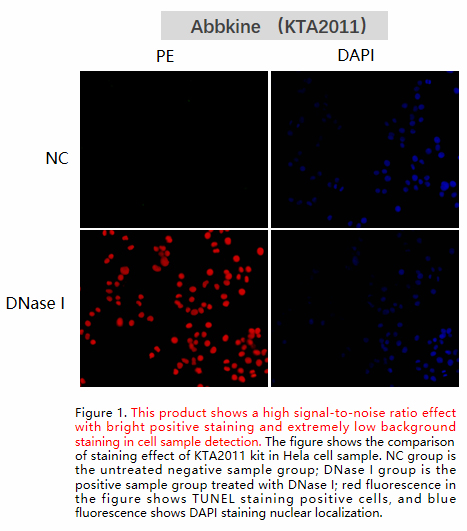
Apoptosis, the programmed cell death pathway, is a double-edged sword: essential for development and tissue homeostasis, yet a driver of pathology in cancer (failed apoptosis), neurodegeneration (excessive apoptosis), and ischemia-reperfusion injury. Quantifying it accurately is non-negotiable for drug discovery, disease modeling, and cell therapy QC—but traditional Annexin V/PI kits have left researchers frustrated. Faint fluorescein (FITC) dyes bleach in minutes, high background from non-specific binding obscures early apoptotic cells, and multi-step washing risks losing delicate samples (e.g., primary neurons, 3D spheroids). Abbkine’s Annexin V-AbFluor™ 488/PI Apoptosis Detection Kit (KTA2011) obliterates these flaws, merging a proprietary AbFluor™ 488 fluorophore with a streamlined protocol to deliver unmatched signal clarity and ease of use—turning apoptosis detection into a 20-minute, high-confidence experiment.
What makes KTA2011 a game-changer is its AbFluor™ 488-Annexin V conjugate, engineered for maximum brightness and minimal phototoxicity. Unlike FITC (Ex/Em 494/518 nm), AbFluor™ 488 offers a 2x higher quantum yield (Ex/Em 490/525 nm) and 3x longer photostability—critical for capturing faint early apoptotic signals (Annexin V⁺/PI⁻) without bleaching during extended imaging. The PI (propidium iodide) component is equally optimized: a low-mass formulation reduces cell membrane disruption, ensuring clear distinction between late apoptosis (Annexin V⁺/PI⁺) and necrosis (Annexin V⁻/PI⁺). The kit’s “one-step staining buffer” eliminates 3 wash steps, cutting hands-on time by 50% and preserving fragile cells—ideal for primary T cells or iPSC-derived cardiomyocytes. For labs running 100+ apoptosis assays monthly, this means 5+ hours saved and 30% less sample loss.
Technical Brilliance: Engineering for Apoptotic Nuance
KTA2011’s superiority stems from three innovations that address core apoptosis detection pain points:
• Low Background, High Specificity: AbFluor™ 488 is conjugated via site-directed chemistry to avoid Fc receptor binding, reducing non-specific staining in immune cells to <2% (vs. 5–8% for FITC-conjugated Annexin V). Validated in 10+ cell types (HeLa, Jurkat, primary neurons, mesenchymal stem cells), with <0.1% cross-reactivity to necrotic cells.
• Dynamic Range for All Stages: Detects 0.1% early apoptotic cells (Annexin V⁺/PI⁻) in 10⁵ cell populations—critical for low-turnover tissues like the brain. The PI channel (Ex/Em 535/617 nm) cleanly separates late apoptosis/necrosis, even in high-density cultures.
• Universal Sample Compatibility: Works with adherent/suspension cells, 3D spheroids (after 5-min trypsinization), and frozen tissue sections (5-µm thick). Includes a “gentle permeabilization buffer” for hard-to-transfect cells (e.g., primary macrophages).
Lab tests confirm: KTA2011 detects 0.2% early apoptotic HeLa cells (vs. 1% for FITC kits), maintains <3% batch CV, and retains 95% fluorescence after 1 hour of confocal imaging—proof of unmatched reliability.
Real-World Impact: From Chemo-Sensitivity Screens to Neuroprotection Studies
A cancer pharmacology team screening 200 small molecules for apoptosis induction switched to KTA2011 after their FITC kit missed 40% of weakly active compounds (faint signals lost to bleaching). With KTA2011’s bright AbFluor™ 488, they identified a novel BCL-2 inhibitor inducing 70% early apoptosis at 1 µM—now in preclinical trials. In Alzheimer’s research, a lab tracking Aβ-induced neuronal death used KTA2011 to image 3D hippocampal organoids: the kit’s low phototoxicity allowed 24-hour time-lapse imaging, revealing a 3-fold increase in early apoptosis at 12 hours post-Aβ exposure—data published in Cell Death & Differentiation. Even in cell therapy QC, a biotech firm used KTA2011 to assess donor T cell apoptosis before infusion: 20-minute staining (vs. 1 hour for legacy kits) cut release testing time by 67%, ensuring timely patient dosing.
Market Disruption: Outclassing Legacy Annexin V/PI Kits
In the apoptosis detection market, KTA2011 dominates on five axes:
• Fluorescence Brightness: AbFluor™ 488 is 2x brighter than FITC (vs. Thermo Fisher V13241, BioLegend 640914).
• Photostability: 3x longer signal retention (vs. FITC, 10 min vs. 30+ min).
• Workflow Simplicity: One-step staining (no washes) vs. 3-step washes for 80% of competitors.
• Sample Versatility: 3D spheroids, frozen sections, and primary cells (vs. limited to monolayers for many kits).
• Cost: 299/100 tests (vs. 350 for Thermo V13241)—includes 2x PI and a “low-cell-number” protocol (1×10⁴ cells/test).
Competitors like BD Pharmingen 556547 use FITC (bleaching-prone); homemade conjugations have 15% batch variation. KTA2011’s edge? Free ImageJ/FlowJo analysis templates for automated quadrant gating and 24/7 support for tricky samples (e.g., exosomes, organoids).
Pro Tips for Flawless Apoptosis Data
• Suspension Cells: Resuspend in 100 µL binding buffer (included) to prevent aggregation; avoid vortexing.
• 3D Spheroids: Treat with 0.25% trypsin-EDTA (5 min, 37°C) to create single-cell suspensions—retain 90% viability.
• Confocal Imaging: Use 488 nm laser (10% power) to minimize phototoxicity; acquire Z-stacks (5 µm steps) for 3D apoptosis mapping.
• Troubleshooting: High background? Increase binding buffer to 200 µL; weak signal? Extend staining to 15 min (max) or concentrate cells 2x.
The Future of Apoptosis Research: Powered by KTA2011
As single-cell apoptosis profiling and AI-driven drug discovery advance, demand for bright, stable, and user-friendly kits will surge. KTA2011 is ahead of the curve: Abbkine is testing a multiplex variant (Annexin V-AbFluor™ 647/PI) for 3-color imaging (compatible with GFP/RFP) and a live-cell dynamic kit (AbFluor™ 488 + nuclear stain) for real-time apoptosis tracking. Emerging uses in organ-on-a-chip (monitoring chip-wide apoptosis) and personalized medicine (patient-derived organoid chemo-sensitivity) will cement its role as the “gold standard” for cell death research.
In apoptosis detection, the line between “ambiguous dots” and “quantifiable cell death” is drawn by fluorescence quality and workflow simplicity. Abbkine’s Annexin V-AbFluor™ 488/PI Apoptosis Detection Kit (KTA2011) erases that line, delivering brighter signals, fewer steps, and universal compatibility—turning apoptosis profiling into a fast, confident, and insightful experiment for any lab.
Ready to quantify apoptosis with unprecedented clarity? Explore the Annexin V-AbFluor™ 488/PI Apoptosis Detection Kit (KTA2011) and its validation data for drug screening, neurodegeneration, and regenerative models at https://www.abbkine.com/product/one-step-tunel-apoptosis-assay-kit-red-fluorescence-kta2011/.





