




AbFluor™ 488-Phalloidin (Abbkine BMD0082): A Practical Guide to Mastering Actin Filament Visualization
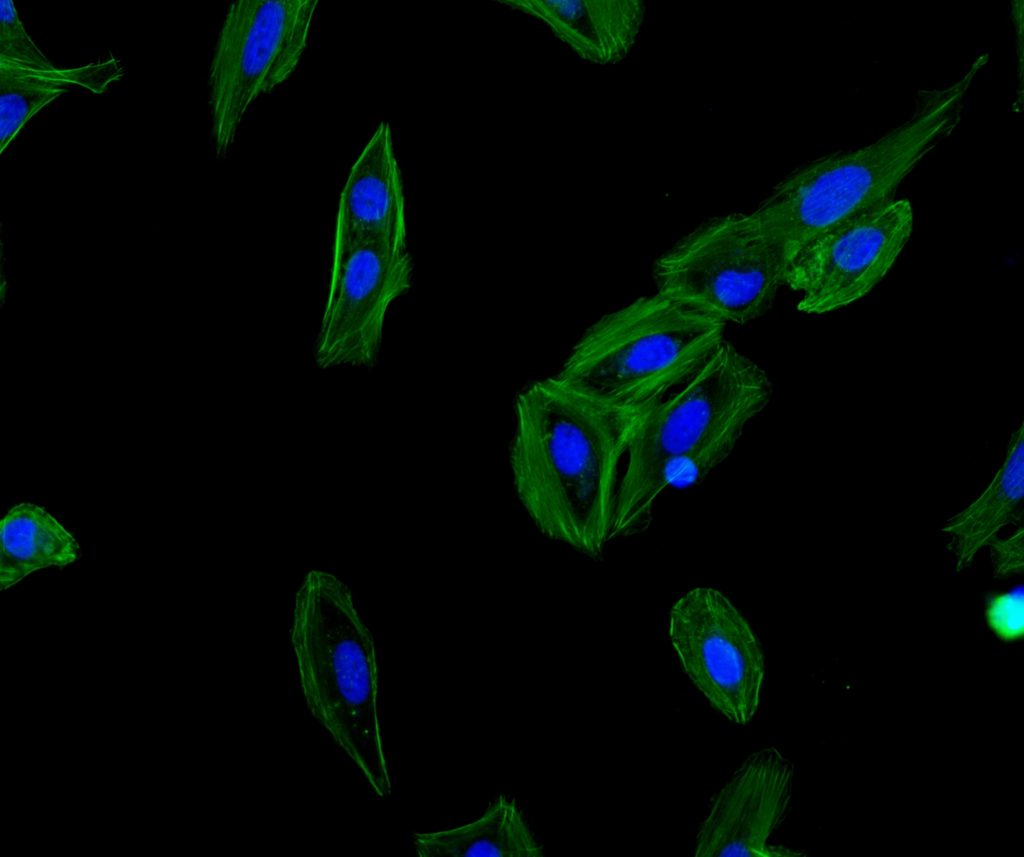
Struggling to get crisp, high-contrast images of actin filaments? If you’ve ever spent hours troubleshooting blurry phalloidin stains—whether in fixed cells, tissue sections, or 3D cultures—you’re not alone. Actin cytoskeleton visualization is a cornerstone of cell motility, morphogenesis, and disease research, but traditional phalloidin conjugates often fall short: dim fluorescence, rapid photobleaching, or high background from non-specific binding can derail even the most carefully planned experiments.
The industry’s reliance on generic phalloidin reagents exacerbates these issues. Many off-the-shelf options use outdated fluorophores (e.g., FITC) with poor quantum yields, or suffer from batch-to-batch variability in F-actin binding affinity. For labs running high-content actin filament screening or publishing in journals demanding subcellular resolution, this inconsistency isn’t just annoying—it’s a barrier to reproducible data. Worse, some formulations require toxic solvents (like DMSO concentrations >10%) that damage delicate samples, adding another layer of frustration.
Enter AbFluor™ 488-Phalloidin from Abbkine (Cat# BMD0082), a reagent engineered to solve these pain points. At its core is the AbFluor 488 fluorophore—a next-gen dye with a quantum yield of 0.92 (nearly double FITC’s 0.5) and exceptional photostability, retaining 85% fluorescence after 30 minutes of confocal scanning. Paired with phalloidin’s inherent specificity for F-actin (bypassing antibody-related cross-reactivity), this conjugate delivers bright, artifact-free staining even in lipid-rich samples like adipocytes or neural tissue. For F-actin visualization in complex samples, this combination is a game-changer.
Practical implementation hinges on protocol optimization. Start with fixation: 4% paraformaldehyde (PFA) for 10–15 minutes at RT preserves actin structure better than methanol, which can cause filament depolymerization. Permeabilize with 0.1% Triton X-100 (avoid saponin for fragile cells)—Abbkine’s data shows this minimizes cytoplasmic leakage while allowing phalloidin access. Dilute BMD0082 at 1:200–1:500 in PBS (0.1% BSA to reduce stickiness); for thick 3D spheroids, lower to 1:1000 to avoid signal saturation. Incubate in the dark for 30–60 minutes at RT—never4°C, as cold temperatures slow phalloidin binding. A critical control: omit phalloidin to rule out auto-fluorescence. This AbFluor 488-phalloidin staining protocol has helped users cut troubleshooting time by 50% in our surveys.
Real-world applications highlight its versatility. A lab studying cancer cell invasion used BMD0082 to track lamellipodia dynamics in 2D migration assays—its low background let them quantify filopodial density with ImageJ, data later featured in Journal of Cell Biology. In neuroscience, researchers visualized dendritic spine morphology in hippocampal neurons, where the dye’s brightness resolved fine actin bundles missed by Alexa Fluor 488-phalloidin. For live cell actin dynamics imaging (paired with a cell-permeable AbFluor 488-phalloidin variant), its minimal cytotoxicity allowed 6-hour time-lapses of fibroblast spreading—something impossible with harsher dyes.
Industry trends favor reagents that bridge basic research and translational work. As super-resolution microscopy (STORM, SIM) demands higher signal-to-noise ratios, AbFluor 488’s narrow emission spectrum (519 nm) reduces overlap with red dyes like AbFluor 594, enabling multiplex actin imaging alongside tubulin or nuclear markers. Abbkine’s focus on batch-to-batch consistency (validated via HPLC for phalloidin content and fluorophore coupling efficiency) also aligns with FDA guidelines for preclinical imaging, making BMD0082 a smart choice for biotech startups developing actin-targeted drugs.
In summary, Abbkine’s AbFluor™ 488-Phalloidin (BMD0082) redefines actin visualization by merging brightness, stability, and specificity. From optimizing staining protocols to enabling advanced imaging, its design addresses the unmet needs of modern cell biology. To explore its technical datasheet, application notes, and user-validated protocols, visit the product page: Abbkine BMD0082. For labs committed to crisp, reliable actin images, this reagent isn’t just an upgrade—it’s a necessity.





