




Abbkine’s One-step TUNEL Apoptosis Assay Kit (Orange Fluorescence) (Catalog KTA2011): Precision Detection for Apoptotic DNA Fragmentation
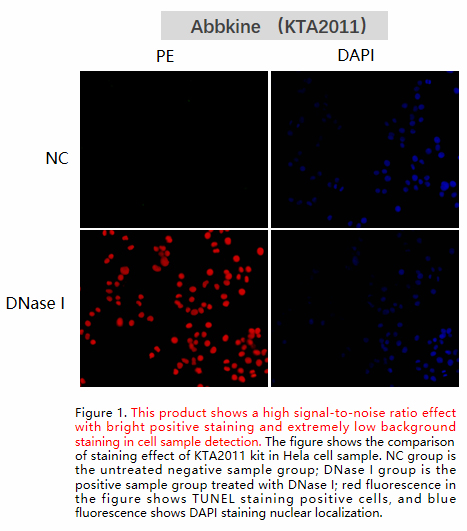
In the landscape of cell biology and drug discovery, accurate detection of apoptosis—programmed cell death—stands as a cornerstone of understanding disease mechanisms, drug efficacy, and cellular response pathways. DNA fragmentation, a hallmark of late-stage apoptosis, requires sensitive, specific tools to distinguish apoptotic cells from healthy or necrotic ones. Abbkine’s One-step TUNEL Apoptosis Assay Kit (Orange Fluorescence) (catalog number KTA2011, available at https://www.abbkine.com/?s_type=productsearch&s=KTA2011) addresses this critical need with a streamlined, high-performance solution. As a promoted product priced at $159 for 20 tests, it combines the specificity of the TUNEL (Terminal Deoxynucleotidyl Transferase dUTP Nick End Labeling) assay with the versatility of orange fluorescence, filling gaps in multiplex imaging and low-background detection. As the industry shifts toward faster, more reproducible apoptosis assays, KTA2011 emerges as a transformative tool—let’s explore its technical edge, industry relevance, and the value it brings to diverse research workflows.
At the core of KTA2011’s reliability is its one-step TUNEL assay design, engineered to simplify protocol execution while preserving detection specificity. Traditional TUNEL assays require separate mixing of terminal deoxynucleotidyl transferase (TdT) enzyme, labeled dUTP, and reaction buffers—introducing room for error, variability, and prolonged assay times. Abbkine’s kit integrates all critical components into a single, pre-optimized reaction mixture: TdT enzyme, orange-fluorescent dUTP, and a buffer that maintains enzyme activity and cell integrity. This design reduces hands-on time from hours to ~90 minutes (including fixation and permeabilization) and eliminates the need for precise reagent titration. The TdT enzyme selectively catalyzes the incorporation of orange-fluorescent dUTP into the 3’-OH ends of fragmented DNA in apoptotic cells, while healthy cells (with intact DNA) remain unstained. For researchers, this translates to consistent results across experiments—whether you’re a seasoned scientist running high-throughput drug screens or a student validating apoptotic pathways. This focus on simplicity aligns with a key industry trend: as research scales toward automation and high-throughput analysis, tools that minimize human intervention are becoming indispensable.
The orange fluorescence emission of KTA2011 (excitation ~550nm, emission ~570nm) offers unique advantages for multiplex imaging and low-background detection. Unlike green-fluorescent TUNEL kits, which often suffer from spectral overlap with autofluorescent cellular components (e.g., flavins, collagen) or co-stained fluorophores (e.g., GFP, FITC), orange fluorescence bypasses these interferences. This makes KTA2011 ideal for multiplex experiments where researchers need to simultaneously detect apoptosis and other cellular markers—such as nuclear staining with DAPI (blue) or protein-specific labeling with green/red fluorophores. For example, in cancer research, KTA2011 can be paired with a GFP-tagged oncoprotein antibody to visualize apoptotic cells within tumor spheroids, providing clear spatial context for drug-induced cell death. Additionally, the bright, photostable orange fluorophore ensures strong signal-to-noise ratios, even in low-abundance apoptotic populations or thick tissue sections. This technical advantage addresses a longstanding industry pain point: autofluorescence and spectral crosstalk that obscure apoptotic signals, leading to inaccurate quantification.
Compatibility with diverse sample types and applications positions KTA2011 as a versatile workhorse for academic and industrial labs alike. The kit is validated for use with adherent cells, suspension cells, frozen tissue sections, and formalin-fixed paraffin-embedded (FFPE) tissues—covering the most common sample formats in apoptosis research. Whether you’re studying drug-induced apoptosis in cancer cell lines (e.g., HeLa, MCF-7), analyzing apoptotic rates in primary immune cells, or evaluating tissue damage in animal models, KTA2011 adapts seamlessly. Its performance in FFPE tissues is particularly notable: the kit’s reaction buffer is formulated to reverse formalin-induced DNA crosslinking, ensuring TdT enzyme access to fragmented DNA without compromising tissue morphology. For translational research (e.g., analyzing apoptotic markers in patient samples), this compatibility with clinical-grade FFPE tissues bridges the gap between basic science and clinical applications. As the industry increasingly prioritizes translational relevance, tools like KTA2011 that work across sample types are becoming critical for accelerating drug development and disease understanding.
From an industry perspective, KTA2011 reflects the growing demand for cost-effective, high-specificity apoptosis assays in drug discovery and basic research. Pharmaceutical companies rely on TUNEL assays to evaluate the efficacy of anti-cancer, anti-inflammatory, or neuroprotective drug candidates—requiring kits that deliver consistent, quantifiable results across thousands of wells. KTA2011’s 20-test format ($159) balances cost and utility, offering a lower cost-per-assay than many competitors while maintaining premium performance. Academic labs, meanwhile, benefit from its ease of use and compatibility with standard fluorescence microscopes, confocal systems, and flow cytometers—eliminating the need for specialized equipment. The kit’s “Promotion” status also underscores its market traction: researchers are increasingly choosing one-step, fluorescent TUNEL kits over traditional colorimetric or radioactive methods, driven by the need for faster, more sensitive, and safer detection. This shift aligns with broader industry trends toward non-radioactive, high-throughput assays that reduce environmental impact and accelerate data generation.
Practical considerations for maximizing KTA2011’s performance ensure researchers achieve reliable, publishable results with minimal troubleshooting. For cell samples: Fix cells with 4% paraformaldehyde for 15 minutes at room temperature, permeabilize with 0.1% Triton X-100 in PBS for 10 minutes (critical for TdT enzyme access), then incubate with the one-step reaction mixture for 60 minutes at 37°C. For FFPE tissues: Deparaffinize and rehydrate sections, perform antigen retrieval (citrate buffer, pH 6.0) to reverse crosslinking, then follow the same fixation/permeabilization steps as cells. Avoid over-fixation or harsh permeabilization, as this can damage DNA or reduce fluorophore stability. After staining, wash samples gently with PBS to remove unincorporated fluorescent dUTP—this step minimizes background noise. For quantification, use image analysis software (e.g., ImageJ, CellProfiler) to count orange-fluorescent apoptotic cells relative to total cells (DAPI-stained), ensuring objective, reproducible data. These guidelines, paired with KTA2011’s inherent technical strengths, make the kit accessible to researchers of all experience levels.
In conclusion, Abbkine’s One-step TUNEL Apoptosis Assay Kit (Orange Fluorescence) (catalog KTA2011) is more than a detection tool—it’s a precision-engineered solution that simplifies apoptosis research while delivering exceptional specificity and versatility. Its one-step design streamlines workflows, orange fluorescence enables multiplex imaging and low-background detection, and compatibility with diverse sample types bridges basic and translational research. As the industry continues to prioritize speed, reproducibility, and multiplexing capability, KTA2011 aligns perfectly with these goals—empowering researchers to accelerate discoveries in cancer biology, drug development, and cellular physiology. Whether you’re quantifying drug-induced apoptosis in cell lines or visualizing apoptotic cells in patient tissues, this kit delivers consistent, reliable results that stand up to scientific scrutiny. To integrate KTA2011 into your apoptosis detection workflow, visit its product page at https://www.abbkine.com/?s_type=productsearch&s=KTA2011—and elevate your apoptotic DNA fragmentation analysis to the next level.
For researchers seeking a trustworthy, versatile, and cost-effective TUNEL assay kit, KTA2011 stands out as a leader in its class. Its technical advantages, user-centric design, and alignment with industry trends make it an essential asset for any lab studying programmed cell death—proving that when it comes to apoptosis detection, simplicity, specificity, and compatibility are the keys to unlocking impactful scientific insights.





