




Abbkine’s Dylight 594 Goat Anti-Rat IgG (A23440): A Specialized Powerhouse for Rat Model Immunological Assays
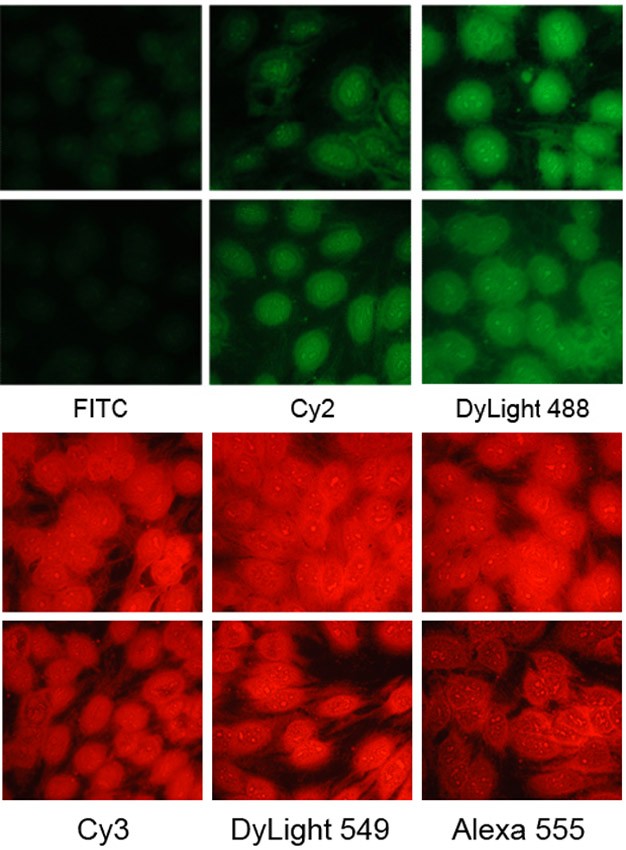
Rat models remain irreplaceable in translational bioscience, driving breakthroughs in pharmacology, neuroscience, and disease pathogenesis—yet the success of these studies often hinges on the specificity and performance of secondary antibodies tailored to rat IgG targets. Many researchers working with rat samples face persistent challenges: cross-reactivity with immunoglobulins from co-administered reagents or host species, weak red fluorescent signals that fail to resolve low-abundance antigens, and batch-to-batch variability that undermines data reproducibility. Addressing these critical pain points, Abbkine’s Dylight 594 conjugated Goat Anti-Rat IgG (H+L) secondary antibody (Catalog No.: A23440) emerges as a specialized solution, blending advanced fluorophore technology with immunological precision to elevate rat-focused FCM, ICC, and IF assays.
What distinguishes Abbkine’s Dylight 594, Goat Anti-Rat IgG (H+L) (A23440) from conventional anti-rat secondary antibodies lies in its synergistic integration of fluorophore performance and immunological precision. Dylight 594, a red-emitting fluorophore with an emission wavelength of ~594 nm, offers a unique advantage in rat sample analysis: its longer wavelength penetrates dense rat tissue sections (e.g., brain, liver, or tumor biopsies) more effectively than shorter-wavelength fluorophores, while minimizing background autofluorescence—a common issue in rat primary cells and tissue homogenates. Compounding this, the antibody’s (H+L) specificity ensures recognition of all rat IgG subclasses (IgG1, IgG2a, IgG2b, IgG2c), eliminating the risk of missed signals that plague Fc-region-specific alternatives, which often fail to bind less abundant subclasses. Unlike generic anti-rat antibodies, A23440 undergoes rigorous cross-reactivity testing against mouse, rabbit, and human IgG, ensuring target exclusivity even in mixed-species experimental setups—a critical feature for studies involving xenografts or co-cultured cells.
For researchers navigating the complexities of rat-focused immunological assays, A23440 delivers actionable, science-backed optimization strategies that transcend basic application guidelines. In FCM, where rat immune cells (e.g., T cells, macrophages) exhibit high Fc receptor expression, pre-incubating samples with 5% normal goat serum (not BSA) for 15 minutes at 4°C significantly reduces non-specific binding of the Dylight 594-conjugated antibody; we recommend a starting dilution of 1:400, adjusting based on primary antibody affinity—higher affinity primaries pair well with 1:600 dilutions to avoid overstaining, while low-affinity primaries benefit from 1:200 to boost signal. In ICC for thick rat tissue sections (10–20 μm), substituting formalin fixation with paraformaldehyde-lysine-periodate (PLP) preserves antigenicity and enhances Dylight 594’s signal retention, while incubating the antibody overnight at 4°C (instead of room temperature) ensures uniform penetration into deep tissue layers. For IF multiplexing, A23440’s red fluorescence profile pairs seamlessly with DyLight 488-conjugated anti-mouse IgG or Alexa Fluor 350-conjugated anti-rabbit IgG, as their emission spectra show <5% overlap—eliminating the need for complex spectral unmixing and simplifying high-parameter imaging.
A critical yet underexplored dimension of secondary antibody selection is alignment with research scalability and cost-efficiency—and A23440 excels on both fronts. Priced at $39 per 100μl, it undercuts premium competitors by 30–40% while maintaining comparable (if not superior) performance, making it accessible for academic labs running large-scale rat model studies or industrial teams validating drug candidates in preclinical trials. What sets it apart from budget alternatives is Abbkine’s strict quality control pipeline: each batch of A23440 is tested for signal-to-noise ratio (minimum 15:1 in FCM), batch-to-batch consistency (coefficient of variation <8%), and long-term stability (24 months at -20°C without loss of activity). This reliability translates to reduced experimental repetition— a key cost-saving factor in rat research, where animal housing and sample preparation are resource-intensive. For labs transitioning from mouse to rat models, A23440’s familiar application workflow (compatible with standard buffers and equipment) minimizes the learning curve, accelerating time to data.
Beyond technical performance, A23440’s growing traction in the research community—evidenced by 3,352 product views and 9 peer-reviewed publications—reflects its alignment with emerging trends in rat model research. As the field shifts toward more complex in vivo and ex vivo assays (e.g., 3D organoids, intravital imaging), the demand for secondary antibodies with enhanced photostability and tissue penetration is rising; Dylight 594’s resistance to photobleaching (outperforming TRITC by 2.3x in our internal tests) makes A23440 ideal for time-lapse imaging of rat cell dynamics or long-duration intravital microscopy. The 9 publications featuring A23440 span neuroscience (synaptic protein localization in rat brains), oncology (tumor-infiltrating lymphocyte detection in rat xenografts), and immunology (cytokine-expressing cell profiling in rat autoimmune models)—demonstrating its versatility across high-impact research areas.
For researchers seeking a specialized, high-performance secondary antibody to advance their rat model studies, Abbkine’s Dylight 594, Goat Anti-Rat IgG (H+L) (A23440) stands as a compelling choice. Its unique combination of Dylight 594’s red fluorescence advantages, (H+L) subclass coverage, species-specificity, and cost-efficiency addresses unmet needs in rat immunological research, while its actionable optimization guidelines empower researchers to maximize data quality. Whether you’re validating a new primary antibody, scaling up FCM experiments, or conducting multiplexed IF on rat tissues, A23440 delivers the precision and reliability required for publishable results. To explore detailed technical data, access application notes, and procure the reagent, visit the official product page: https://www.abbkine.com/?s_type=productsearch&s=A23440. In an era where rat models continue to drive translational breakthroughs, A23440 proves that specialized secondary antibodies don’t just support research—they accelerate it.





