




Abbkine’s Dylight 594 Goat Anti-Mouse IgG (A23410): A Pivotal Tool for Red Fluorescent-Based Biological Assays
Red fluorescent secondary antibodies have emerged as indispensable tools in advanced biological research, addressing critical limitations of shorter-wavelength fluorophores in applications ranging from deep-tissue imaging to multiplexed analysis. For studies targeting mouse IgG, researchers frequently grapple with challenges such as signal quenching in thick samples, cross-reactivity with non-target immunoglobulins, and inconsistent performance across experimental batches—issues that can compromise data integrity and delay research progress. Against this backdrop, Abbkine’s Dylight 594, Goat Anti-Mouse IgG (H+L) secondary antibody (Catalog No.: A23410) stands out as a meticulously engineered solution, designed to meet the rigorous demands of modern immunological research while delivering unparalleled reliability.
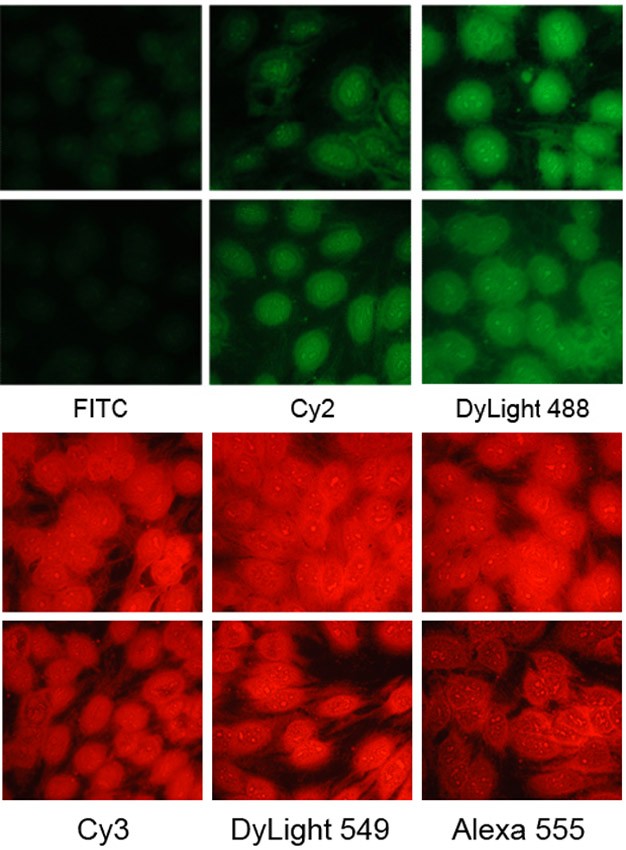
At the core of Abbkine’s Dylight 594, Goat Anti-Mouse IgG (H+L) secondary antibody (A23410) lies a synergistic combination of Dylight 594’s superior photophysical properties and tailored immunological specificity. Dylight 594, a red-emitting fluorophore, offers distinct advantages over shorter-wavelength alternatives: its longer emission wavelength (≈594 nm) minimizes background autofluorescence from biological samples, enhances tissue penetration for thick-section imaging, and enables seamless integration into multi-color assay panels alongside fluorophores like DyLight 488 or FITC. Complementing this fluorophore’s strengths is the antibody’s (H+L) specificity, which ensures binding to both heavy and light chains of mouse IgG—covering all IgG subclasses and eliminating the risk of missed signals that plague Fc-region-specific secondary antibodies. With over 12,990 product views and 20 peer-reviewed publications validating its performance, A23410 has established itself as a trusted reagent among immunologists, cell biologists, and translational researchers worldwide.
Industry trends in immunofluorescence (IF), immunocytochemistry (ICC), and flow cytometry (FCM) increasingly prioritize reagents that balance sensitivity, specificity, and compatibility with multiplexed workflows—and A23410 aligns seamlessly with these demands. Multiplexed imaging, a rapidly growing approach for studying complex biological systems, relies on secondary antibodies with distinct, non-overlapping emission spectra; Dylight 594’s red fluorescence profile makes A23410 an ideal choice for pairing with green or blue fluorophores, enabling simultaneous detection of multiple targets without signal crosstalk. Additionally, the rise of high-content screening (HCS) in drug discovery and basic research demands reagents with consistent batch-to-batch performance— a requirement Abbkine meets through rigorous quality control protocols for A23410, including testing for specificity, signal intensity, and stability.
Beyond its technical merits, Abbkine’s commitment to accessibility sets A23410 apart in a crowded market of secondary antibodies. Priced at $39 per 100μl, the reagent delivers high-performance results without the prohibitive cost of premium alternatives— a critical advantage for academic labs operating on tight budgets, as well as industrial research teams scaling up experiments. This affordability does not come at the expense of quality: A23410 undergoes stringent validation to ensure exclusive reactivity with mouse IgG, eliminating cross-reactivity with immunoglobulins from other species (e.g., rat, rabbit, human) that can confound results in mixed-sample experiments. For researchers seeking a balance of performance, cost-effectiveness, and reliability, A23410 fills a key gap in the secondary antibody landscape.
For researchers deploying A23410 in FCM, ICC, or IF assays, understanding its optimal use in context-specific workflows unlocks maximum value. In FCM applications, the antibody’s bright red fluorescence enhances detection of low-abundance mouse IgG targets, even in heterogeneous cell populations; titrating A23410 at a 1:300–1:600 dilution (depending on primary antibody concentration) helps strike the right balance between signal strength and background noise. In ICC for thick tissue sections or 3D cell cultures, Dylight 594’s deep tissue penetration ensures uniform staining across samples, while minimal autofluorescence preserves signal-to-noise ratios. For IF experiments, pairing A23410 with a DAPI counterstain (for nuclear labeling) creates clear, publication-ready images, leveraging the fluorophore’s photostability to withstand extended imaging sessions without signal degradation.
The growing body of research leveraging A23410—evidenced by 20 peer-reviewed publications and over 12,900 product views—speaks to its reliability and relevance in contemporary bioscience. As the demand for precise, multiplexed, and cost-effective immunological tools continues to rise, Abbkine’s Dylight 594, Goat Anti-Mouse IgG (H+L) secondary antibody (A23410) positions itself as a cornerstone reagent for studies involving mouse IgG targets. Whether advancing basic research on protein localization, investigating cellular signaling pathways, or supporting drug discovery efforts, A23410 delivers the specificity, sensitivity, and consistency that researchers need to generate robust, reproducible data. To explore detailed specifications, access technical resources, and procure the reagent, visit the official product page: https://www.abbkine.com/?s_type=productsearch&s=A23410. In an era where research efficiency and data quality are paramount, A23410 proves that high-performance secondary antibodies don’t have to come with a premium price tag.





