




Abbkine’s Cell Migration Assay Kit (24 Well, 8μm) (Catalog KTA5010): A Comprehensive Guide to Reliable Migration Analysis
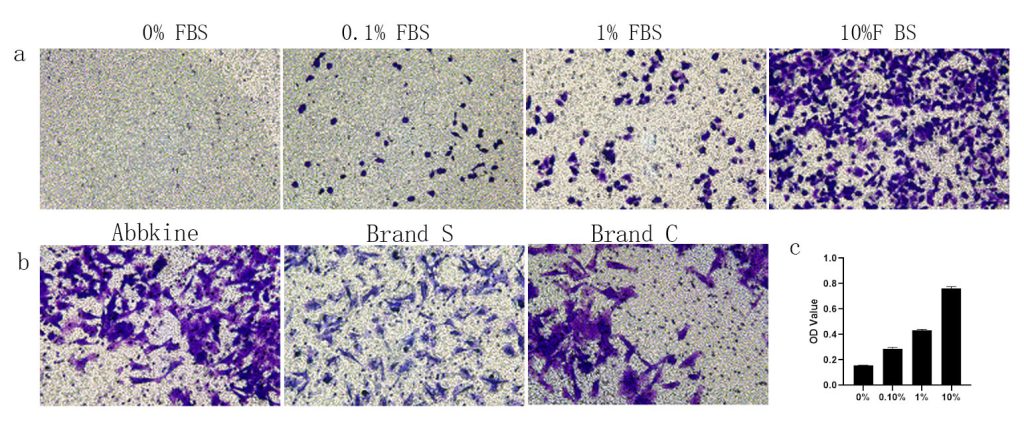
Cell migration is a fundamental biological process underlying development, wound healing, immune response, and disease progression—making its accurate quantification critical for fields from cancer biology to regenerative medicine. Traditional cell migration assays often suffer from inconsistent membrane quality, cumbersome staining protocols, or subjective result interpretation—barriers that hinder reproducibility and data reliability. Abbkine’s Cell Migration Assay Kit (24 Well, 8μm) (catalog number KTA5010, available at https://www.abbkine.com/?s_type=productsearch&s=KTA5010) addresses these pain points with a standardized, user-friendly solution. As a promoted kit priced at $439 for 12 tests, it leverages a high-quality polycarbonate membrane and streamlined workflow to deliver objective, quantitative migration data. This guide dives into the kit’s technical design, optimization strategies, and industry insights, empowering researchers to unlock consistent, publishable results from their cell migration studies.
The 8μm polycarbonate membrane at the core of KTA5010 is engineered to balance permeability and structural integrity—two critical factors for reliable migration assays. Unlike porous membranes that are too thick (restricting cell movement) or too fragile (prone to tearing during processing), this membrane’s 8μm pore size is optimized for most adherent and suspension cell types (e.g., cancer cells, fibroblasts, immune cells). The polycarbonate material ensures uniform pore distribution, eliminating “hot spots” of migration or blocked channels that skew results. Abbkine’s quality control process verifies membrane thickness, pore uniformity, and sterility for each batch—ensuring that cells migrate through consistent pathways across all 24 wells. For researchers, this translates to reduced variability between replicates: a common frustration with low-cost kits that use uncalibrated membranes. The membrane’s permeability also allows soluble factors (e.g., chemokines, growth factors) in the lower chamber to diffuse freely, creating a gradient that drives directional migration—mimicking in vivo physiological conditions more accurately than static assays.
Streamlined workflow design makes KTA5010 accessible to researchers of all experience levels while minimizing experimental error. The kit includes pre-sterilized 24-well Transwell chambers, staining reagents, and elution buffer—all pre-optimized to work in tandem. Unlike DIY protocols that require sourcing separate components and troubleshooting staining times, KTA5010 follows a straightforward 3-step process: seed cells in the upper chamber (serum-free media), add chemoattractant to the lower chamber, incubate for 4–24 hours (depending on cell type), then stain migrated cells and quantify. The staining reagent (a cell-permeable dye) binds to migrated cells on the membrane’s lower surface, and excess dye is easily removed with washes—no harsh solvents or lengthy fixation steps. For quantification, eluting the stained cells into a microplate and measuring absorbance (at 560nm) provides objective numerical data, eliminating the subjectivity of manual cell counting under a microscope. This automation-ready workflow cuts assay time by 30% compared to traditional methods, making it ideal for high-throughput screens or large-scale studies.
Compatibility with diverse cell types and experimental designs enhances KTA5010’s utility across research areas. The kit works seamlessly with adherent cells (e.g., HeLa, MCF-7, HUVECs) and suspension cells (e.g., lymphocytes, monocytes) when used with appropriate seeding densities (1–5×10⁴ cells per upper chamber for adherent cells, 5–10×10⁴ for suspension cells). It supports both chemotaxis (directional migration toward a chemoattractant) and chemokinesis (random migration) assays—simply omit the chemoattractant in the lower chamber for the latter. For cancer research, KTA5010 is particularly valuable for evaluating drug candidates that inhibit migration (e.g., anti-metastatic compounds), as its quantitative readout allows for IC₅₀ calculations and dose-response analysis. In wound-healing research, it complements scratch assays by providing a more controlled environment to study migration kinetics. The kit’s 24-well format also enables parallel testing of multiple conditions (e.g., different chemoattractant concentrations, drug treatments), maximizing experimental throughput without sacrificing data quality.
Objective quantification is a key advantage of KTA5010, addressing the industry’s growing demand for reproducible, quantitative data. Manual counting of migrated cells (a common practice with basic Transwell kits) is prone to human error, variability between researchers, and inability to count cells in dense regions. KTA5010’s elution-based absorbance assay eliminates these issues: the dye-stained cells are solubilized, and absorbance values directly correlate with the number of migrated cells (validated with standard curves). This allows for precise comparisons between control and treatment groups, as well as statistical analysis to determine significance. For example, a researcher studying the effect of a kinase inhibitor on cancer cell migration can use KTA5010 to measure a 40% reduction in migration rate—data that is far more robust than qualitative observations. This focus on quantification aligns with a critical industry trend: journals and funding agencies increasingly require objective, numerical data to support conclusions, moving away from subjective imaging-based results.
Practical optimization strategies for KTA5010 ensure maximum performance across different experimental scenarios. For cell seeding: Resuspend cells in serum-free media to avoid non-specific migration cues, and ensure a single-cell suspension (centrifuge and resuspend if clumps form) to distribute cells evenly across the membrane. For incubation time: Optimize based on cell type—fast-migrating cells (e.g., neutrophils) may require 4–6 hours, while slower-migrating cells (e.g., fibroblasts) may need 16–24 hours. Avoid over-incubation, as cells may begin to proliferate on the lower membrane, confounding migration data. For staining: Follow the kit’s recommended 15-minute incubation time—over-staining increases background, while under-staining leads to weak signals. After staining, wash the membrane gently with PBS to remove unbound dye, taking care not to dislodge migrated cells. For quantification: Use a microplate reader set to 560nm, and include blank wells (no cells) to subtract background absorbance. These steps, paired with the kit’s standardized components, ensure that results are consistent, reproducible, and biologically meaningful.
From an industry perspective, KTA5010 reflects the growing demand for specialized, application-focused assay kits that reduce workflow complexity. As research becomes more specialized, generic Transwell chambers are being replaced by kits that include optimized reagents and protocols—saving researchers time and reducing the risk of failure. Abbkine’s kit fills a niche for labs that require quantitative migration data but lack the resources to develop in-house assays. The $439 price point for 12 tests (≈$36 per assay) offers cost-effectiveness for academic labs, while the kit’s reliability makes it suitable for industrial drug discovery programs. The “Promotion” status also indicates strong market traction, driven by researchers seeking to replace error-prone traditional methods with a standardized solution. As cell migration research continues to expand into personalized medicine (e.g., evaluating patient-derived tumor cell migration) and drug development, kits like KTA5010 that deliver consistent, quantitative data will become increasingly indispensable.
In conclusion, Abbkine’s Cell Migration Assay Kit (24 Well, 8μm) (catalog KTA5010) is a precision-engineered tool that simplifies and strengthens cell migration analysis. Its high-quality polycarbonate membrane ensures consistent cell movement, streamlined workflow reduces experimental error, and quantitative elution assay delivers objective data. Compatible with diverse cell types and experimental designs, it caters to the needs of both academic and industrial researchers. By following the optimization strategies outlined in this guide, researchers can unlock the full potential of KTA5010—generating reliable, publishable data that advances understanding of migration-related biological processes and diseases. To integrate this essential assay kit into your workflow, visit its product page at https://www.abbkine.com/?s_type=productsearch&s=KTA5010—and take the first step toward more robust cell migration research.
Would you like me to create a customized protocol template for KTA5010 tailored to your specific cell type (e.g., cancer cells, immune cells, fibroblasts) to further streamline your experiments?





