




ABBkine KTA2010: The Game-Changing One-Step TUNEL Apoptosis Assay Kit (Green Fluorescence) for Research Excellence
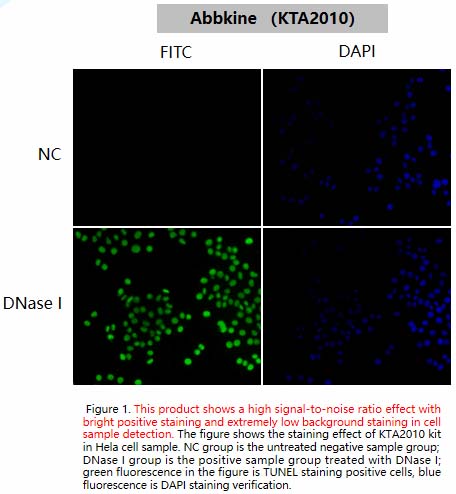
In the fast-paced world of life sciences research, having reliable tools that deliver accurate results while saving time is non-negotiable. When it comes to detecting DNA fragmentation—a key hallmark of apoptosis—researchers often grapple with cumbersome protocols and inconsistent outcomes. Enter the One-step TUNEL Apoptosis Assay Kit (Green Fluorescence) from ABBkine, bearing the product code KTA2010. This kit isn’t just another addition to the lab shelf; it’s a solution that’s reshaping how apoptosis studies are conducted, and if you haven’t checked it out yet, you’re missing out on a game-changer. You can find all the details on the official product page here: https://www.abbkine.com/?s_type=productsearch&s=KTA2010.
First off, let’s talk about what makes this kit stand out from the crowd. Apoptosis research hinges on the ability to detect DNA breaks with precision, and the TUNEL (Terminal Deoxynucleotidyl Transferase dUTP Nick End Labeling) assay is the gold standard for this purpose. But traditional TUNEL kits often require multiple steps, lengthy incubations, and careful handling to avoid nonspecific staining—frustrations that slow down experiments and introduce room for error. ABBkine’s KTA2010 changes the game with its one-step design. That’s right, no more juggling multiple reagents or waiting around for hours on end. The kit streamlines the entire process, allowing researchers to go from sample preparation to fluorescence detection in a fraction of the time, without compromising on sensitivity.
What’s truly impressive about the KTA2010 is its versatility. Whether you’re working with cultured cells, tissue sections, or even fixed samples, this kit delivers consistent, reliable results. The green fluorescence signal is bright and distinct, making it easy to visualize under a fluorescence microscope or quantify using flow cytometry. Unlike some kits on the market that suffer from high background noise, ABBkine has optimized the reagent formulation to minimize nonspecific binding, ensuring that every fluorescent signal you detect is a true indicator of apoptotic cells. This level of specificity is a game-changer for researchers who need to trust their data—after all, bad data leads to wasted time, resources, and missed breakthroughs.
Let’s dive into the technical stuff, but keep it real—no jargon overload here. The kit leverages terminal deoxynucleotidyl transferase (TdT) to catalyze the incorporation of fluorescein-labeled dUTP into the 3’-OH ends of fragmented DNA. The one-step protocol combines all necessary reagents into a single mix, eliminating the need for sequential additions and reducing the risk of contamination. Each kit comes with 20 tests, priced at $159—a cost-effective option for labs of all sizes, from academic research teams to biotech startups. Think about it: for less than $8 per test, you get a high-performance assay that cuts down on experimental time and delivers reproducible results. That’s a bang for your buck that’s hard to beat in the current research landscape, where budget constraints often force labs to choose between quality and affordability.
Industry-wise, the demand for user-friendly, high-sensitivity apoptosis assay kits is on the rise. As research into diseases like cancer, neurodegenerative disorders, and autoimmune conditions deepens, understanding the role of apoptosis in pathogenesis has become more critical than ever. Researchers need tools that can keep up with the pace of discovery, and ABBkine’s KTA2010 is perfectly positioned to meet that need. Its one-step format not only saves time but also reduces the learning curve, making it accessible to graduate students and seasoned researchers alike. Plus, the green fluorescence is compatible with common imaging systems and can be combined with other fluorescent probes for multiplexing—opening up new possibilities for comprehensive cell death analysis.
Another thing to love about ABBkine as a brand is its commitment to quality. The KTA2010 is manufactured under strict quality control standards, ensuring batch-to-batch consistency. This is crucial in research, where even small variations in reagent performance can skew results and derail projects. Users have reported that the kit delivers consistent outcomes across multiple experiments, giving them the confidence to publish their findings without second-guessing their data. And let’s not forget the technical support—ABBkine’s team of experts is on hand to assist with any questions or troubleshooting, a huge plus for labs that need reliable backup when experiments don’t go as planned.
In a market saturated with apoptosis assay kits, the ABBkine KTA2010 stands out for its simplicity, sensitivity, and value. It’s not just a tool; it’s a partner in research, helping scientists overcome common pain points and accelerate their work. Whether you’re studying the effects of a new drug on cancer cell apoptosis, investigating neuronal death in Alzheimer’s disease, or exploring apoptosis in developmental biology, this kit has you covered. The green fluorescence signal is sharp and easy to quantify, making it ideal for both qualitative and quantitative analysis. And with the convenience of the one-step protocol, you can spend less time on assay setup and more time on what really matters—analyzing your results and making groundbreaking discoveries.
If you’re still using a traditional TUNEL kit that’s slowing you down or giving you inconsistent results, it’s time to make the switch. The ABBkine KTA2010 One-step TUNEL Apoptosis Assay Kit (Green Fluorescence) is a game-changer that delivers on its promises: simplicity, sensitivity, and reliability. At $159 for 20 tests, it’s an investment that pays off in saved time, improved data quality, and peace of mind. Head over to the product page now to learn more and place your order—your next breakthrough could be just one assay away. Trust me, once you try this kit, you’ll wonder how you ever worked without it.





