




Abbkine Actin Polyclonal Antibody (ABP0056): A Universal Gold-Standard Tool for Actin Detection Across Biological Research
Actin is one of the most evolutionarily conserved and ubiquitously expressed cytoskeletal proteins in eukaryotic cells, serving as a foundational structural component for cell shape maintenance, motility, intracellular transport, and cytokinesis—while also acting as the undisputed gold-standard loading control for nearly all molecular biology immunoassays. The reliability of Actin detection is non-negotiable for both functional cytoskeletal research and quantitative experimental normalization, yet many commercial Actin antibodies suffer from critical limitations: narrow species reactivity, cross-reactivity with other cytoskeletal proteins, poor performance across diverse assay formats, or weak signal for endogenous Actin. The Abbkine Actin Polyclonal Antibody (Cat. No. ABP0056) (product link: https://www.abbkine.com/product/actin-polyclonal-antibody-abp0056/) resolves these industry pain points, engineered as a robust, versatile, and high-performance reagent raised against the C-terminal region of human Actin. This affinity-purified rabbit polyclonal antibody delivers exceptional specificity for endogenous Actin, broad cross-species reactivity, and validated performance across Western Blot (WB), Immunohistochemistry (IHC), Immunofluorescence (IF), and ELISA—establishing a new benchmark for Actin detection tools in basic and translational life science research.
Targeted immunogen design forms the molecular foundation of the Abbkine ABP0056 Actin Polyclonal Antibody’s uncompromising specificity for endogenous Actin isoforms. Unlike many commercial Actin antibodies that target highly variable N-terminal domains or conserved motifs shared with other structural proteins (e.g., tubulin, vimentin), this antibody is generated using a synthetic peptide derived from the C-terminal region of human Actin (amino acid range 300-380)—a sequence that is highly conserved across the major cytoplasmic Actin isoforms (beta-actin and gamma-actin) and exhibits minimal homology with non-Actin cytoskeletal proteins. The antibody is further refined via affinity-chromatography using the epitope-specific immunogen, a rigorous purification process that depletes non-specific immunoglobulins from rabbit antiserum and enriches for high-affinity Actin-binding antibodies. This dual optimization ensures the ABP0056 antibody exclusively detects endogenous Actin at its expected molecular weight of 45kD, with no observable off-target bands or background signal in complex cell lysates or tissue sections—an essential feature for both functional Actin research and its use as a loading control, where non-specific signal would irreparably skew experimental data and quantification.
Broad cross-species reactivity is a defining strength of the Abbkine ABP0056 Actin Polyclonal Antibody, addressing a critical need in interdisciplinary research that utilizes multiple eukaryotic model systems. Validated for robust reactivity with human, mouse, rat, and fish Actin, this single antibody eliminates the need for researchers to source, validate, and store separate species-specific Actin reagents—a time-consuming and costly process that plagues studies spanning developmental biology, comparative physiology, aquatic biology, and translational medicine. For example, developmental biologists investigating cytoskeletal dynamics in zebrafish (a key fish model for embryonic development) can use the ABP0056 antibody to directly validate their findings in mouse and human cell lines, while aquatic biologists studying environmental stress-induced cytoskeletal changes in fish can compare data with mammalian models without assay re-optimization. This cross-species consistency also ensures reliable normalization as a loading control across different species samples, a common practice in translational research that links model organism discoveries to human biological processes. The conservation of the C-terminal immunogen sequence across these diverse species is the basis for this broad reactivity, making the ABP0056 antibody a truly universal tool for Actin detection.
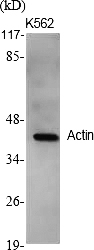
Multi-assay validated performance elevates the Abbkine ABP0056 Actin Polyclonal Antibody far above single-application commercial reagents, aligning perfectly with the modern research lab’s demand for versatile, cost-effective, and high-throughput tools. The antibody is fully validated for use in four core molecular biology immunoassays—WB, IHC, IF, and ELISA—with clear, researcher-friendly suggested starting dilutions tailored to each format: 1:500–1:2000 for WB, 1:100–1:300 for IHC, 1:50–200 for IF, and an ultra-high 1:10000 for quantitative ELISA. Real-world experimental data confirms its exceptional performance in WB, where it produces a sharp, single 45kD band at a 1:2000 dilution across a diverse range of cell lines (HeLa, K562, MCF-7, 3T3) and mouse tissue lysates (lung, brain, spleen, kidney, heart, liver)—a level of sensitivity that minimizes antibody usage and maximizes experimental throughput. For IHC and IF, the antibody delivers crisp, cytoplasmic-specific staining in formalin-fixed paraffin-embedded (FFPE) tissues and cultured cells, with no diffuse background signal that would obscure subcellular Actin localization analysis. Its compatibility with ELISA further extends its utility to quantitative Actin expression detection, making the ABP0056 antibody a single reagent that supports both qualitative (localization) and quantitative (expression level) Actin research—a rare and valuable combination in the commercial Actin antibody market.
Optimized formulation and robust storage stability ensure the Abbkine ABP0056 Actin Polyclonal Antibody maintains peak performance over its shelf life, a critical consideration for ensuring experimental reproducibility and reducing reagent waste in all research settings. The antibody is supplied as a ready-to-use liquid solution at a concentration of 1 mg/ml, formulated in a gold-standard buffer of PBS containing 50% glycerol, 0.5% BSA, and 0.02% sodium azide. The 50% glycerol prevents ice crystal formation during freezing, eliminating antibody denaturation from repeated freeze-thaw cycles—a common cause of reduced binding affinity in lesser formulations—while BSA acts as a protein stabilizer to preserve the antibody’s tertiary structure and epitope-binding capacity. The antibody is stable for one year at -20°C from the date of shipment, with simple, actionable handling guidelines to maximize recovery: centrifuge the vial after thawing before opening to collect antibody adhered to the vial wall, and aliquot the antibody into small volumes to avoid repeated freezing and thawing. Unlike lyophilized antibodies that require reconstitution (a step that introduces experimental variability), the liquid formulation of the ABP0056 antibody allows for immediate use upon thawing, reducing assay setup time and ensuring consistent antibody concentration across all experiments.
The Abbkine ABP0056 Actin Polyclonal Antibody addresses a universal industry demand for a reliable, all-in-one Actin detection tool, filling a significant gap in the market where commercial reagents often force researchers to compromise on specificity, species reactivity, or multi-assay performance. Actin’s role as the gold-standard loading control stems from its ubiquitous expression and consistent protein levels across most cell types and experimental conditions, yet this utility is severely limited if an Actin antibody produces non-specific bands, fails in key assays, or is restricted to a single species. Many low-cost Actin antibodies on the market suffer from cross-reactivity with tubulin or other cytoskeletal proteins, while high-end reagents often offer only single-assay validation or narrow species reactivity. The ABP0056 antibody strikes an unbeatable balance of performance and cost-effectiveness: priced at $229 for 100μl (1 mg/ml), its high suggested dilutions (e.g., 1:2000 for WB, 1:10000 for ELISA) mean a single vial can support hundreds of assays—far exceeding the cost-performance ratio of competing reagents. This affordability, combined with its exceptional performance, makes the ABP0056 antibody an ideal choice for both small academic labs with limited budgets and large research institutions or biotech companies with high-throughput experimental needs.
Beyond its utility as a loading control, the Abbkine ABP0056 Actin Polyclonal Antibody is a powerful tool for functional Actin research, a rapidly evolving field with critical implications for understanding disease pathogenesis. Dysregulation of Actin cytoskeletal dynamics is linked to a wide range of human diseases, including cancer cell invasion and metastasis, neurodegenerative disorders (e.g., Alzheimer’s disease), cardiovascular disease, and congenital myopathies. The antibody’s high specificity for endogenous Actin and robust performance in IF and IHC make it an ideal reagent for investigating Actin’s subcellular localization and dynamic rearrangements in healthy and diseased cells—for example, tracking Actin stress fiber formation in cancer cells during epithelial-to-mesenchymal transition (EMT) or measuring Actin cytoskeletal disruption in neuronal cells in neurodegenerative disease models. Its compatibility with ELISA also enables quantitative measurement of Actin expression levels in biological fluids or cell lysates, supporting translational research into Actin as a potential disease biomarker or therapeutic target. In this way, the ABP0056 antibody bridges basic cytoskeletal biology and translational disease research, empowering researchers to uncover new insights into the role of Actin in health and disease.
In conclusion, the Abbkine Actin Polyclonal Antibody (Cat. No. ABP0056) (product link: https://www.abbkine.com/product/actin-polyclonal-antibody-abp0056/) stands as the gold-standard research tool for Actin detection, combining targeted immunogen design, exceptional specificity for endogenous Actin, broad cross-species reactivity (human, mouse, rat, fish), and validated multi-assay performance (WB, IHC, IF, ELISA). Its optimized liquid formulation, robust storage stability, and outstanding cost-performance ratio address the core needs of life science researchers across all disciplines, eliminating the compromises associated with lesser commercial Actin antibodies. Whether used as a reliable loading control for quantitative immunoassays or as a powerful reagent for investigating the functional role of Actin in cytoskeletal dynamics and disease pathogenesis, the ABP0056 antibody delivers consistent, reproducible, and publication-quality results across diverse experimental systems and model organisms. As a universal and indispensable tool for Actin detection, it solidifies its place in every molecular biology lab, empowering researchers to advance basic biological understanding and drive translational research discoveries.





